
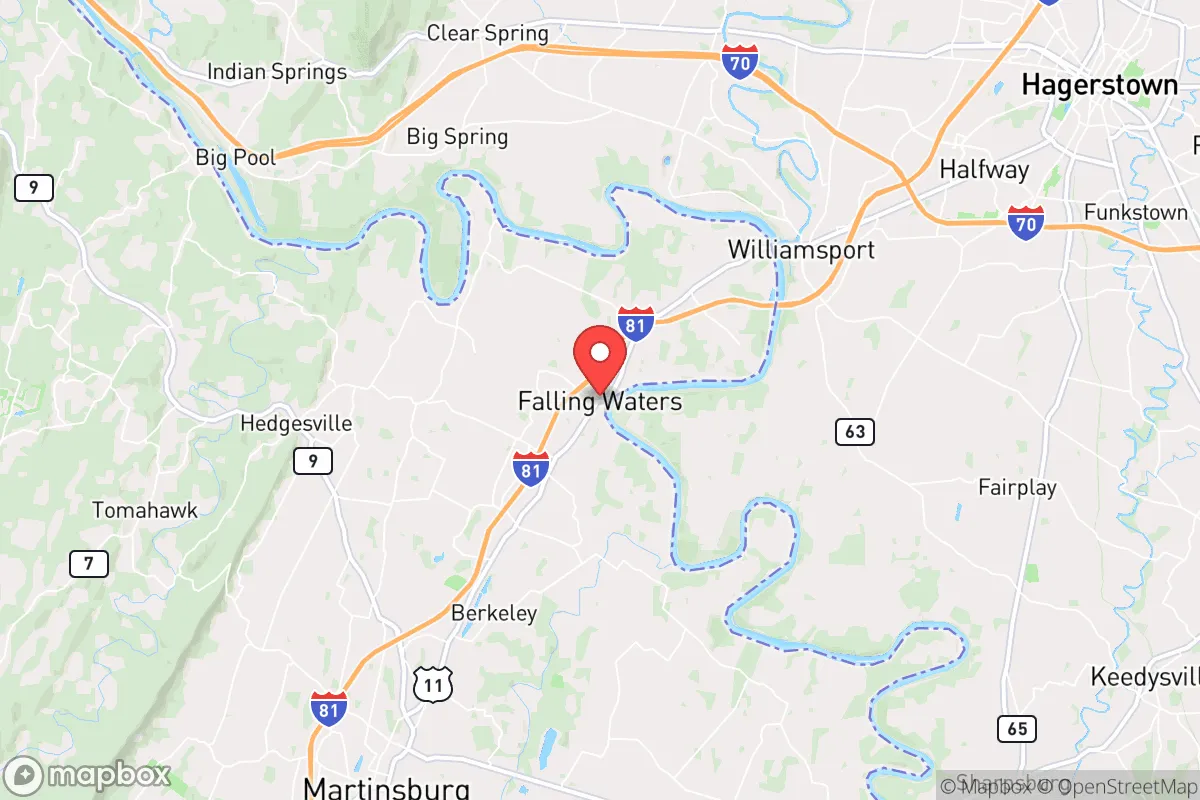
Political ClimatePolitical Climate in Falling Waters, WV
District shown is the primary district for this city’s centroid. Cities may span multiple districts.
Local Political AnalysisPolitical Analysis of Falling Waters, WV
Falling Waters, West Virginia, is about as reliably conservative as it gets, with a Cook PVI of R+20 that puts it deep in the red column. This isn’t a purple area that flips back and forth—it’s a place where Republican candidates routinely win by double digits, and the local culture reflects that. The political trajectory here has been steady for decades, though there’s a growing unease among long-time residents about outside influences creeping in from the D.C. suburbs and the Eastern Panhandle’s rapid growth. People here value their independence and don’t take kindly to government overreach, whether it’s from Charleston or Washington.
How it compares
Drive 15 minutes south to Martinsburg, and you’ll notice a slightly more mixed political vibe—Berkeley County has been trending purple in recent years, with some precincts in the city itself leaning blue. Head east across the Potomac into Maryland, and places like Hagerstown or Frederick are a whole different world, with progressive policies on taxes, zoning, and public health mandates that would never fly in Falling Waters. Even nearby Shepherdstown, just 20 minutes away, is a liberal college town that feels like another planet. Falling Waters, by contrast, remains a stronghold where Second Amendment rights are non-negotiable, property taxes are low, and the idea of a mask mandate or vaccine passport would be met with serious pushback. The contrast is stark, and it’s one reason why folks here are wary of any regional planning that tries to homogenize local laws.
What this means for residents
For the people who live here, the conservative lean means a lighter touch from government in daily life. There’s no city income tax, zoning is minimal, and you’re generally left alone to run your property and raise your family as you see fit. That’s a big draw for families and retirees moving from more regulated states like Maryland or Virginia. But there’s a real concern that as development accelerates—new subdivisions, data centers, and commuter traffic—the political character could shift. Some worry that newcomers from blue states will bring their voting habits with them, slowly eroding the local culture. So far, that hasn’t happened in Falling Waters itself, but it’s something to watch. The school board and county commission races are where you see the tension play out, with debates over curriculum transparency and land-use rules getting heated.
One cultural distinction that stands out is the area’s strong sense of self-reliance. You won’t find a lot of HOA-style restrictions or busybody ordinances here. People take care of their own property and expect the same from their neighbors. The local gun culture is matter-of-fact, not performative—most households have firearms for hunting and protection, and there’s no appetite for red flag laws or waiting periods. If you’re looking for a place where the government stays out of your business and the political climate matches that philosophy, Falling Waters is still that kind of town. But keep an eye on the growth—if the balance tips too far toward the D.C. exurbs, the character could change faster than anyone expects.

State Political ClimatePolitical Climate in West Virginia
State Political AnalysisPolitical Environment in the State
West Virginia has long been one of the most reliably Republican states in the nation, but that wasn’t always the case. As recently as 2000, the Mountain State was a battleground, voting for George W. Bush by just 6 points. Today, it’s a deep red stronghold: Donald Trump won it by 39 points in 2020 and by a similar margin in 2024. The shift is driven by a wholesale realignment of the white working class, particularly in the southern coalfields and rural counties, away from the Democratic Party and toward the GOP. The state’s two U.S. Senators, Joe Manchin (now an independent) and Shelley Moore Capito, reflect the old and new guard, but the legislature is overwhelmingly Republican, holding supermajorities in both chambers. For a conservative looking to relocate, West Virginia offers one of the most politically aligned environments in the country, but the picture is more nuanced than the raw numbers suggest.
Urban vs. rural divide
The political map of West Virginia is stark. The only reliably blue counties are the state’s small urban islands: Kanawha County (Charleston), Monongalia County (Morgantown), and Raleigh County (Beckley) occasionally lean blue in local races, but even these have shifted right. Charleston, the state capital, is a Democratic holdout due to unionized government workers and a small professional class, but it’s surrounded by deep-red suburbs like South Charleston and St. Albans. Morgantown, home to West Virginia University, is the most liberal pocket in the state, with a younger, college-educated population that votes reliably Democratic in presidential years. But drive 20 minutes in any direction—into Preston County or Marion County—and you’re back in Trump country. The rural-urban divide is extreme: in 2020, Trump won McDowell County (southern coalfields) by 72 points, while Biden won Morgantown’s precincts by 30. The state’s few growing suburbs, like Teays Valley (Putnam County) and Martinsburg (Berkeley County), are solidly Republican and growing fast, driven by in-migration from the D.C. metro area. These exurban areas are where the state’s political future is being shaped—more conservative, more family-oriented, and less tied to the old coal economy.
Policy environment
West Virginia’s policy environment is aggressively conservative, with a few notable exceptions. The state has no personal income tax on Social Security benefits, and the corporate net income tax was cut from 6.5% to 6% in 2023, with a phase-down to 4% by 2028. The sales tax is 6%, but groceries and prescription drugs are exempt. Property taxes are among the lowest in the nation, capped by the state constitution at 1.5% of assessed value. On education, the state passed a robust school choice law in 2021—the West Virginia Hope Scholarship—which provides up to $4,800 per student for private school tuition, homeschooling, or tutoring. This is a major draw for conservative parents. Healthcare is a mixed bag: the state expanded Medicaid under the Affordable Care Act in 2014, a decision that remains controversial among conservatives, but there’s no state-run insurance exchange, and the legislature has repeatedly blocked efforts to create one. Election laws are solid: voter ID is required, early voting is limited to 10 days, and absentee voting requires an excuse. The state also passed a constitutional amendment in 2018 explicitly stating that nothing in the state constitution creates a right to abortion, effectively preempting any future court challenges. For a conservative, the policy environment is largely welcoming, though the Medicaid expansion and a relatively high cigarette tax ($1.20 per pack) are lingering sore points.
Trajectory & freedom
West Virginia is becoming more free in several key areas, but the trajectory is uneven. On gun rights, the state is a national leader: in 2023, it passed constitutional carry (permitless carry for adults 21 and older), and there are no state-level magazine capacity limits or assault weapon bans. The state also has a strong Stand Your Ground law. On parental rights, the legislature passed the Parental Bill of Rights in 2021, requiring schools to notify parents of any changes to a child’s health or well-being, including gender identity issues. This was followed in 2023 by the Save Women’s Sports Act, banning biological males from competing in female sports. On medical autonomy, the state has a broad Right to Try law for terminally ill patients and allows the use of medical cannabis (though the program is slow to implement). However, property rights remain a concern: the state’s eminent domain laws are still tilted toward energy companies, particularly for pipeline projects, which has sparked grassroots resistance. Taxation is trending in the right direction: the personal income tax was cut from 6.5% to 5.12% in 2023, with a goal of elimination by 2030. The biggest freedom concern is the state’s opioid litigation—West Virginia has sued dozens of pharmaceutical companies, and the resulting settlements have created a massive government fund that critics worry will be used to expand state power rather than reduce addiction. Overall, the state is moving in a libertarian-leaning conservative direction, but the legacy of big-government coal subsidies and ongoing litigation creates friction.
Civil unrest & political movements
West Virginia has a long history of labor unrest, but modern political movements are more focused on cultural and constitutional issues. The 2018 teacher strike shut down schools across the state for nine days, demanding higher pay and better benefits—a rare moment of cross-party unity that ultimately succeeded. More recently, the 2021 Hope Scholarship debate sparked intense protests from teachers’ unions, but the law passed anyway. On the right, the West Virginia Citizens Defense League is a powerful grassroots force, organizing against any gun control proposals. The state has seen a surge in Second Amendment sanctuary resolutions, with over 40 counties passing them. Immigration politics are muted—the state has one of the smallest foreign-born populations in the country (about 1.5%)—but there is strong support for border security, and the legislature passed a resolution in 2023 calling on Congress to impeach Homeland Security Secretary Alejandro Mayorkas. Election integrity is a live issue: the state’s Voter ID law was strengthened in 2021, and there are ongoing calls to ban ballot drop boxes entirely. The most visible flashpoint for a new resident would be the opioid epidemic—the state has the highest overdose death rate in the nation, and you’ll see it in every town. This has fueled a growing harm reduction movement, but also a strong law-and-order backlash. There’s no serious secession talk, but there is a persistent undercurrent of frustration with federal overreach, particularly on environmental regulations affecting the coal industry.
Projection
Over the next 5-10 years, West Virginia will likely become even more conservative, but with a different flavor. The old coal-based Democratic machine is dead; the future is a mix of exurban refugees from the Northeast and D.C. area, plus younger families drawn by low cost of living and conservative policies. The Eastern Panhandle (Berkeley, Jefferson, Morgan counties) is the fastest-growing region, and it’s pulling the state’s politics toward a more suburban, culture-war-focused conservatism—think school choice, parental rights, and low taxes. The southern coalfields will continue to shrink and age, but their Republican loyalty will remain rock-solid. The biggest wildcard is in-migration from blue states: if the trend accelerates, West Virginia could see a modest liberalization in Morgantown and Charleston, but the state’s political structure is so deeply red that even a 10% influx of progressive-leaning newcomers would only shift the margin from +39 to +30. The state’s income tax phase-out is likely to be completed by 2030, making it even more attractive to conservatives fleeing high-tax states. The biggest risk is the opioid crisis—if it worsens, it could drive up social services costs and create pressure for tax increases, which would undermine the state’s competitive advantage. For now, the trajectory is clear: West Virginia is doubling down on conservative governance, and it’s working.
For a conservative moving to West Virginia, the bottom line is this: you’ll find a state that shares your values on guns, education, taxes, and family, and you’ll pay far less to live here than almost anywhere else in the country. The downsides are real—the drug crisis, limited job diversity, and a healthcare system that’s still catching up—but the political climate is as aligned with your worldview as any state in the union. If you’re looking for a place where your vote counts, your rights are respected, and your kids can attend a school that reflects your values, West Virginia is a strong contender. Just be prepared for the winters and the fact that you’ll have to drive an hour for a Trader Joe’s.
* Values derived from national, state, county, city and local statistics and may differ in a specific area. Last updated: 2026-04-23T05:59:21.000Z
Narrative content on this page is AI-generated and may contain mistakes. Verify any details that matter before acting on them.
ReloMaps may earn a commission from affiliate links at no extra cost to you.

