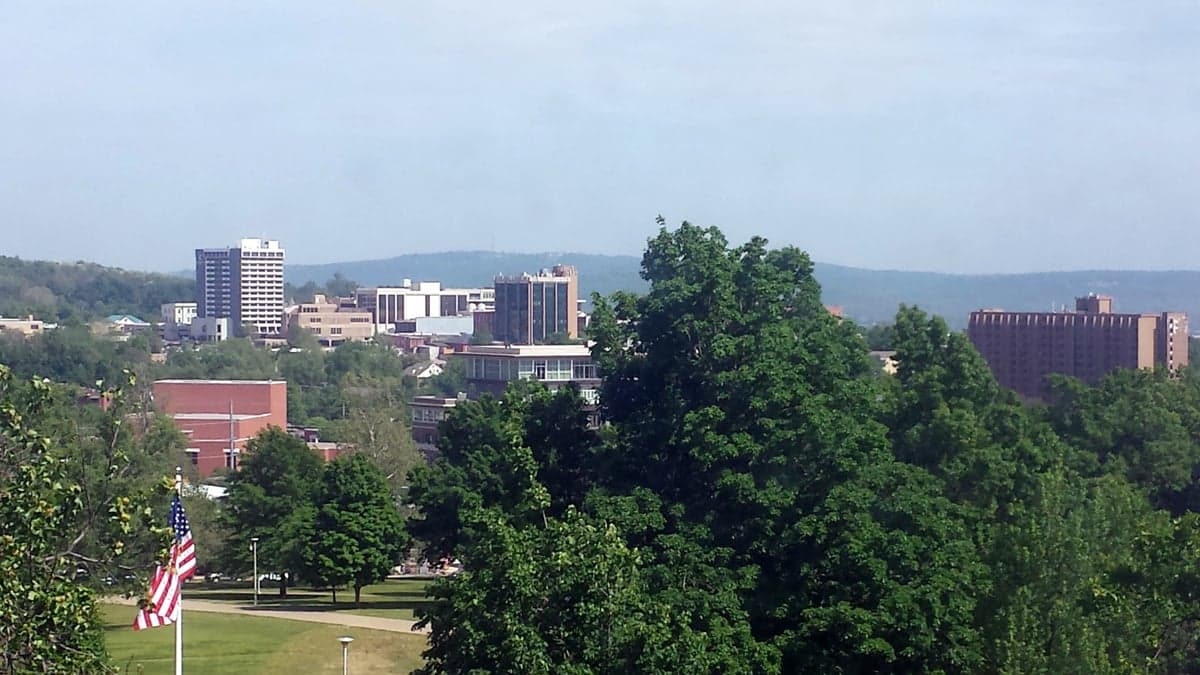
Photo: Wikipedia
Personal Sovereignty in Fayetteville, AR
Viable for self-reliance. Generally workable, though some barriers may limit total independence.
What does Personal Sovereignty tell us?
Personal Sovereignty measures your capacity for self-reliance and independence with minimal government friction. Higher scores mean fewer barriers between you and the way you want to live... but it assumes you have the space you need and good neighbors.
What does this tell us?
Personal Sovereignty measures your capacity for self-reliance and independence with minimal government friction. Higher scores mean fewer barriers between you and the way you want to live... but it assumes you have the space you need and good neighbors.
State Policy
Energy independence: Importer (35% of energy produced in-state)
Personal Liberty
Homesteading

Personal Liberty Analysis
Fayetteville, Arkansas offers a notably strong environment for personal sovereignty compared to many similarly-sized college towns, largely due to the state’s constitutional carry law, low property tax burden, and a regulatory culture that still respects individual decision-making. While no location is immune from federal overreach or creeping local ordinances, Fayetteville sits in a state where the legislature has actively pushed back against mandates and restrictions that erode autonomy. For a single individual or parent looking to minimize government interference in daily life—from how you defend your home to how you educate your children—this corner of the Ozarks presents a compelling, if not perfect, option.
Tax burden and regulatory posture in Fayetteville
Arkansas ranks among the more tax-friendly states for those prioritizing financial sovereignty. The state’s top individual income tax rate is 4.4% as of 2026, down from nearly 7% a decade ago, and the state has no estate or inheritance tax. Property taxes in Washington County, where Fayetteville sits, average about 0.52% of assessed value—well below the national average of 0.99%. This means a $300,000 home carries roughly $1,560 in annual property tax, leaving more money in your pocket for supplies, land, or savings. Sales tax in Fayetteville is 9.25% (state plus local), which is high but typical for the region. On the regulatory side, Arkansas is a right-to-work state with minimal business licensing hurdles, and Fayetteville’s city government has not adopted the kind of aggressive zoning or environmental overlay districts seen in places like Austin or Portland. However, note that Fayetteville is a more progressive enclave within a conservative state—the city council has occasionally pushed symbolic resolutions on climate or social issues, but these rarely translate into enforceable restrictions on property use or commerce. The net effect: you keep more of what you earn, and the state generally stays out of your way.
Self-defense and gun law specifics in Fayetteville
Arkansas is a constitutional carry state, meaning no permit is required to carry a concealed firearm for any law-abiding adult 18 or older. This went into full effect in 2021 and has not been rolled back. Fayetteville itself has no local firearm ordinances that exceed state law—no magazine capacity bans, no waiting periods, no “safe storage” mandates that would interfere with home defense. Stand-your-ground laws are on the books, with no duty to retreat in any place you are lawfully present. For parents, this means you can legally keep a firearm loaded and accessible in your home or vehicle without fear of violating a storage statute. The state also preempts local governments from regulating firearms, so even if Fayetteville’s city council wanted to impose restrictions, they would be overruled by the Arkansas General Assembly. One practical consideration: while the University of Arkansas campus is in Fayetteville, state law allows concealed carry on public college campuses for permit holders (though not in stadiums or certain event spaces). For the survivalist mindset, the legal framework here is about as permissive as it gets in the continental U.S., short of a few states like Alaska or Idaho.
Self-reliance and homesteading viability in Fayetteville
Fayetteville’s zoning code is relatively friendly to self-reliance, but with caveats. Within city limits, standard residential lots range from 6,000 to 10,000 square feet, and many older neighborhoods have larger lots up to half an acre. Raising chickens is permitted in most residential zones (hens only, no roosters), and beekeeping is allowed with registration. However, keeping goats, pigs, or larger livestock requires a minimum lot size of two acres and a special use permit, which is rarely granted inside city limits. For serious homesteading—gardens, root cellars, rainwater collection, solar panels—the city has no explicit bans, but homeowners’ associations (HOAs) in newer subdivisions often restrict visible infrastructure like solar arrays or clotheslines. The better play for a prepper is to look just outside Fayetteville in unincorporated Washington County, where land runs $5,000–$10,000 per acre and zoning is minimal. Off-grid living is feasible there: Arkansas has no state-level ban on rainwater harvesting, and while grid-tied solar is encouraged, off-grid systems are legal as long as they meet basic electrical codes. The county also allows private wells and septic systems on parcels of one acre or more. For a family wanting to reduce dependency on municipal utilities and supply chains, the rural fringe of Fayetteville offers a realistic path without the regulatory hostility found in coastal states.
Personal liberties in Fayetteville: parental rights, medical autonomy, speech, and property
Arkansas has been a battleground for parental rights, and the results are mixed but generally favorable. The state passed the Arkansas Parental Rights Amendment in 2023, which affirms that parents have the fundamental right to direct the upbringing, education, and healthcare of their children. This has been used to challenge school policies on curriculum transparency and medical consent. In practice, Fayetteville Public Schools have not been as aggressive as some districts in other states regarding gender ideology or critical race theory, but they are not immune to progressive influence—parents should remain engaged. On medical autonomy, Arkansas banned gender transition procedures for minors in 2021 (Act 626), and the law has survived court challenges. Vaccine mandates for adults are nonexistent at the state level, and while some private employers in Fayetteville may require them, there is no state or city mandate. Free speech is protected under the Arkansas Constitution, which explicitly states that “no law shall be passed to restrain or abridge the liberty of speech.” The city has not attempted to create “hate speech” ordinances or restrict political expression on private property. Property rights are strong: Arkansas is a “Dillon’s Rule” state, meaning local governments only have powers explicitly granted by the state, which limits Fayetteville’s ability to impose rent control, inclusionary zoning, or other infringements on private property use. For the individualist, the legal climate here respects your right to live as you see fit, provided you don’t harm others.
Overall, Fayetteville offers a level of personal sovereignty that is rare in a city of its size and educational profile. The combination of constitutional carry, low property taxes, minimal zoning outside city limits, and strong parental rights protections creates a buffer against the kind of government overreach that has driven many conservatives out of blue states. It is not a libertarian paradise—the sales tax is high, the city council leans left, and the university brings a transient population with different values. But compared to Austin, Denver, or Portland, Fayetteville is a refuge where a survivalist-minded individual or family can live with fewer legal constraints, keep more of their income, and maintain the tools and space needed for self-reliance. If you are weighing relocation based on sovereignty, this area deserves a serious look—just be prepared to drive 15 minutes outside city limits for the full homesteading experience.

* Values derived from national, state, county, city and local statistics and may differ in a specific area. Last updated: 2026-04-29T02:32:23.000Z
Narrative content on this page is AI-generated and may contain mistakes. Verify any details that matter before acting on them.
ReloMaps may earn a commission from affiliate links at no extra cost to you.

