 Popular
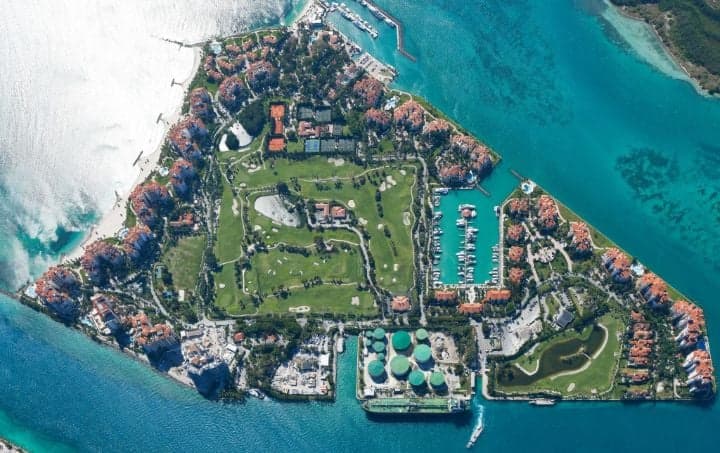
Photo: Wikipedia
Strategic Assessment of Fisher Island, FL
Meaningful friction. Expect exposure to either population pressure, blast zones, or natural disaster risk. Consider buying a retreat property.
What does the Strategic Assessment tell us?
Our Strategic Assessment grades tactical survivability of an area. Major population centers, military targets, fallout zones, natural disasters, and border exposure all drive risk — lower exposure means a more defensible position in a crisis.
This is heavily inspired by Joel Skousen's Strategic Relocation book. Highly recommended you checkout the book ($)What does this tell us?
Our Strategic Assessment grades tactical survivability of an area. Major population centers, military targets, fallout zones, natural disasters, and border exposure all drive risk — lower exposure means a more defensible position in a crisis.
This is heavily inspired by Joel Skousen's Strategic Relocation book. Highly recommended you checkout the book ($)Strategic Pillars

Key Distances
Regional Safe Places
Below is our recommended "safe zones" in Florida and the surrounding area based on our strategic heuristics. For most people, it's unrealistic to live in a “safe zone” full-time due to work, family or other personal reasons. They tend to be more rural. However, many of these areas are perfect for second homes and retreat properties that double as a vacation home or even a short-term rental.

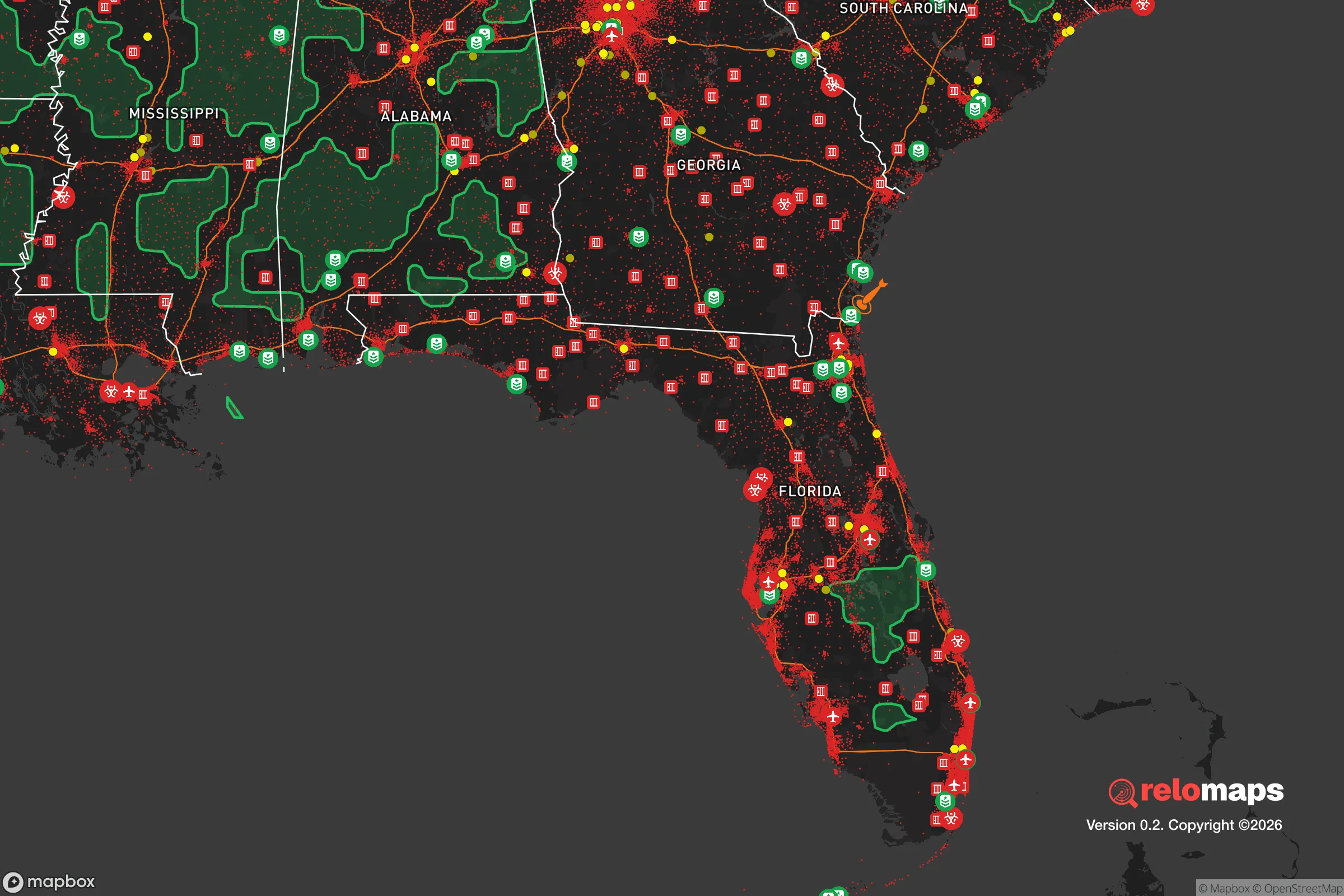


Important Note: For informational purposes only. This does not mean nothing bad ever happens in the green zones. Please use common sense. This is based on public data and modeled with AI. We tried to take a conservative approach but mistakes happen. We update this regularly as new information becomes available.
Solar Generator Recommendations
Backup power matters more here than in safer locations. We've picked three solar generators across budgets and capacity tiers — start with the budget unit if you only need a few essentials, or step up if you want to run a fridge and HVAC for days at a time.

Jackery Portable Power Station Explorer 300
Budget OptionPower on the Go: Weighing only 11 lbs, it's convenient to set up and store with book-sized foldable solar panels

BLUETTI Portable Power Station AC180
Designed for both indoor and outdoor scenarios, AC180 is highly capable as it has a robost capacity and continuous output power.

EF ECOFLOW DELTA Pro Ultra Power Station
Upgraded PickEcoFlow DELTA Pro Ultra is a whole-home energy system designed to grow with your family. Integrated with the Smart Home Panel 2, it scales to meet your evolving energy needs — keeping your home powered, intelligent, and secure through every stage of life.
We earn a commission, at no additional cost to you.
Strategic Assessment Analysis
Fisher Island, Florida, presents a paradox for the strategic relocator: it is arguably the most defensible residential enclave in the continental United States, yet its very desirability and location create a unique set of vulnerabilities that demand serious consideration. This seven-mile-long barrier island, accessible only by private ferry, helicopter, or yacht, offers a level of physical isolation that few other locations can match. For those prioritizing operational security and the ability to control access during periods of civic unrest, the island’s natural moat and single-point entry are unmatched assets. However, its proximity to Miami—a major population center, international transit hub, and potential target for both natural and man-made disasters—means that any strategic assessment must weigh the benefits of fortress-like seclusion against the risks of being adjacent to a high-consequence environment.
Geographic position and natural advantages for long-term security
Fisher Island’s geography is its primary strategic asset. Situated in Biscayne Bay, it is separated from the mainland by a mile of open water, with the Atlantic Ocean to the east and the protected Intracoastal Waterway to the west. This isolation is not merely aesthetic; it provides a natural buffer against the chaos that can quickly engulf a city. In a scenario involving widespread civil unrest, gridlock, or infrastructure failure, the island’s ferry-dependent access becomes a critical choke point. The island’s small permanent population—roughly 800 residents—means that the community is inherently manageable, and the high property values ensure that neighbors are likely to be resourceful and invested in maintaining order. The island also sits on a high ridge of fossilized coral, giving it an elevation advantage over much of South Florida, which is critical for storm surge protection. While no place in Florida is immune to hurricanes, Fisher Island’s elevation and engineered seawalls make it one of the most structurally resilient locations in the region for weathering a direct hit.
Risks, exposures, and proximity to fallout-relevant landmarks
The most significant strategic drawback of Fisher Island is its proximity to Miami, a city that presents multiple overlapping threat vectors. Miami International Airport, the Port of Miami, and the downtown skyline are all within a few miles, making the area a potential target for anything from a coordinated attack to a cascading infrastructure failure. In the event of a major disaster—whether natural, economic, or geopolitical—Miami’s population of over 6 million in the metro area could become a liability. The island’s single ferry point could be overwhelmed by desperate individuals attempting to flee the mainland, and the local authorities would likely be stretched thin. Additionally, the island’s reliance on mainland utilities—power, water, and fuel—means that a disruption in Miami would immediately affect Fisher Island. The island does have backup generators and private water systems for its luxury condos and estates, but these are designed for short-term convenience, not long-term survival. The strategic relocator must also consider that the island’s very wealth makes it a potential target for looting or extortion in a breakdown scenario, as it would be perceived as a concentration of resources.
Practical resilience for a relocator: food, water, energy, and defensibility
For a relocator serious about self-sufficiency, Fisher Island requires a proactive approach. The island has no grocery stores, no gas stations, and no public infrastructure for food production. Residents rely entirely on mainland supply chains for everything from fresh produce to medical supplies. A prepper would need to stockpile at least 90 days of non-perishable food, water filtration systems, and medical kits, as resupply could be cut off for weeks. The island’s desalination plant, which serves the luxury residences, is a significant advantage—it provides a local source of potable water, but it is not a public utility and access is limited to property owners. Energy resilience is mixed: most buildings have backup generators, but fuel for them must be brought in by ferry. Solar panels are not common on the island’s historic Mediterranean-style architecture, so a relocator would need to install their own off-grid system, which is feasible but expensive. Defensibility is the island’s strongest suit. The single ferry dock can be monitored and secured with a small team, and the island’s perimeter is entirely water, making it difficult to approach undetected. The community is tight-knit and private security is already present, which could be leveraged into a neighborhood watch or mutual defense arrangement. However, the island is not a fortress—it has multiple private docks and a helipad, which could be entry points for a determined adversary.
The overall strategic picture for Fisher Island is one of high reward paired with high responsibility. It offers a level of physical security and community control that is rare in the modern United States, particularly for those who can afford the substantial entry cost. For a conservative-leaning individual or family who values autonomy, privacy, and the ability to control their environment, the island provides a defensible base of operations that is close enough to Miami to access its resources—hospitals, airports, and supply chains—but far enough to avoid the daily friction of urban life. The key is to treat Fisher Island not as a final retreat, but as a hardened forward operating base. The relocator must be prepared to be self-reliant, to invest in redundant systems, and to build relationships with like-minded neighbors. In a world where the stability of major cities is increasingly uncertain, Fisher Island’s isolation is both its greatest strength and its most demanding requirement. It is not a place for passive wealth; it is a place for active stewardship of one’s security.

* Values derived from national, state, county, city and local statistics and may differ in a specific area. Last updated: 2026-10-10T16:27:27.000Z
Narrative content on this page is AI-generated and may contain mistakes. Verify any details that matter before acting on them.
ReloMaps may earn a commission from affiliate links at no extra cost to you.

