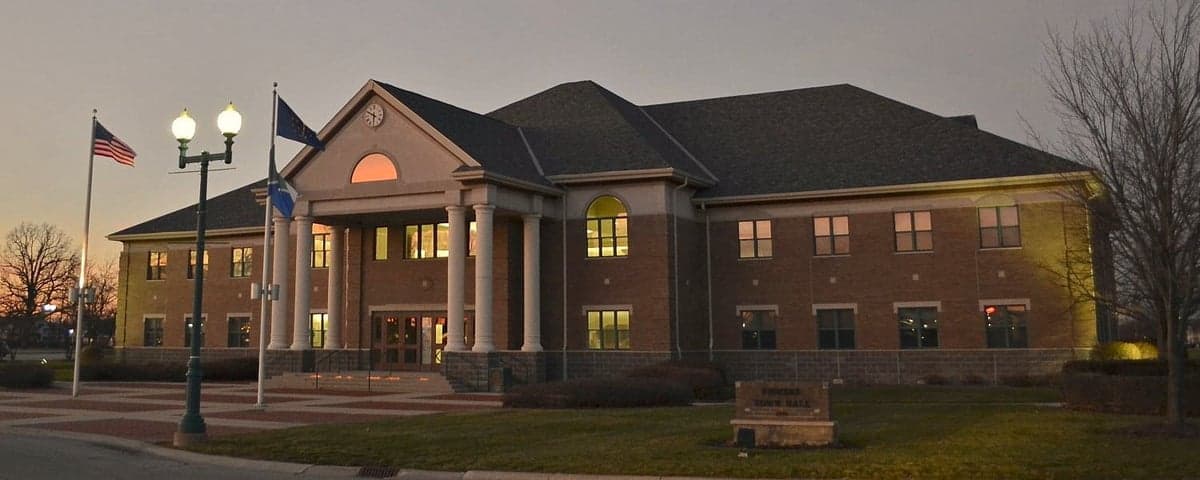
Photo: Wikipedia
Personal Sovereignty in Fishers, IN
Viable for self-reliance. Generally workable, though some barriers may limit total independence.
What does Personal Sovereignty tell us?
Personal Sovereignty measures your capacity for self-reliance and independence with minimal government friction. Higher scores mean fewer barriers between you and the way you want to live... but it assumes you have the space you need and good neighbors.
What does this tell us?
Personal Sovereignty measures your capacity for self-reliance and independence with minimal government friction. Higher scores mean fewer barriers between you and the way you want to live... but it assumes you have the space you need and good neighbors.
State Policy
Energy independence: Importer (35% of energy produced in-state)
Personal Liberty
Homesteading

Personal Liberty Analysis
Fishers, Indiana, offers a notably high degree of personal sovereignty relative to many suburban enclaves, particularly for those who prioritize minimal government interference in daily life. While no location is a libertarian utopia, the combination of Indiana’s strong state-level preemption laws, a low tax burden, and a culture that leans heavily toward self-reliance creates an environment where residents can largely live as they see fit. For the survivalist or prepper mindset, the key question is whether the local regulatory climate supports—or undermines—the ability to prepare, defend, and provide for oneself and one’s family. The answer is generally favorable, though with important caveats regarding land use and local ordinances.
Tax burden and regulatory posture: How much the state and county take
Indiana’s tax structure is a clear win for personal sovereignty. The state imposes a flat income tax rate of 3.05% as of 2026, with no progressive brackets that penalize higher earners or those building wealth through multiple income streams. Property taxes in Fishers are managed under a statewide cap—1% of assessed value for owner-occupied homes—which prevents the kind of runaway assessments seen in blue states. Hamilton County’s overall tax burden is moderate, and there is no state-level estate or inheritance tax, meaning you can pass assets to the next generation without the government taking a cut. On the regulatory front, Indiana is a right-to-work state, which limits union power and gives individuals more freedom in employment contracts. Occupational licensing is less onerous than in many states, though still present for certain trades. The state’s regulatory climate is generally business-friendly, which translates to fewer bureaucratic hurdles for those looking to start a side hustle, run a home-based business, or engage in direct sales of goods like food or crafts. However, Fishers itself has a reputation for active code enforcement, particularly regarding property appearance and noise—so while the state keeps its hands off, the local municipality may still impose rules that chafe against a “live and let live” ethos.
Self-defense and gun law specifics: What you can carry and where
Indiana is a constitutional carry state, meaning no permit is required to carry a handgun, openly or concealed, for anyone legally allowed to possess a firearm. This is a foundational element of personal sovereignty for the prepper community. Fishers, being a suburban city, does not impose its own additional restrictions beyond state law, so you are not dealing with the patchwork of local ordinances that plague states like California or New York. Stand-your-ground laws are in effect, with no duty to retreat in any place you have a legal right to be. Castle doctrine protections are strong, covering your home, vehicle, and occupied structure. Magazine capacity is not restricted, and there is no state-level registry for firearms. The only notable limitation is that Fishers is within a county that has seen some local pushback on gun rights—for example, the Hamilton County Sheriff’s Office has historically been supportive of the Second Amendment, but the city itself has occasionally floated symbolic resolutions. In practice, this means you can stockpile ammunition, own NFA items (with federal compliance), and train on your own property without fear of local overreach. The legal climate is one of the most permissive in the Midwest, which is a significant draw for those prioritizing self-defense autonomy.
Self-reliance and homesteading viability: Lot sizes, zoning, and off-grid feasibility
This is where Fishers shows its suburban limitations. The city is largely built out with standard subdivision lots ranging from 0.15 to 0.5 acres, which severely restricts any serious homesteading. Raising chickens is permitted on lots under one acre, but with strict limits on coop placement and noise. Larger livestock like goats or pigs are generally prohibited within city limits. Zoning codes require connections to municipal water and sewer, so true off-grid living—well water, septic, solar panels with battery storage—is effectively impossible in most residential areas. The city’s building codes also mandate certain construction standards that can conflict with alternative building methods like earthships or straw bale homes. However, if you are willing to look just outside the city limits—into unincorporated Hamilton County or neighboring Madison County—you can find 2- to 10-acre parcels where zoning is far more permissive. These areas allow for private wells, septic systems, and even limited agricultural activities. For the prepper who wants a suburban base with a rural retreat within 30 minutes, Fishers serves as a viable hub, but it is not a place to go full homestead within the city itself. The trade-off is access to excellent infrastructure and a strong job market, which funds the ability to buy land elsewhere.
Personal liberties: Parental rights, medical autonomy, speech, and property
Indiana has become a battleground for several key liberty issues, and the outcomes have been mixed but generally favorable for conservative priorities. Parental rights are strongly protected under state law, with a 2024 law requiring schools to notify parents of any changes in a student’s health or well-being, and prohibiting instruction on gender identity and sexual orientation in K-3 classrooms. This aligns with the values of many in the prepper community who view the family as the primary unit of sovereignty. Medical autonomy is more complicated: Indiana has some of the strictest abortion laws in the nation, which many conservatives see as a protection of life, but the state also has a vaccine mandate for certain healthcare workers and schoolchildren that has been a point of contention. The state does not have a broad religious exemption for medical procedures, so those seeking complete medical freedom may need to look to states like Idaho or Texas. Free speech is robust, with no hate speech laws or social media censorship mandates at the state level. Property rights are strong, with no statewide rent control and relatively weak eminent domain powers. The biggest threat to property sovereignty in Fishers is the homeowners association (HOA)—many subdivisions have them, and they can impose strict rules on everything from paint colors to parking. If you buy outside an HOA, you have near-total control over your land, but that is increasingly rare within city limits.
Overall, Fishers offers a solid foundation for personal sovereignty compared to most suburban areas in the United States, particularly those on the coasts. The state-level protections for gun rights, low taxes, and parental rights create a framework where an individual can live with a high degree of autonomy. The main compromises are the suburban density and HOA culture, which limit homesteading and off-grid living, and the local code enforcement that can feel intrusive. For the strategic relocator with a prepper mindset, Fishers works best as a base of operations—a place to earn a good income, raise a family with minimal government interference in education and self-defense, and then use that capital to acquire land in the surrounding rural counties for true self-reliance. It is not a sovereign citizen’s paradise, but it is a pragmatic choice for those who want to live free without moving to the absolute boondocks.

* Values derived from national, state, county, city and local statistics and may differ in a specific area. Last updated: 2026-04-22T10:27:21.000Z
Narrative content on this page is AI-generated and may contain mistakes. Verify any details that matter before acting on them.
ReloMaps may earn a commission from affiliate links at no extra cost to you.

