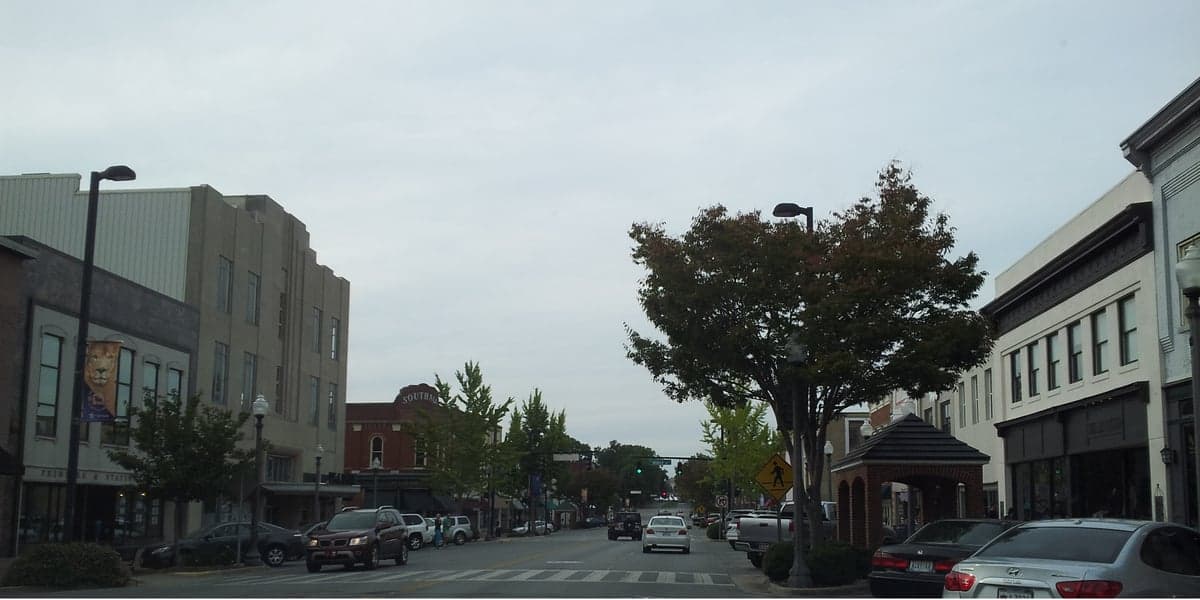
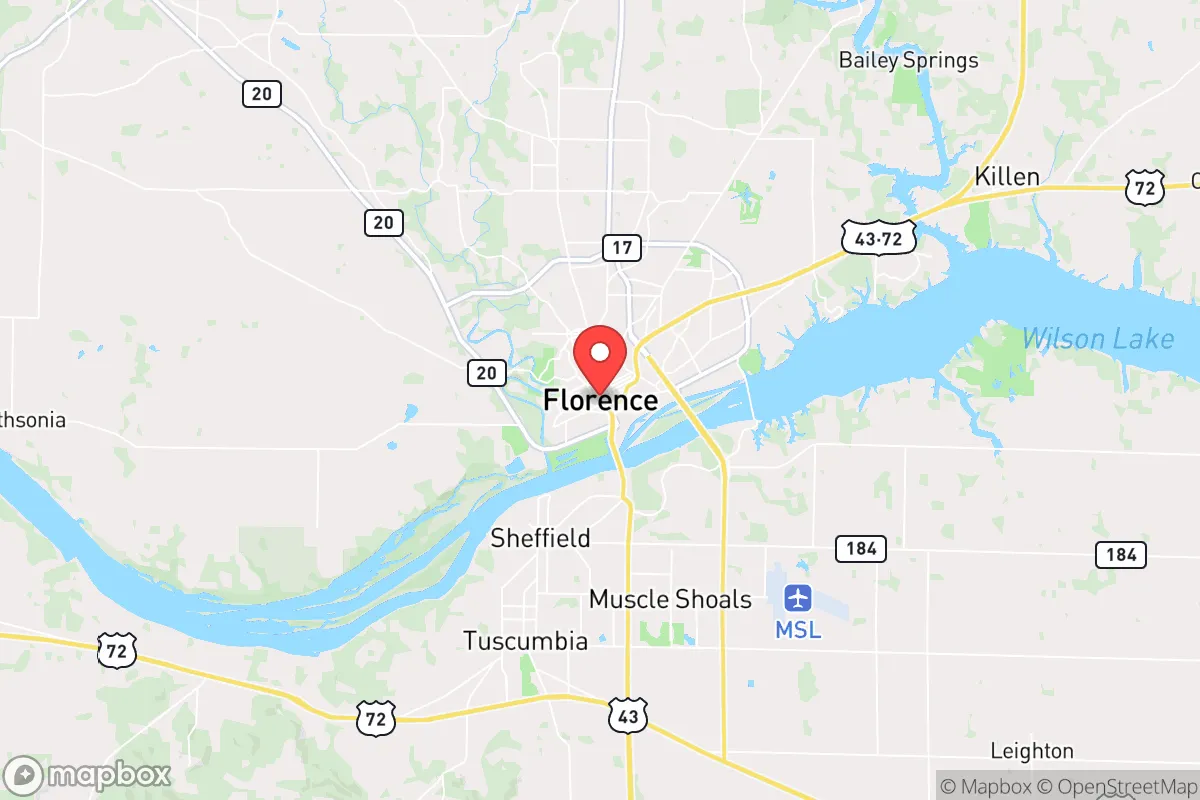
Photo: Wikipedia
Demographics of Florence, AL
Affluence Level in Florence, AL
A below-average socioeconomic profile. Incomes, home values, and educational attainment trail the U.S., with higher poverty and unemployment.
People of Florence, AL
The people of Florence, Alabama, today number 41,231, forming a predominantly white (71.0%) and native-born (97.0% U.S.-born) community with a significant Black minority (17.2%) and a small but growing Hispanic population (5.6%). The city’s character is rooted in its role as a regional hub for education, healthcare, and manufacturing, anchored by the University of North Alabama and a workforce tied to industries like auto parts and aerospace. Distinctively, Florence retains a strong sense of place as the birthplace of W.C. Handy and a center of the Shoals music scene, yet its demographic profile is notably less diverse than the national average, with a foreign-born share of just 3.0% and a college-educated rate of 31.1% that trails many peer cities.
How the city was settled and grew
Florence was founded in 1818 as a planned community on a bluff above the Tennessee River, part of the Cypress Land Company’s development. The original white settlers were primarily Scotch-Irish and English farmers from Virginia, Tennessee, and the Carolinas, drawn by the promise of fertile bottomland and river access for cotton shipping. The city’s early growth was fueled by the cotton trade and the establishment of the University of North Alabama (then LaGrange College) in 1830, which attracted educators and merchants. The historic Downtown Florence district, with its antebellum homes and commercial buildings, was built by this planter-merchant class. After the Civil War, the city’s Black population grew as freedmen moved to the area for work on farms and in emerging industries, settling in neighborhoods like East Florence and North Florence, which remain predominantly Black communities today. The arrival of the railroad in the 1880s spurred a second wave of white migration from rural Alabama and Tennessee, filling new streetcar suburbs like Woodland and Sherrod Drive with working-class families employed in lumber mills and textile plants.
Modern era (post-1965)
After the 1965 Immigration and Nationality Act, Florence saw minimal international immigration compared to coastal cities. The foreign-born population remains low at 3.0%, with the largest groups being Hispanic (5.6% of total population) and East/Southeast Asian (0.6%), many of whom arrived in the 1990s and 2000s for jobs in manufacturing plants like the Toyota-Mazda joint venture in nearby Huntsville and local suppliers. These newer residents have concentrated in West Florence and newer subdivisions along the Cox Creek Parkway corridor, where affordable housing and proximity to industrial parks are draws. The Indian-subcontinent population is negligible at 0.3%, reflecting the absence of a large tech or medical employer that typically attracts that group. Domestically, the post-1965 era saw white flight from older neighborhoods like East Florence to suburban developments in Green Oaks and Cloverdale, accelerating racial segregation. The Black population, which was 25% in 1970, has declined to 17.2% as middle-class Black families also moved to newer subdivisions, while the white share has remained stable around 71% due to in-migration from rural areas. The Hispanic population, though small, has grown from near zero in 1990 to 5.6% today, driven by construction and service-sector jobs.
The future
Florence’s population is likely to continue growing slowly, with projections from the University of Alabama’s Center for Business and Economic Research suggesting a 5-8% increase by 2040. The city is homogenizing in terms of race—the white share is stable, the Black share is slowly declining, and the Hispanic share is rising but from a low base. The foreign-born population is plateauing, as new immigration is offset by assimilation and out-migration of second-generation residents to larger cities. The city is not tribalizing into distinct enclaves; rather, newer subdivisions are more integrated than older neighborhoods, though East Florence and North Florence remain predominantly Black, while West Florence and Green Oaks are overwhelmingly white. The next 10-20 years will likely see continued suburban expansion along the U.S. 72 corridor toward Muscle Shoals, with the population becoming slightly more Hispanic and slightly less Black, but remaining overwhelmingly native-born and white. The college-educated share may rise as the University of North Alabama expands its graduate programs, but the city will likely remain a regional service center rather than a destination for international migration.
For someone moving in now, Florence is becoming a slowly diversifying but still deeply traditional Southern city—stable, affordable, and family-oriented, with a population that values local roots and community institutions. The low foreign-born share and modest Hispanic growth mean that newcomers will find a culturally homogeneous environment, particularly in the newer western suburbs, while older neighborhoods retain distinct racial and historical identities. The city’s future is one of gradual, incremental change rather than rapid transformation, making it a predictable choice for those seeking a quiet, established community.

* Values derived from national, state, county, city and local statistics and may differ in a specific area. Last updated: 2026-04-19T18:50:36.000Z
Narrative content on this page is AI-generated and may contain mistakes. Verify any details that matter before acting on them.
ReloMaps may earn a commission from affiliate links at no extra cost to you.

