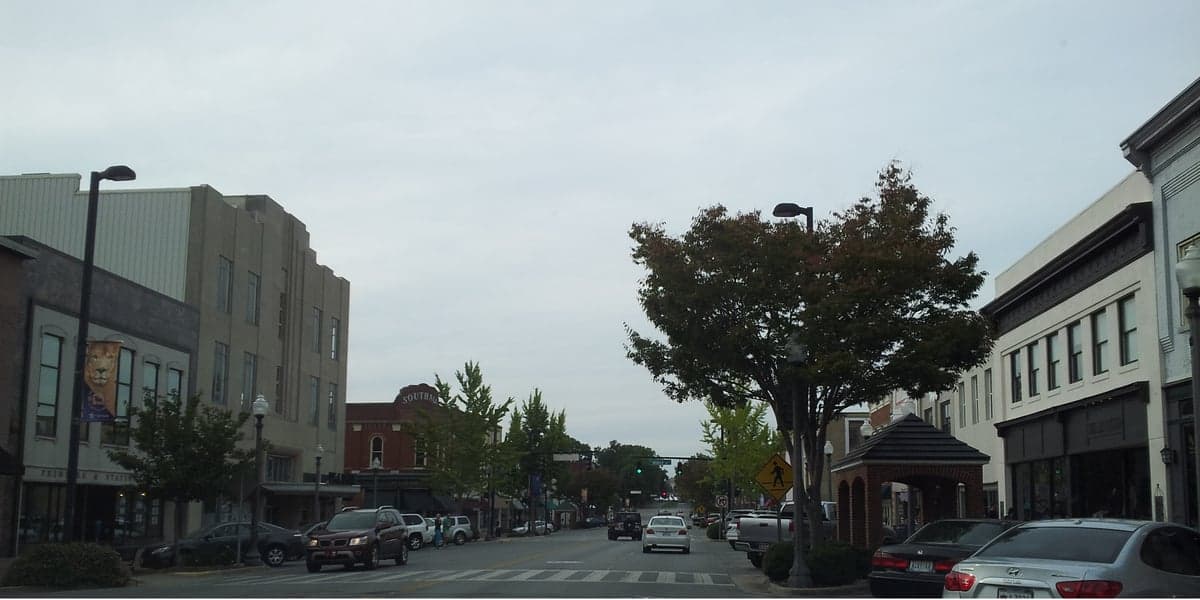
Photo: Wikipedia
Political ClimatePolitical Climate in Florence, AL
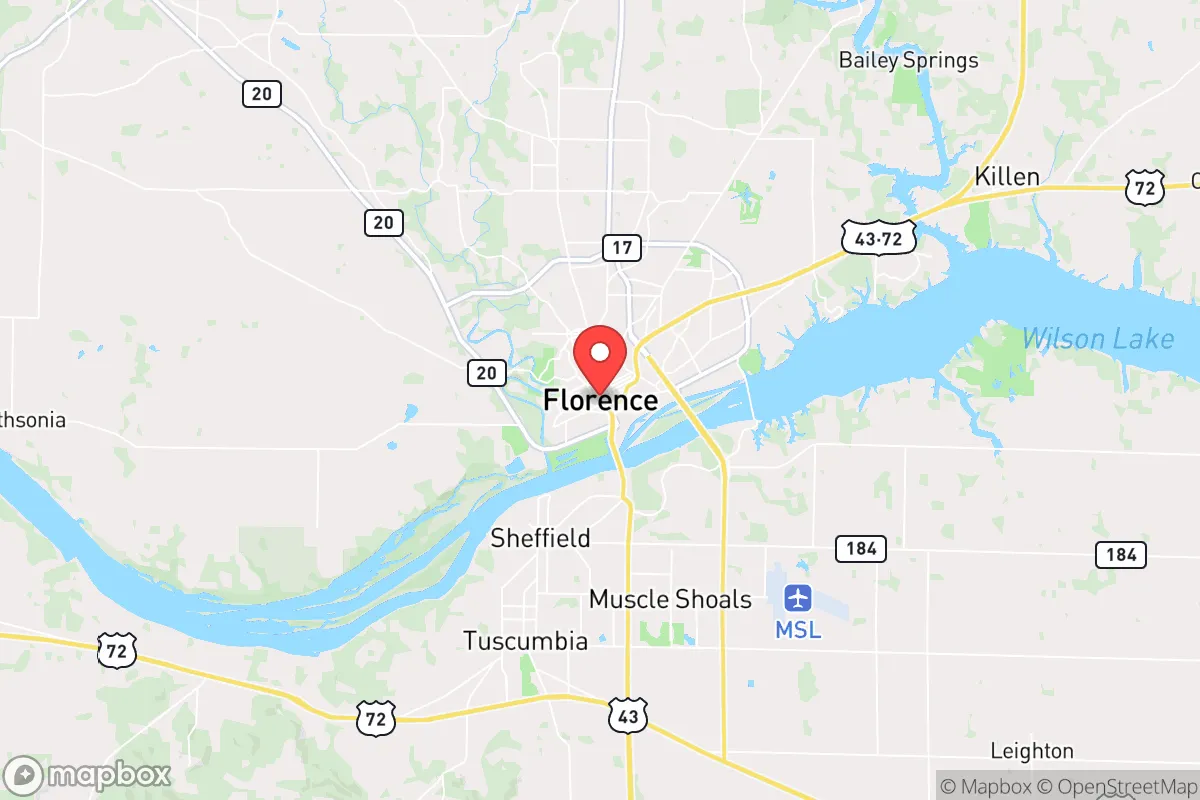
District shown is the primary district for this city’s centroid. Cities may span multiple districts.
Local Political AnalysisPolitical Analysis of Florence, AL
Florence, Alabama, sits deep in the heart of conservative northwest Alabama, and the numbers back up what you’ll feel the moment you step into a local diner or church. The Cook PVI rating of R+33 tells you this isn’t a purple area—it’s a solid red stronghold where Republican candidates routinely win by double-digit margins. Lauderdale County, where Florence is the county seat, hasn’t voted for a Democratic presidential candidate since 1976, and in 2024, the county went for the GOP ticket by over 40 points. That’s not just a trend; it’s a deeply rooted cultural and political identity that’s held steady for decades, though you’ll hear old-timers grumble about a slow drift toward more moderate suburban attitudes creeping in from the Huntsville corridor.
How it compares
Drive 45 minutes east to Huntsville, and you’ll hit a different world—Madison County is still reliably red, but it’s trending purple thanks to tech transplants and defense contractors. Florence, by contrast, feels like a time capsule of traditional Alabama values. The surrounding towns—Sheffield, Tuscumbia, Muscle Shoals—are even more conservative, with smaller populations and older demographics. Florence’s university presence (University of North Alabama) brings a slight liberal tint to the downtown core, but it’s mild. The real contrast is with cities like Birmingham or Montgomery, where progressive policies on taxes, zoning, and public spending have taken hold. Here, the county commission and city council are dominated by fiscal conservatives who keep property taxes low and resist what locals call “government overreach” into personal freedoms—whether that’s mask mandates, business closures, or land-use restrictions.
What this means for residents
For someone moving here, the political climate means you’re largely left alone to live your life. The local government isn’t in the habit of telling you how to run your business, what to do with your property, or how to raise your kids. That’s a big deal for folks who’ve fled states where COVID-era lockdowns or recent pushes for progressive school curricula felt like an invasion of personal rights. Florence’s school board, for instance, has resisted controversial library books and gender-identity policies that have stirred up fights in more liberal districts. The downside? If you’re hoping for rapid public transit, bike lanes, or heavy investment in social programs, you’ll be disappointed. The tax base is modest, and the prevailing attitude is that government should stay small. For conservatives who value self-reliance and local control, that’s a feature, not a bug.
That said, there are signs of change that give some long-time residents pause. The University of North Alabama has grown significantly, bringing in faculty and students from out of state who sometimes push for more progressive policies—like diversity initiatives or climate resolutions. So far, these efforts have been met with skepticism from the city council, but the demographic shift is real. If you’re looking at Florence as a place to raise a family or retire, the political climate today is still overwhelmingly conservative and freedom-minded. But keep an eye on the next decade: if the Huntsville-style growth spills over, you might see a slow erosion of the hands-off, small-government ethos that makes this area feel like a refuge from the chaos of bigger cities.

State Political ClimatePolitical Climate in Alabama
State Political AnalysisPolitical Environment in the State
Alabama is one of the most reliably Republican states in the country, with a deep-red partisan lean that has only intensified over the past two decades. The state hasn’t voted for a Democratic presidential candidate since 1976, and in 2024, Donald Trump carried it by roughly 30 points. The dominant coalition is a mix of rural, evangelical, and working-class voters, with the GOP holding supermajorities in both chambers of the legislature and every statewide office. Over the last 10-20 years, the shift has been away from the old “Dixiecrat” tradition and toward a solid, Trump-aligned Republican base, though some suburban pockets around Birmingham and Huntsville have shown signs of moderation.
Urban vs. rural divide
The political map of Alabama is a textbook study in urban-rural polarization. The state’s largest metro, Birmingham (Jefferson County), is a Democratic stronghold, driven by a majority-Black population and a growing professional class. In 2024, Jefferson County voted about 60% for Kamala Harris. Montgomery and Mobile also lean Democratic, though Mobile’s margins are narrower. In contrast, the rural Black Belt counties—like Lowndes and Wilcox—vote overwhelmingly Democratic due to high African American populations, but they have low turnout and shrinking populations. The real GOP engine is the rest of the state: the Birmingham suburbs like Hoover and Vestavia Hills vote heavily Republican, as do the fast-growing Huntsville metro (Madison County) and the Wiregrass region around Dothan. The Tennessee Valley, including Florence and Muscle Shoals, is reliably red. The divide isn’t just urban vs. rural—it’s also racial and economic, with white voters in exurbs and small towns forming the GOP’s base.
Policy environment
Alabama’s policy environment is among the most conservative in the nation, with a strong emphasis on limited government and traditional values. The state has no state income tax on wages for most residents—only a flat 5% on taxable income—and property taxes are among the lowest in the country, averaging about 0.4% of home value. The regulatory posture is business-friendly, with right-to-work laws and minimal zoning restrictions in most areas. Education policy is a flashpoint: the state passed the Alabama CHOOSE Act in 2024, creating education savings accounts (ESAs) that let parents use public funds for private school or homeschooling—a major win for school choice advocates. Healthcare is a mixed bag; Alabama did not expand Medicaid under the Affordable Care Act, leaving many rural hospitals struggling, but the state has a strong network of faith-based clinics. Election laws are strict: voter ID is required, and the state passed a 2021 law banning curbside voting and limiting absentee ballot assistance. The legislature also passed a near-total abortion ban in 2019 (the Human Life Protection Act), which took effect after Dobbs. Overall, the policy environment is designed to maximize personal freedom in economic and family matters, but with a heavy hand on social issues.
Trajectory & freedom
Alabama is trending toward more freedom in several key areas, particularly around parental rights, gun rights, and tax relief. In 2022, the state passed constitutional carry (permitless carry of handguns), making it one of about 25 states with no permit requirement. The Alabama Parental Rights Protection Act (2022) requires schools to notify parents of any medical or counseling services offered to minors, and the 2024 CHOOSE Act expanded school choice dramatically. On the tax front, the state cut the grocery tax from 4% to 3% in 2023 and is phasing out the corporate income tax. However, there are concerning trends: the state has seen increased federal overreach in environmental regulations, particularly around the Tennessee River and coal ash cleanup, which some locals view as federal overreach. Medical freedom took a hit during COVID, with some local health departments imposing mask mandates, but the legislature responded by banning vaccine mandates for state employees and students in 2022. The trajectory is toward more personal liberty in the traditional conservative sense—guns, school choice, low taxes—but with a wary eye on federal encroachment.
Civil unrest & political movements
Alabama has a history of civil rights activism, but in recent years, political movements have been more about election integrity and immigration. The 2020 election saw no major unrest, but the state’s Republican leadership pushed for a forensic audit of the 2020 results in 2021, though it was limited in scope. Immigration politics are heated in places like Albertville and Russellville, where meatpacking plants have drawn a growing Hispanic population; the state passed a strict immigration law (HB 56) in 2011, though parts were struck down. In 2024, the legislature considered a bill to ban sanctuary cities, though none exist. On the left, the Alabama Poor People’s Campaign and Black Lives Matter have held protests in Birmingham and Montgomery, but they are small and localized. The most visible political movement is the Alabama Freedom Caucus, a hardline conservative group that has pushed for school choice, gun rights, and anti-ESG legislation. A new resident would notice the strong presence of evangelical churches in politics—prayer breakfasts, pastor-led rallies, and a general expectation that politicians attend church. There’s no serious secessionist movement, but “state sovereignty” rhetoric is common in local GOP circles.
Projection
Over the next 5-10 years, Alabama is likely to become more Republican and more culturally conservative, driven by in-migration from blue states and natural population growth in the Huntsville and Baldwin County (Gulf Shores) areas. The Huntsville metro is booming with aerospace and defense jobs, attracting a mix of conservative and moderate professionals, but the overall political tilt will remain deep red. The Black Belt will continue to shrink, reducing Democratic turnout. The biggest wildcard is the 2025 redistricting battle: a federal court ordered Alabama to draw a second majority-Black congressional district, which could flip one seat to Democrat, but the state is appealing. Expect more school choice expansion, further tax cuts, and continued resistance to Medicaid expansion. The state will likely pass a constitutional amendment to ban income tax entirely, following the path of Tennessee and Florida. For a new resident, the next decade looks like more of the same: a stable, low-tax, high-freedom environment for conservatives, with cultural battles over education and immigration intensifying at the local level.
For someone moving to Alabama, the bottom line is this: you’ll find a state that respects your right to own guns, choose your child’s school, and keep more of your paycheck. The political climate is stable and predictable—no surprise blue shifts or radical policy swings. The trade-off is that you’ll live in a state where social conservatism is the norm, and progressive voices are a distinct minority. If that aligns with your values, Alabama offers a level of personal freedom that’s hard to beat in the modern United States.
* Values derived from national, state, county, city and local statistics and may differ in a specific area. Last updated: 2026-04-19T18:50:36.000Z
Narrative content on this page is AI-generated and may contain mistakes. Verify any details that matter before acting on them.
ReloMaps may earn a commission from affiliate links at no extra cost to you.

