Photo: Wikipedia
Demographics of Fond Du Lac, WI
Affluence Level in Fond Du Lac, WI
A middle-class area roughly in line with national averages across income, home values, education, and employment.
People of Fond Du Lac, WI
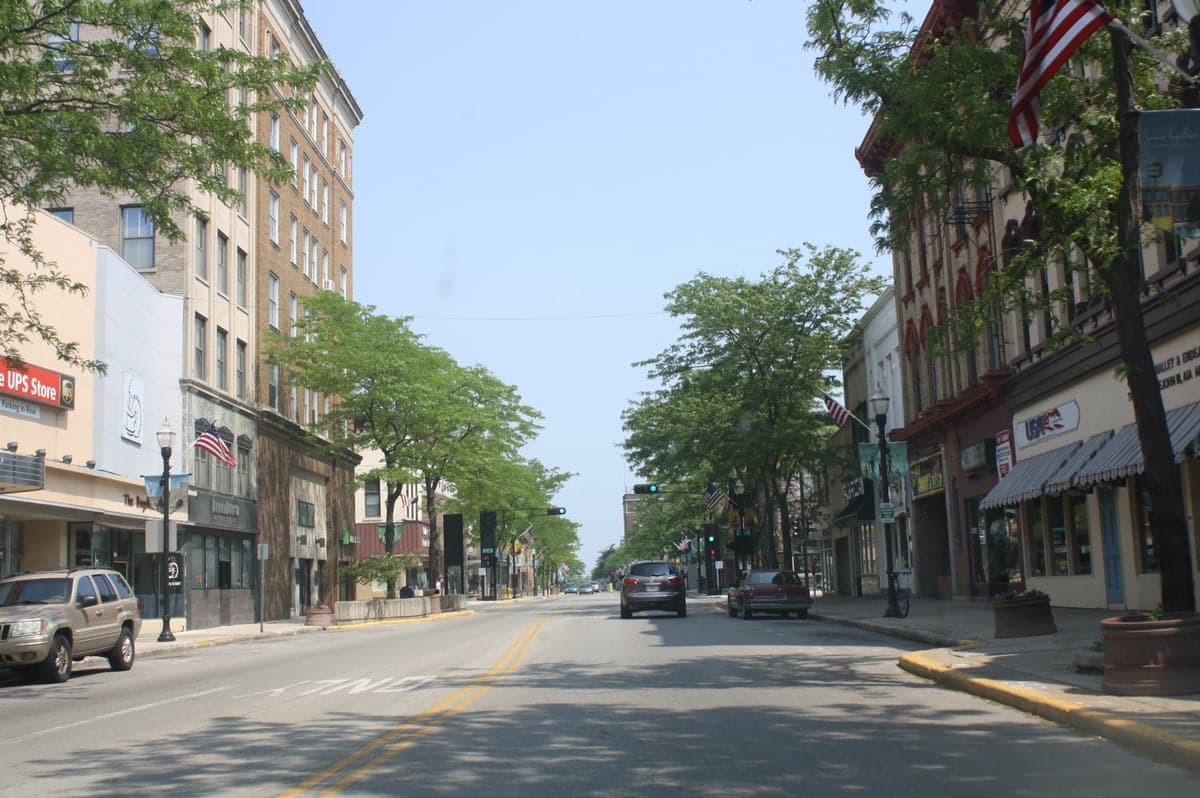
The people of Fond du Lac, Wisconsin, today number 44,491, forming a community that is 82.0% white, 8.7% Hispanic, 2.8% Black, and 2.8% East/Southeast Asian, with a foreign-born population of just 3.0%. The city retains a distinctly Midwestern, blue-collar character shaped by its history as a manufacturing and lake-transport hub, with a college attainment rate of 21.7% that trails state averages. Residents often describe the social atmosphere as stable and family-oriented, with strong ties to local employers like Mercury Marine and the Agnesian Healthcare system, and a noticeable absence of the rapid demographic churn seen in larger Wisconsin cities.
How the city was settled and grew
Fond du Lac’s population history begins with the Ho-Chunk and Menominee peoples, who used the area as a portage between Lake Winnebago and the Fond du Lac River. European-American settlement began in earnest after the 1836 Treaty of the Cedars forced tribal land cessions. The city was platted in 1835 and incorporated in 1852, with its early growth driven by the lumber industry and its position as a rail and lake shipping point. The first major wave of settlers were Yankees from New England and New York, who built the East Side neighborhoods around Main Street and the lakefront, establishing the city’s commercial and civic core. By the 1850s, German immigrants arrived in large numbers, drawn by farmland and industrial jobs; they settled heavily in the West Side and South Side districts, particularly around what is now the 9th Street and Scott Street corridors, building churches, breweries, and social halls. A smaller wave of Irish immigrants followed, clustering near the railroad yards in the North Fond du Lac area, which remained a working-class enclave through the early 1900s. The city’s population peaked at roughly 42,000 in the 1960s, supported by a diversified manufacturing base that included Mercury Marine (founded 1939), Giddings & Lewis, and several foundries.
Modern era (post-1965)
After the 1965 Hart-Cellar Act, Fond du Lac saw only modest immigration, reflecting its inland location and limited service-sector growth. The foreign-born share today (3.0%) is well below the national average, and the city’s racial composition has shifted gradually rather than dramatically. The Hispanic population, now 8.7%, began growing in the 1990s, driven by Mexican and Central American migrants recruited for light manufacturing and food-processing jobs. These families concentrated in the South Side neighborhoods near the industrial parks along Highway 41, particularly around the 18th Street and Pioneer Road area, where several Spanish-language churches and tiendas have opened. The Black population (2.8%) is largely composed of families who moved from Milwaukee and Chicago during the 1990s and 2000s, seeking lower housing costs and safer schools; they are dispersed across the city but have a visible presence in the East Side near the Marian University campus. The East/Southeast Asian community (2.8%) is primarily Hmong, with families resettled from Laos after the Vietnam War and later through secondary migration from other Wisconsin cities. They are concentrated in the West Side near the Fond du Lac High School and the North Fond du Lac village, where a Hmong mutual assistance association operates. The Indian-subcontinent population is effectively zero (0.0%), a notable absence compared to larger Wisconsin metros.
The future
Fond du Lac’s population is aging and slowly declining, with a median age of 40.5 and a birth rate below replacement. The white population is projected to shrink further as younger adults leave for college and jobs in the Fox Cities or Milwaukee, while the Hispanic and Hmong communities are growing through higher birth rates and continued in-migration. The city is not tribalizing into starkly separate enclaves, but distinct ethnic clusters are solidifying: the South Side is becoming more Hispanic, the West Side more Hmong, and the East Side more diverse but still predominantly white. The foreign-born share is likely to rise to 5-6% by 2035, driven by continued Hispanic and Hmong growth, but the city will remain far less diverse than the national average. The biggest demographic wildcard is whether Fond du Lac can attract younger, college-educated workers to replace retiring baby boomers; without that, the population could dip below 40,000 by 2040.
For a conservative-leaning individual or family considering relocation, Fond du Lac offers a stable, slow-changing community where traditional social structures—church, family, local employer—still anchor daily life. The population is becoming slightly more diverse, but at a pace that feels organic rather than disruptive, and the city’s identity as a manufacturing and lake-town community remains intact. The key trade-off is between low crime, affordable housing, and strong schools on one hand, and limited career opportunities and a shrinking young-adult population on the other.

* Values derived from national, state, county, city and local statistics and may differ in a specific area. Last updated: 2026-04-21T10:29:09.000Z
Narrative content on this page is AI-generated and may contain mistakes. Verify any details that matter before acting on them.
ReloMaps may earn a commission from affiliate links at no extra cost to you.

