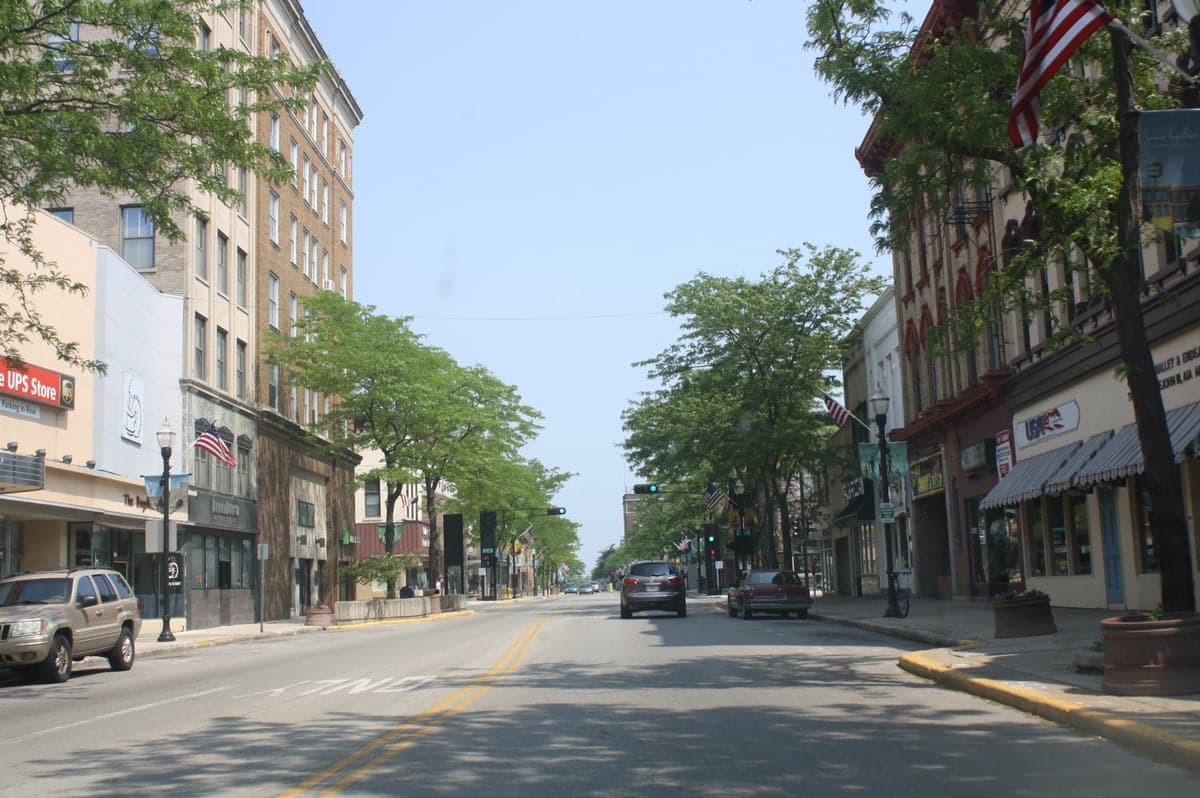
Photo: Wikipedia
Strategic Assessment of Fond Du Lac, WI
Meaningful friction. Expect exposure to either population pressure, blast zones, or natural disaster risk. Consider buying a retreat property.
What does the Strategic Assessment tell us?
Our Strategic Assessment grades tactical survivability of an area. Major population centers, military targets, fallout zones, natural disasters, and border exposure all drive risk — lower exposure means a more defensible position in a crisis.
This is heavily inspired by Joel Skousen's Strategic Relocation book. Highly recommended you checkout the book ($)What does this tell us?
Our Strategic Assessment grades tactical survivability of an area. Major population centers, military targets, fallout zones, natural disasters, and border exposure all drive risk — lower exposure means a more defensible position in a crisis.
This is heavily inspired by Joel Skousen's Strategic Relocation book. Highly recommended you checkout the book ($)Strategic Pillars

Key Distances
Regional Safe Places
Below is our recommended "safe zones" in Wisconsin and the surrounding area based on our strategic heuristics. For most people, it's unrealistic to live in a “safe zone” full-time due to work, family or other personal reasons. They tend to be more rural. However, many of these areas are perfect for second homes and retreat properties that double as a vacation home or even a short-term rental.
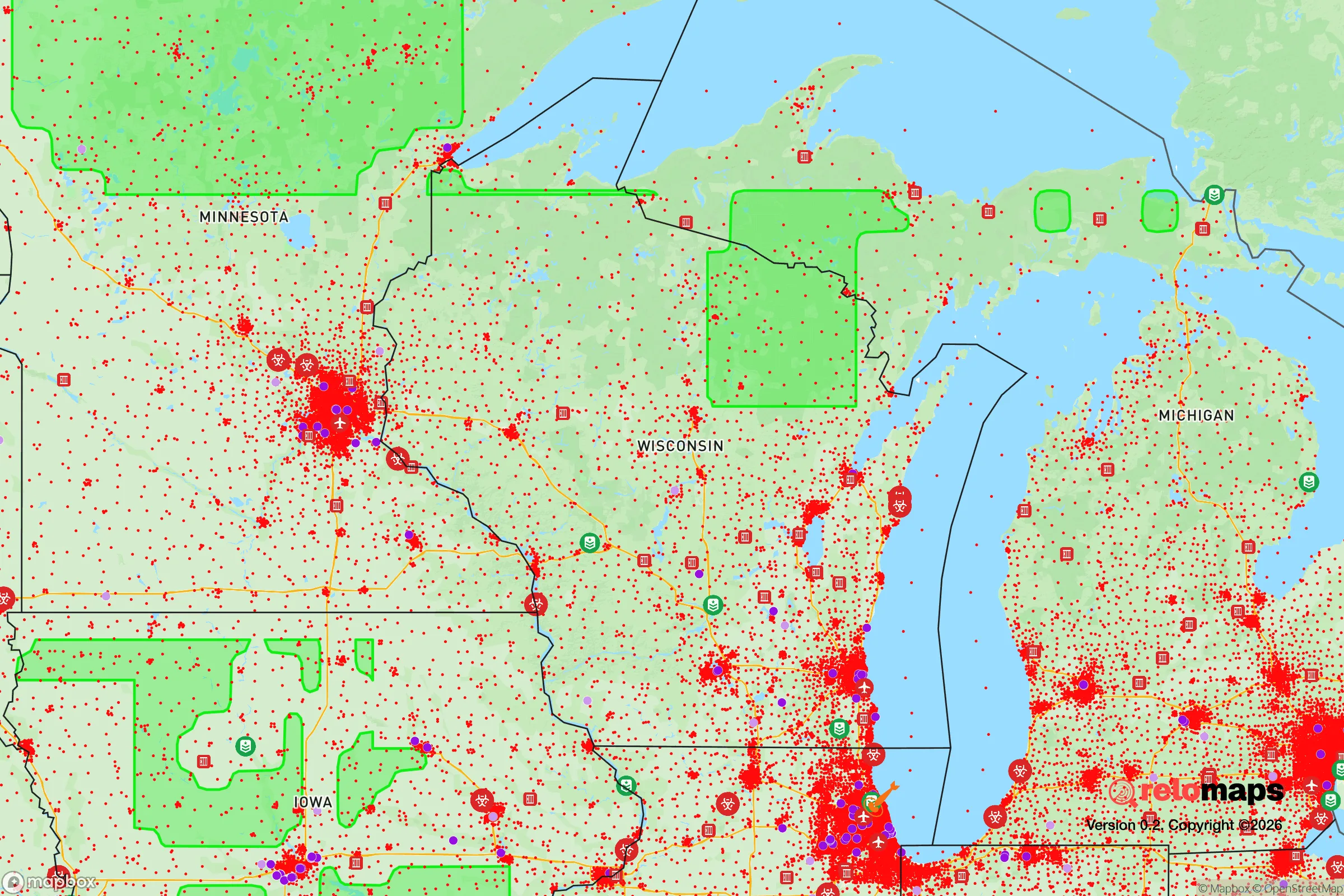
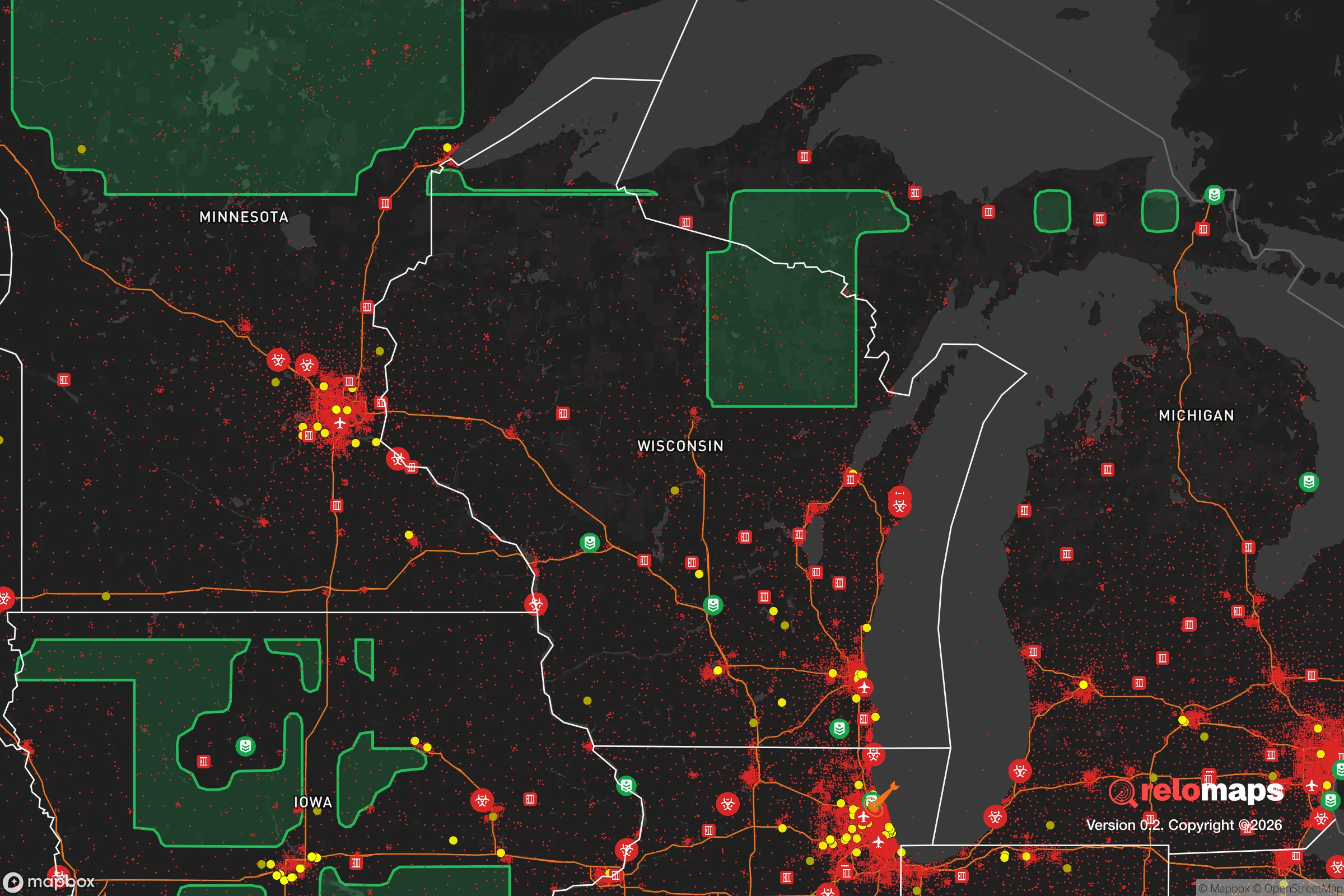


Important Note: For informational purposes only. This does not mean nothing bad ever happens in the green zones. Please use common sense. This is based on public data and modeled with AI. We tried to take a conservative approach but mistakes happen. We update this regularly as new information becomes available.
Solar Generator Recommendations
Backup power matters more here than in safer locations. We've picked three solar generators across budgets and capacity tiers — start with the budget unit if you only need a few essentials, or step up if you want to run a fridge and HVAC for days at a time.

Jackery Portable Power Station Explorer 300
Budget OptionPower on the Go: Weighing only 11 lbs, it's convenient to set up and store with book-sized foldable solar panels

BLUETTI Portable Power Station AC180
Designed for both indoor and outdoor scenarios, AC180 is highly capable as it has a robost capacity and continuous output power.

EF ECOFLOW DELTA Pro Ultra Power Station
Upgraded PickEcoFlow DELTA Pro Ultra is a whole-home energy system designed to grow with your family. Integrated with the Smart Home Panel 2, it scales to meet your evolving energy needs — keeping your home powered, intelligent, and secure through every stage of life.
We earn a commission, at no additional cost to you.
Strategic Assessment Analysis
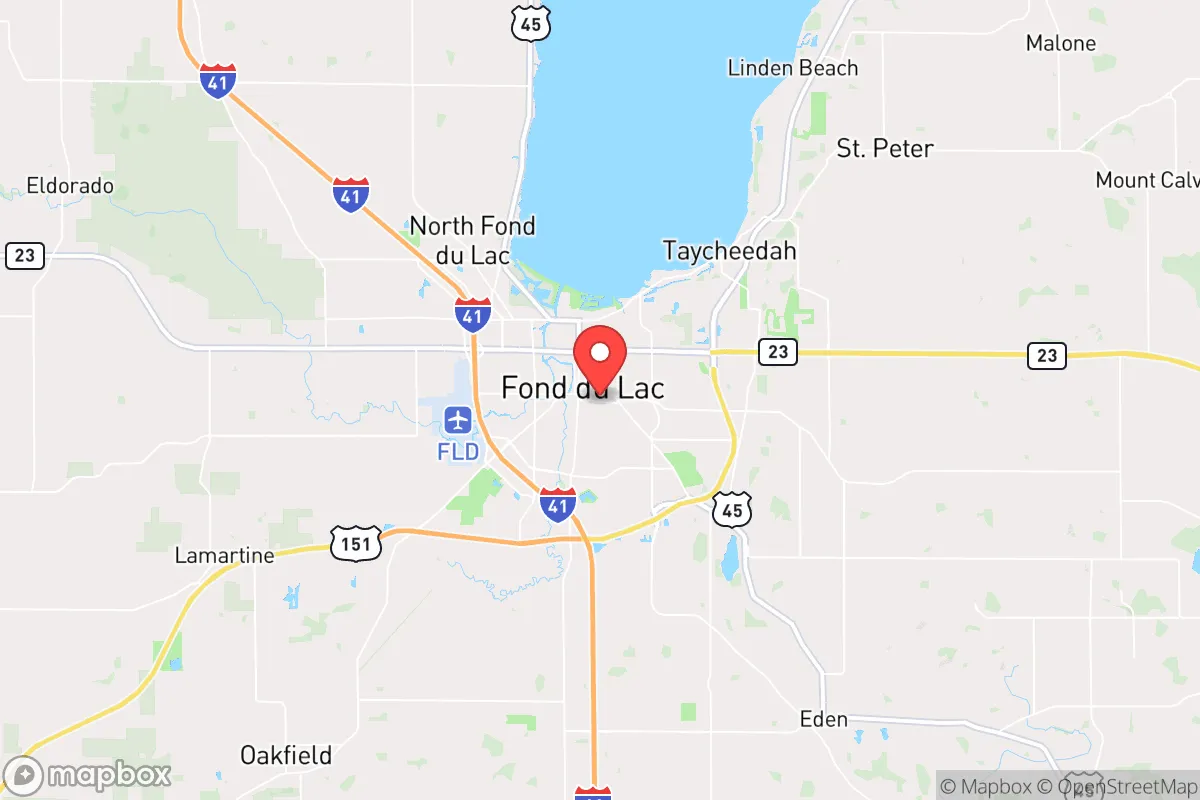
Fond du Lac, Wisconsin, sits in a sweet spot that few preppers fully appreciate: close enough to the economic engine of the Fox Valley to sustain a normal life, yet far enough from the major population centers to avoid the worst of a collapse scenario. Its position on the southern tip of Lake Winnebago gives it a natural water buffer to the north and east, while the surrounding farmland offers both food security and a defensible perimeter. For a conservative-leaning relocator looking to balance daily convenience with long-term survivability, this city punches above its weight in resilience, provided you understand its specific vulnerabilities.
Geographic position and natural advantages for long-term survival
Fond du Lac’s geography is its strongest card. The city is anchored by Lake Winnebago, the largest inland lake in Wisconsin, which provides a massive freshwater reservoir that is less vulnerable to contamination than rivers or wells in drought-prone regions. The surrounding landscape is a mix of rolling hills, hardwood forests, and prime agricultural soil—the kind of terrain that can sustain small-scale farming and hunting. To the west, the Horicon Marsh and the Kettle Moraine State Forest offer rugged, low-population corridors for retreat or resupply. Critically, Fond du Lac sits at the intersection of US-151 and I-41, giving you road access to the northwoods (a classic bug-out zone) and the rural counties of Dodge and Sheboygan without forcing you through Milwaukee or Green Bay. The city’s population of roughly 44,000 is dense enough to support a hospital, hardware stores, and a regional airport (KFLD), but sparse enough that a grid-down scenario wouldn’t trigger the kind of mass exodus you’d see in Madison or Chicago. The local topography also offers natural chokepoints: the lake to the east, the Fond du Lac River cutting through town, and the surrounding farm fields create a funnel that would slow any large-scale movement, buying time for a prepared resident to secure their perimeter.
Risks, exposures, and proximity to fallout-relevant landmarks
No location is a fortress, and Fond du Lac has real liabilities. The most obvious is its proximity to the Fox Valley corridor—Oshkosh (20 miles north), Appleton (30 miles north), and Neenah-Menasha (25 miles north) form a metro area of over 250,000 people. In a major crisis, that population would likely flow south along I-41 toward Fond du Lac, creating a refugee wave that could overwhelm local resources. The city itself has a rail line running through its core (the Canadian National Railway), which is a double-edged sword: useful for supply movement if you control it, but a target for sabotage or a vector for hazmat spills. The Fond du Lac County Airport is a general aviation field, not a major military hub, but it could become a staging point for FEMA or National Guard operations, drawing unwanted attention. On the industrial side, the city hosts a Mercury Marine manufacturing plant and several metal fabrication shops—these aren’t nuclear targets, but they could be secondary targets in a cyberattack or EMP scenario due to their role in the supply chain. The bigger concern is the Kewaunee Nuclear Power Plant, roughly 60 miles northeast on Lake Michigan. While that’s outside the typical 10-mile evacuation zone, a major release could push fallout across the lake and into Fond du Lac depending on wind patterns. Similarly, the Sheboygan County area has chemical storage facilities along the lake that could be compromised in a natural disaster. For a prepper, the takeaway is that Fond du Lac is not a remote bunker—it’s a semi-urban hub that requires active monitoring of regional events and a plan to either hunker down or bug out to the northwoods within the first 48 hours.
Practical resilience for a relocator: food, water, energy, and defensibility
For a single individual or family moving here, the practical resilience factors are solid but require work. Water is abundant—Lake Winnebago is a surface reservoir, and the city’s municipal water comes from the lake, treated at the Fond du Lac Water Utility. In a grid-down scenario, a simple Berkey filter or a Sawyer squeeze system can make lake water potable, and the lake’s size means it won’t dry up. The surrounding farmland means local food production is viable: you can buy raw land in adjacent townships (Eden, Oakfield, Brandon) for under $5,000 an acre, and the growing season runs from May to October. The Fond du Lac Farmers Market operates from May through October, giving you a pipeline to local growers for seed stock and livestock. For energy, the area is served by Alliant Energy and Wisconsin Public Service, both of which have a mixed grid (coal, natural gas, and some renewables). Solar is feasible—the region gets about 4.5 peak sun hours per day in summer—but you’ll want battery storage for winter, when cloud cover can stretch for weeks. Defensibility is where Fond du Lac shines for a prepared relocator. The city’s layout is a classic grid, but the lake to the east and the river cutting through create natural barriers. The best residential zones for security are the rural townships just outside city limits—places like Taycheedah or Byron—where you can have acreage, a well, and a septic system without being visible from main roads. The Fond du Lac County Sheriff’s Office is well-regarded locally, but in a SHTF scenario, you’re on your own. The local gun culture is strong—there are multiple gun shops and ranges (e.g., Shooters Sports Center)—and Wisconsin is a shall-issue state for concealed carry, with no waiting period for long guns. For medical resilience, SSM Health St. Agnes Hospital is a 150-bed facility with a Level III trauma center, adequate for routine emergencies but not for mass casualties. You’ll want to stock your own trauma kit and antibiotics, as the hospital would be overwhelmed in a regional crisis.
The overall strategic picture for Fond du Lac is that of a highly livable fallback position rather than a hardened redoubt. It offers the daily convenience of a small city—grocery stores, schools, a library, and a decent job market—while sitting within a 30-minute drive of true rural safety. The risks are real but manageable: the Fox Valley population pressure, the rail line, and the nuclear plant to the northeast are all factors you can mitigate with a solid plan and a few acres of land outside the city limits. For a conservative relocator who wants to maintain a normal life while being ready for the worst, Fond du Lac is a smart bet. It’s not a prepper paradise, but it’s a place where you can build a resilient lifestyle without living like a hermit. The key is to buy land now, establish a water and food cache, and build relationships with the local farming community before the next crisis hits. In a world where most cities are ticking time bombs, Fond du Lac is a solid place to wait out the storm.

* Values derived from national, state, county, city and local statistics and may differ in a specific area. Last updated: 2026-04-21T10:29:09.000Z
Narrative content on this page is AI-generated and may contain mistakes. Verify any details that matter before acting on them.
ReloMaps may earn a commission from affiliate links at no extra cost to you.

