
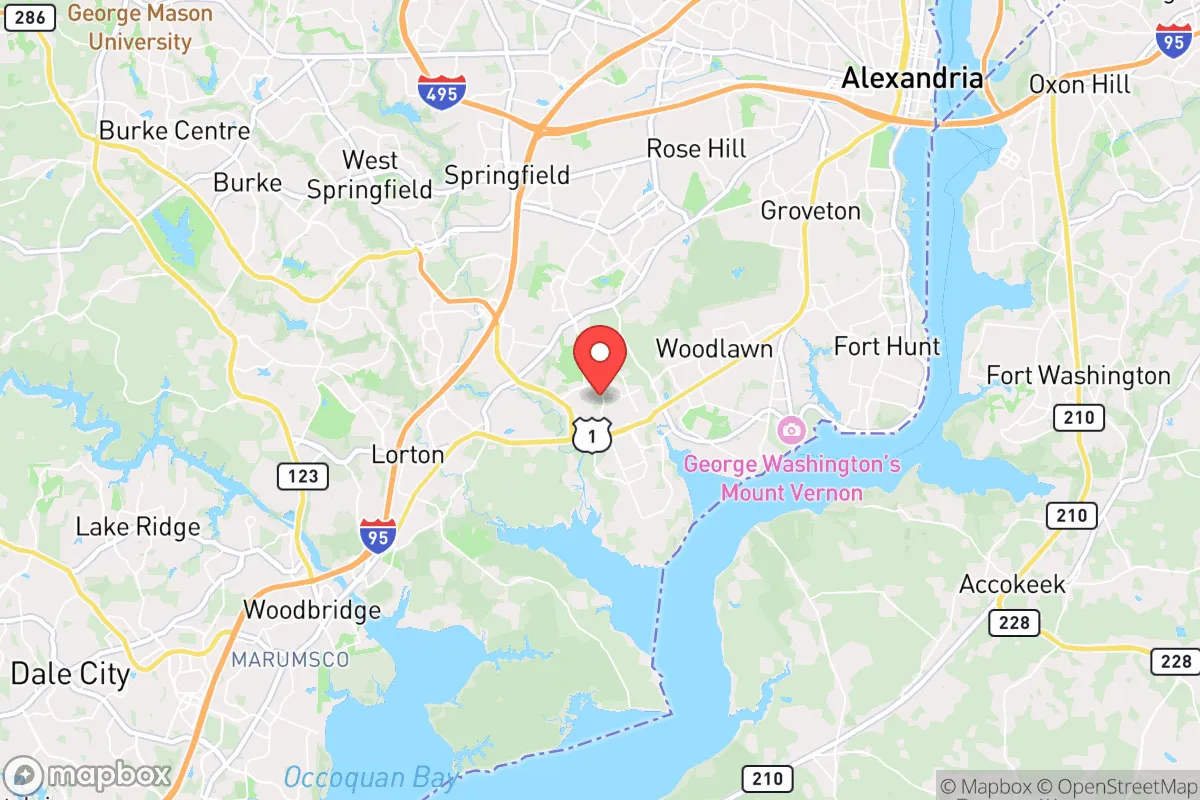
Photo: Wikipedia
Personal Sovereignty in Fort Belvoir, VA
Viable for self-reliance. Generally workable, though some barriers may limit total independence.
What does Personal Sovereignty tell us?
Personal Sovereignty measures your capacity for self-reliance and independence with minimal government friction. Higher scores mean fewer barriers between you and the way you want to live... but it assumes you have the space you need and good neighbors.
What does this tell us?
Personal Sovereignty measures your capacity for self-reliance and independence with minimal government friction. Higher scores mean fewer barriers between you and the way you want to live... but it assumes you have the space you need and good neighbors.
State Policy
Energy independence: Importer (20% of energy produced in-state)
Personal Liberty
Homesteading

Personal Liberty Analysis
Fort Belvoir, Virginia, presents a complex personal sovereignty landscape shaped by its unique status as a major Army installation and its location within Fairfax County, a jurisdiction with some of the most assertive regulatory and tax policies in the state. While the base itself operates under federal jurisdiction, the daily lives of residents—whether military, civilian employees, or contractors—are heavily influenced by Virginia state law and the dense, highly regulated environment of Northern Virginia. For a single individual or family prioritizing personal freedom, the area offers strong protections in self-defense law and parental rights at the state level, but imposes a comparatively heavy tax burden and significant restrictions on property use and off-grid living that directly limit self-reliance.
Tax burden and regulatory posture in Fairfax County
Fairfax County’s tax and regulatory environment is among the most demanding in Virginia, directly impacting the financial autonomy of Fort Belvoir residents. The county levies a real property tax rate of $1.115 per $100 of assessed value (2025 rate), which, combined with the state’s income tax (top marginal rate of 5.75%), creates a substantial combined burden. Personal property tax on vehicles is also a factor, with Fairfax County assessing 100% of a vehicle’s value at a rate of $4.57 per $100, a cost that surprises many relocating from states without such taxes. The regulatory posture is similarly heavy: the county enforces strict zoning codes, building permits, and homeowner association (HOA) covenants that are pervasive in the area. Nearly all residential neighborhoods near Fort Belvoir are governed by HOAs or civic associations, which impose rules on everything from exterior paint colors to fence heights and even the types of vehicles that can be parked in driveways. For a reader seeking maximum autonomy, this means that even owning property in Fairfax County comes with a dense web of local rules that limit individual discretion. The county’s permitting process for home renovations or accessory structures is thorough and can be time-consuming, reflecting a jurisdiction that prioritizes uniformity and oversight over individual flexibility.
Self-defense and gun law specifics in Virginia
Virginia law provides a solid foundation for self-defense rights, but with notable limitations that affect Fort Belvoir residents. The state is a shall-issue jurisdiction for concealed handgun permits, meaning that if a resident meets the statutory requirements (including a background check and a certified firearms safety course), the county must issue the permit. Open carry of handguns is legal for anyone 18 or older who can legally possess a firearm, though local ordinances in Fairfax County do not restrict it further. However, the practical reality on and around Fort Belvoir is more restrictive. The base itself is a federal facility where carrying firearms is strictly prohibited without specific authorization, and the surrounding areas include numerous federal buildings, schools, and parks where carry is banned by law. Virginia also maintains a one-handgun-per-month purchase limit (with exceptions for concealed permit holders), and the state has a "red flag" law (Emergency Substantial Risk Order) that allows law enforcement to petition a court to temporarily seize firearms from an individual deemed a danger. For the self-defense-minded individual, the legal framework is permissive compared to states like Maryland or California, but the dense urban environment and federal restrictions mean that exercising those rights requires careful awareness of location-specific prohibitions. Stand-your-ground laws do not exist in Virginia; the state follows a duty-to-retreat standard outside the home, which is a meaningful constraint for those who prioritize defensive autonomy.
Self-reliance and homesteading viability: lot sizes, zoning, and off-grid feasibility
Homesteading and off-grid living are effectively non-viable within the Fort Belvoir area due to Fairfax County’s zoning and building codes. The typical residential lot in neighborhoods near the base ranges from 0.1 to 0.25 acres, with most homes built on slabs or with basements in dense subdivisions. Agricultural zoning is virtually nonexistent in this part of the county; the land use is overwhelmingly suburban residential, with minimum lot sizes of 10,000 to 20,000 square feet in the few remaining older neighborhoods. Raising livestock—even chickens—is subject to strict regulations: Fairfax County allows up to four hens (no roosters) on lots of at least 10,000 square feet, but only with a permit and adherence to setback requirements. Beekeeping is similarly regulated. Off-grid systems like solar panels are permitted but must comply with the Virginia Uniform Statewide Building Code and local HOA covenants, which often restrict visible panel placement. Rainwater collection is legal in Virginia (since 2013), but Fairfax County requires a permit for systems over 1,000 gallons, and the county’s water authority maintains strict backflow prevention standards. For a family seeking genuine self-reliance—growing food, generating power, or living without municipal utilities—this area is fundamentally incompatible with that goal. The regulatory environment is designed for a connected, suburban lifestyle, and any deviation requires navigating a permitting process that discourages experimentation.
Personal liberties: parental rights, medical autonomy, speech, and property
Virginia offers strong protections for parental rights and free speech, but medical autonomy and property rights face notable constraints. The state’s Code of Virginia explicitly recognizes parental rights as fundamental, including the right to direct a child’s education, upbringing, and medical care. Virginia is a "parental consent" state for minors seeking abortions, and parents have broad authority to opt their children out of public school curricula they find objectionable. Homeschooling is legal and relatively straightforward, requiring only a notice of intent and either a bachelor’s degree, a state-approved curriculum, or a description of the program. Medical autonomy is more mixed: Virginia does not have a broad religious exemption for vaccine mandates in public schools (only medical and religious exemptions are recognized, and the religious exemption has been narrowed in recent years), and the state maintains a prescription drug monitoring program. For property rights, the combination of HOA covenants and county zoning means that what you can do with your land is heavily circumscribed. Free speech is protected under both the U.S. and Virginia Constitutions, and Fairfax County does not have unusual restrictions on signage or public expression beyond standard noise and time-place-manner ordinances. For the reader who values these liberties, the state-level framework is generally favorable, but local implementation in Fairfax County tends toward the restrictive end of the spectrum, particularly on property and medical decisions.
Overall, personal sovereignty in Fort Belvoir is a study in contrasts: strong state-level protections for self-defense and parental rights exist alongside a dense local regulatory environment that limits property autonomy and imposes a high tax burden. For a single individual or family who values independence, this area offers a solid legal foundation for personal liberties but requires accepting significant constraints on self-reliance and financial freedom. Compared to rural Virginia counties like Fauquier or Culpeper, where lot sizes are larger, zoning is lighter, and taxes are lower, Fort Belvoir’s environment is decidedly more managed. For those who prioritize the ability to make unencumbered decisions about their property, income, and daily life, the trade-offs here are substantial and worth weighing carefully against the area’s employment and community benefits.

* Values derived from national, state, county, city and local statistics and may differ in a specific area. Last updated: 2026-08-25T00:25:02.000Z
Narrative content on this page is AI-generated and may contain mistakes. Verify any details that matter before acting on them.
ReloMaps may earn a commission from affiliate links at no extra cost to you.

