
Photo: Wikipedia
Political ClimatePolitical Climate in Fort Belvoir, VA
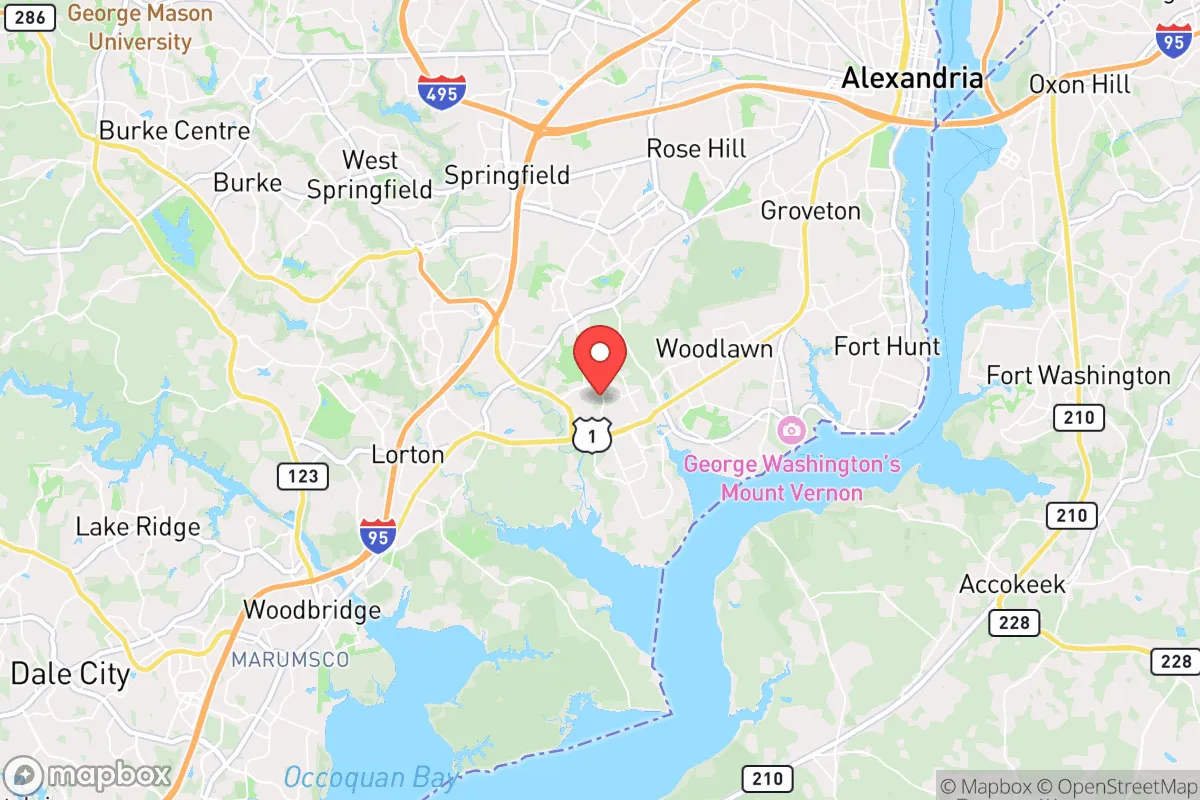
District shown is the primary district for this city’s centroid. Cities may span multiple districts.
Local Political AnalysisPolitical Analysis of Fort Belvoir, VA
Fort Belvoir leans heavily Democratic, with a Cook PVI of D+26 that places it among the most liberal enclaves in Virginia. This isn't a recent shift—the base and its surrounding communities have been reliably blue for decades, driven by a population of federal employees, active-duty military families, and defense contractors who tend to favor progressive policies on social issues and government spending. The trajectory here is steady: if anything, the area has become more Democratic over the past two cycles, mirroring the broader trend in Northern Virginia as younger, college-educated transplants move in for jobs at the Pentagon, Fort Belvoir itself, and nearby agencies like the CIA and DHS.
How it compares
To understand how deep blue Fort Belvoir is, look at the contrast with Virginia as a whole, which has a Cook PVI of D+4—still Democratic-leaning, but far more competitive. The state overall is a purple-to-light-blue battleground where races for governor and Senate are often decided by single digits. Fort Belvoir, by contrast, is a Democratic stronghold where Republican candidates rarely crack 35% in local elections. Drive 30 minutes west to Prince William County’s exurbs like Haymarket or Gainesville, and you’ll find a different world: those areas lean Republican, with voters more focused on taxes, school choice, and Second Amendment rights. Even closer, the city of Alexandria to the north is similarly blue (D+30), but the rural stretch south toward Fredericksburg flips red quickly. The political divide here isn’t just urban vs. rural—it’s a microcosm of the national split, with Fort Belvoir sitting squarely in the deep-blue corner.
What this means for residents
For liberal residents, the political climate feels natural and affirming. Local elections are rarely contested in a meaningful way, so Democratic primaries are where the real decisions get made. You’ll find strong support for public transit expansions (like the Silver Line extension), affordable housing initiatives, and environmental regulations. Conservative residents, however, aren’t silenced—they’re just outnumbered. Many military families lean moderate or conservative on national security and fiscal issues, but they adapt by focusing on local quality-of-life concerns like school funding and base infrastructure, where bipartisan cooperation is common. The practical reality is that a Republican voter here won’t face hostility, but they’ll rarely see their preferred candidates win. Socially, the area is tolerant and diverse, with a large active-duty and veteran population that tends to keep political conversations respectful, even when opinions diverge.
Culturally, Fort Belvoir stands apart from much of Virginia due to its transient, mission-driven population. Unlike the rest of the state, where local identity is tied to centuries of history (think Richmond’s Civil War legacy or the Shenandoah Valley’s agricultural roots), life here revolves around federal service. Policy debates often center on defense spending, veteran benefits, and federal workforce protections—issues that feel abstract in other parts of Virginia but are daily realities here. The result is a community that’s politically engaged but not polarized in the way you’d see in a swing district. Whether you lean left or right, you’ll find neighbors who care more about national security and public service than culture-war flashpoints, making Fort Belvoir a rare pocket of pragmatic blue in a state that’s still figuring out its political identity.

State Political ClimatePolitical Climate in Virginia
State Political AnalysisPolitical Environment in the State
Virginia has shifted from a reliably conservative-leaning swing state to a solidly Democratic-leaning one over the past two decades, currently holding a Cook PVI of D+4. The transformation is driven almost entirely by explosive growth in the Washington, D.C. suburbs, which now overwhelm the state’s historically conservative rural and exurban regions. For a relocator, this means you’re moving into a state with two distinct political realities: the densely populated, blue-leaning urban crescent from Northern Virginia down through Richmond to Hampton Roads, and the redder, slower-growing rest of the state.
Urban vs. rural divide
The political map of Virginia is a story of two Virginias. The urban crescent — anchored by Arlington, Alexandria, and Fairfax County in Northern Virginia, plus Richmond and Norfolk/Virginia Beach — generates the vast majority of the state’s Democratic votes. Fairfax County alone, with over 1.1 million residents, delivers a net Democratic margin of roughly 200,000 votes per election, enough to offset the entire rest of the state’s rural Republican advantage. Meanwhile, the rural south and southwest — places like Roanoke, Lynchburg, and the Shenandoah Valley — remain deeply conservative. A notable recent flip: Loudoun County, once a Republican stronghold, went from voting for Mitt Romney in 2012 to Joe Biden by 25 points in 2020, driven by an influx of D.C.-area professionals. The divide isn’t just partisan; it’s cultural and economic, with the urban crescent tied to the federal government and tech, while rural areas rely more on agriculture, manufacturing, and military bases.
Policy environment
Virginia’s policy environment is a patchwork that reflects its split personality. The state has a flat income tax rate of 5.75% and a sales tax of 5.3% (higher in some localities), which is moderate by national standards. Property taxes are set locally and vary widely — Arlington’s effective rate is around 1.1%, while rural counties like Grayson County are closer to 0.5%. Education policy is decentralized, with the state setting standards but localities controlling funding; Northern Virginia schools are among the nation’s best, while rural districts often struggle with underfunding. Healthcare is a mixed bag: Virginia expanded Medicaid under the Affordable Care Act in 2018, a move that was controversial at the time but is now largely accepted. Election laws are relatively accessible — no-excuse absentee voting and same-day registration are available — but the state does require a photo ID to vote. Gun laws are moderate: the state requires a background check for all firearm sales (including private sales) and has a “red flag” law, but it’s a “shall issue” state for concealed carry permits. There is no permit required to open carry.
Recent policy direction
Over the past five years, Virginia has moved decisively left on several fronts, though the pace has moderated since Democrats lost the governor’s mansion in 2021. In 2020, the Democratic-controlled legislature passed a sweeping package of gun control measures, including the red flag law, a one-handgun-per-month limit, and a ban on assault weapons for those under 21. On education, the state eliminated the Standards of Learning (SOL) graduation requirement in 2022, a move that pleased progressives but alarmed conservatives who saw it as lowering standards. Parental rights became a flashpoint in 2022-2023, with Governor Glenn Youngkin (R) pushing a “Parents’ Bill of Rights” that requires schools to notify parents about instructional materials involving sexuality and to allow parents to opt their children out of such content. On abortion, Virginia remains an outlier in the South: it allows abortion up to 26 weeks, with no waiting period or mandatory counseling, and it’s one of the few Southern states that hasn’t tightened restrictions post-Dobbs. On property rights, the state has no statewide rent control, but localities can impose it — Arlington and Alexandria have considered it. On voting, the state has expanded access: no-excuse absentee voting, same-day registration, and automatic voter registration at the DMV. On privacy and surveillance, Virginia passed the Consumer Data Protection Act in 2021, one of the strongest state-level privacy laws in the country, giving residents the right to access, correct, and delete personal data held by companies.
Civil unrest & political movements
Virginia has been a stage for some of the most visible political flashpoints in the country. The 2017 “Unite the Right” rally in Charlottesville — which turned violent and left one counter-protester dead — remains a defining scar, and the city’s decision to remove a Robert E. Lee statue sparked years of legal battles and protests. More recently, the 2020-2021 protests over police brutality were particularly intense in Richmond, where protesters toppled a statue of Jefferson Davis and the city’s monument avenue became a nightly battleground. On the right, the “Parents Matter” movement, which mobilized around school curriculum and library books, has been especially strong in Loudoun County and Virginia Beach, leading to heated school board meetings and recall efforts. Immigration politics are less volatile than in border states, but Prince William County has seen tensions over its “sanctuary” policies, which limit local police cooperation with federal immigration enforcement. Election integrity remains a live issue: after the 2020 election, Trump supporters held rallies at the state capitol in Richmond, and the state’s voter roll maintenance has been challenged in court. A new resident in Northern Virginia will notice the ubiquity of political yard signs and bumper stickers, while in rural areas, the politics are more quietly embedded in church and community life.
Projection
Over the next 5-10 years, Virginia’s political trajectory is likely to continue its slow leftward drift, but with a ceiling. The D.C. suburbs are still growing — Loudoun County added over 40,000 residents between 2020 and 2024 — and these new arrivals tend to be younger, more diverse, and more Democratic. However, the state’s rural areas are also seeing in-migration from retirees and remote workers fleeing higher-cost states, many of whom lean conservative. The wild card is the 2030 census and redistricting: if population growth in Northern Virginia continues to outpace the rest of the state, the political map will shift further blue. But the state’s constitutional structure — with a strong governor and a part-time legislature — means that policy swings will remain moderate. A conservative relocator can expect to live in a state where their vote for president or Senate will likely be outmatched, but where local elections in many counties and cities remain competitive. A liberal relocator will find a state that is broadly aligned with their views on social issues but where fiscal conservatism still has a strong voice, especially at the local level.
For a new resident, the bottom line is that Virginia offers a genuine choice in lifestyle and politics depending on where you land. If you move to Arlington or Richmond, you’ll be in a blue bubble with high taxes, excellent schools, and progressive policies. If you settle in Roanoke or the Shenandoah Valley, you’ll find a more conservative, lower-cost environment with a slower pace. The state’s political climate is not monolithic, and your experience will be shaped more by your county than by the state as a whole. The key practical takeaway: research your specific locality’s tax rates, school board politics, and zoning laws before you move, because in Virginia, the real action is at the local level.
* Values derived from national, state, county, city and local statistics and may differ in a specific area. Last updated: 2026-08-25T00:25:02.000Z
Narrative content on this page is AI-generated and may contain mistakes. Verify any details that matter before acting on them.
ReloMaps may earn a commission from affiliate links at no extra cost to you.

