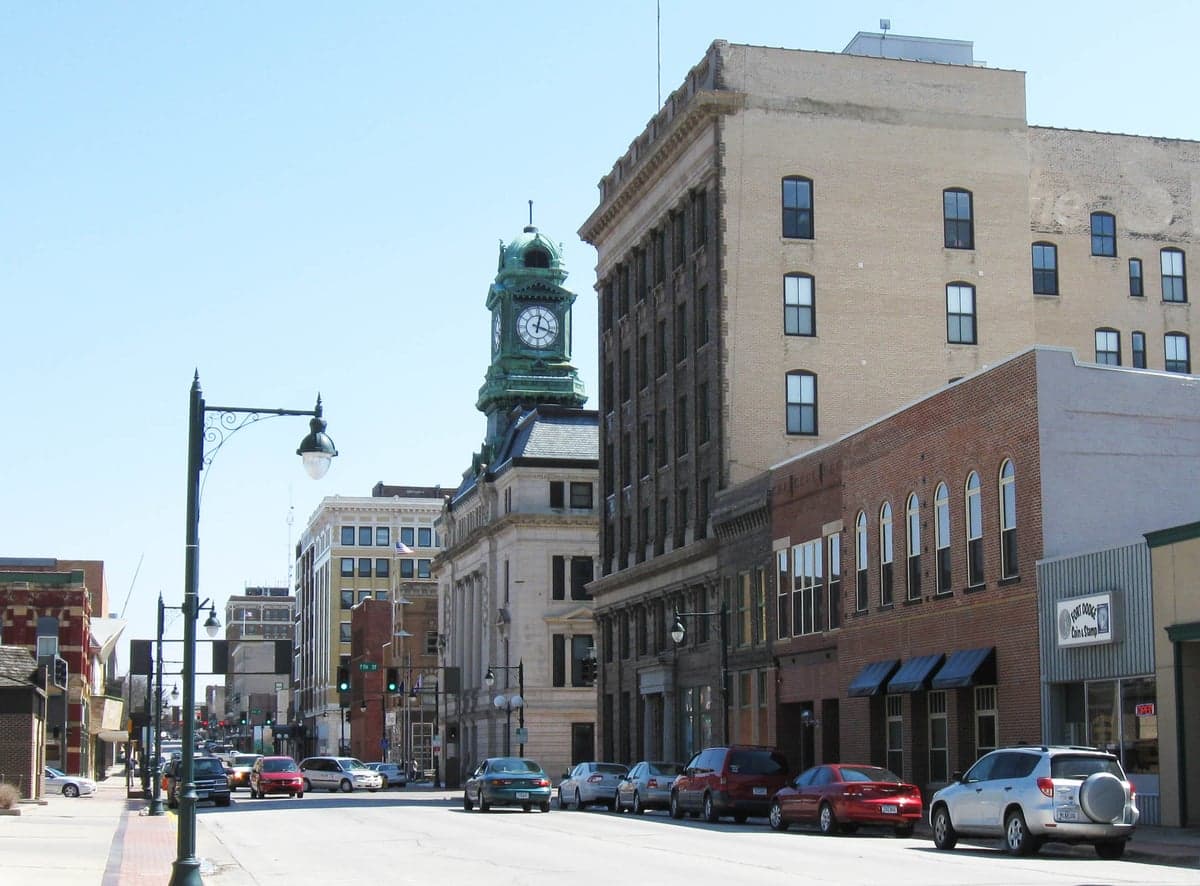
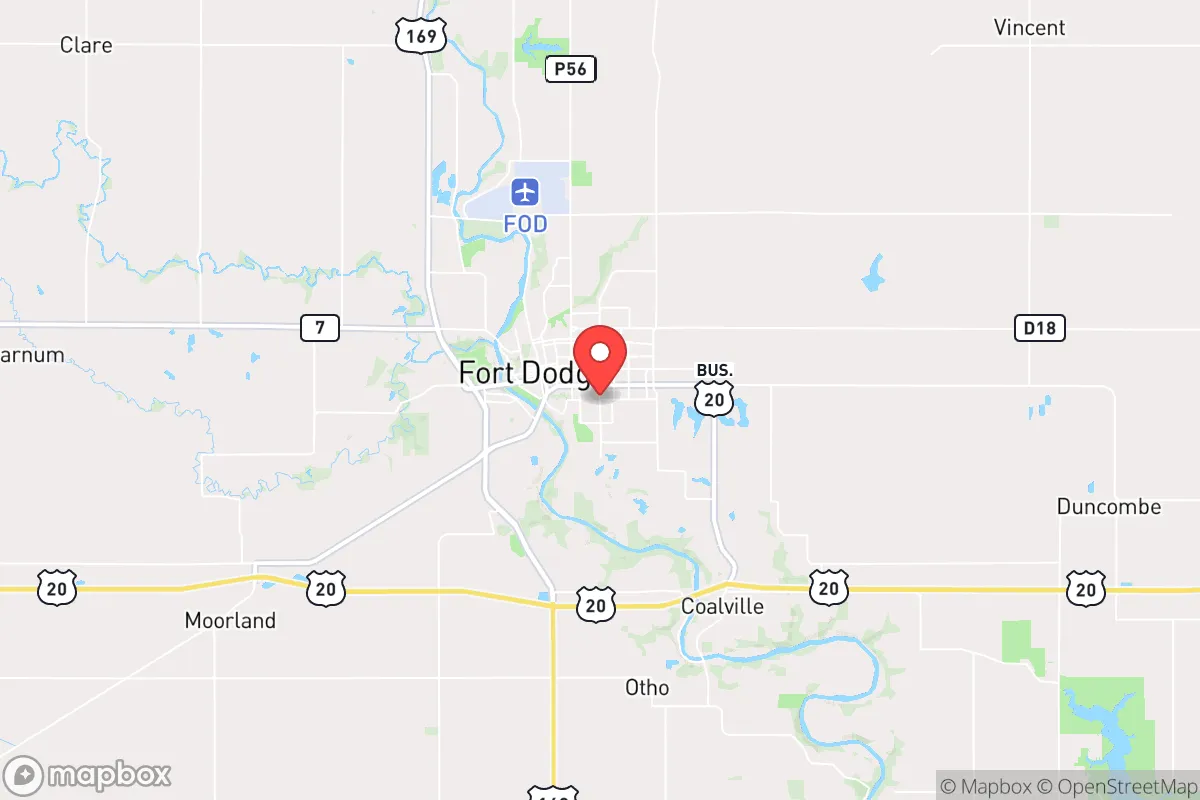
Photo: Wikipedia
Demographics of Fort Dodge, IA
Affluence Level in Fort Dodge, IA
A below-average socioeconomic profile. Incomes, home values, and educational attainment trail the U.S., with higher poverty and unemployment.
People of Fort Dodge, IA
The people of Fort Dodge, Iowa, today number 24,788, forming a predominantly white (80.9%) community with a modest but growing Hispanic presence (7.8%) and smaller Black (4.5%) and East/Southeast Asian (1.6%) populations. The city’s character is rooted in its industrial and agricultural heritage, with a blue-collar, family-oriented identity that leans conservative. With only 3.8% foreign-born residents and a college attainment rate of 20.1%, Fort Dodge remains a relatively homogeneous, working-class hub in north-central Iowa, distinct from the state’s more diverse and educated metro areas like Des Moines or Iowa City.
How the city was settled and grew
Fort Dodge’s human history begins with the U.S. Army establishing Fort Clarke in 1850 to protect settlers moving into land ceded by the Sioux. The fort was renamed Fort Dodge in 1851, and the surrounding settlement grew rapidly after the discovery of gypsum deposits in the 1860s. The first major wave of settlers were Anglo-American farmers and merchants from the eastern U.S., drawn by land grants and the promise of fertile soil. By the 1870s, the arrival of the Illinois Central Railroad turned Fort Dodge into a regional shipping hub for grain and livestock. The gypsum industry—still a major employer today—attracted a second wave of European immigrants, primarily German and Irish laborers, who built homes in the Oak Hill and West Central neighborhoods. These areas, with their modest frame houses and proximity to the rail yards and plaster mills, became the city’s working-class backbone. A smaller wave of Danish and Swedish immigrants settled near the railroad corridor in the North Side district, contributing to the city’s Lutheran church presence. By 1900, Fort Dodge was a thriving industrial town of roughly 12,000, almost entirely native-born white or northern European stock.
Modern era (post-1965)
The post-1965 period brought modest demographic shifts. The 1965 Immigration Act did not dramatically alter Fort Dodge’s composition—foreign-born share remains low at 3.8%—but domestic migration patterns did. The city’s manufacturing base, anchored by Georgia-Pacific and the Fort Dodge Animal Health plant, attracted a small influx of Black workers from Chicago and other Midwestern cities during the 1970s and 1980s. These families concentrated in the Midtown area, near the industrial corridor along 5th Avenue South. The Hispanic population began growing in the 1990s, driven by meatpacking and agricultural jobs. Today, the Hispanic share stands at 7.8%, with many families settling in the South Side neighborhoods around the Iowa Central Community College campus and the Hormel Foods plant. East/Southeast Asian residents (1.6%) are a smaller, more recent addition, largely Vietnamese and Filipino families who arrived in the 2000s for work in healthcare and manufacturing; they are scattered across the city but have a slight concentration in the Crossroads area near the hospital. The Indian subcontinent population is effectively zero (0.0%), reflecting the city’s lack of tech or professional-service sectors that typically draw that group. Suburbanization within Fort Dodge has been limited—the city’s boundaries are largely built out—but newer subdivisions like Lakeside on the northwest edge have attracted middle-class white families seeking newer homes, while older core neighborhoods like Oak Hill have seen population decline and aging housing stock.
The future
Fort Dodge’s population is heading toward gradual diversification, but at a slower pace than Iowa’s larger cities. The Hispanic share is projected to rise to 10-12% by 2035, driven by family reunification and continued employment in food processing and construction. The white population, while still dominant, is aging and declining slightly as younger adults leave for college and jobs in Des Moines or Minneapolis. The Black and East/Southeast Asian populations are likely to remain stable or grow marginally, as the city lacks the economic pull to attract large new waves. The city is not tribalizing into distinct ethnic enclaves—neighborhoods remain largely integrated by income rather than ethnicity—but the South Side is becoming informally recognized as a Hispanic-majority area. The foreign-born share may inch up to 5% but will stay well below the national average. The biggest demographic story is not immigration but domestic out-migration: Fort Dodge is losing young adults, which will keep its population flat or slightly declining over the next decade.
For someone moving in now, Fort Dodge is a stable, affordable, and culturally traditional community where change comes slowly. It offers a low-cost, low-crime environment for families, but those seeking ethnic diversity or a rapidly growing economy will find it limited. The city’s future is one of modest Hispanic growth and white aging, with little prospect of the kind of cosmopolitan transformation seen in Des Moines or Cedar Rapids.

* Values derived from national, state, county, city and local statistics and may differ in a specific area. Last updated: 2026-04-19T09:24:08.000Z
Narrative content on this page is AI-generated and may contain mistakes. Verify any details that matter before acting on them.
ReloMaps may earn a commission from affiliate links at no extra cost to you.

