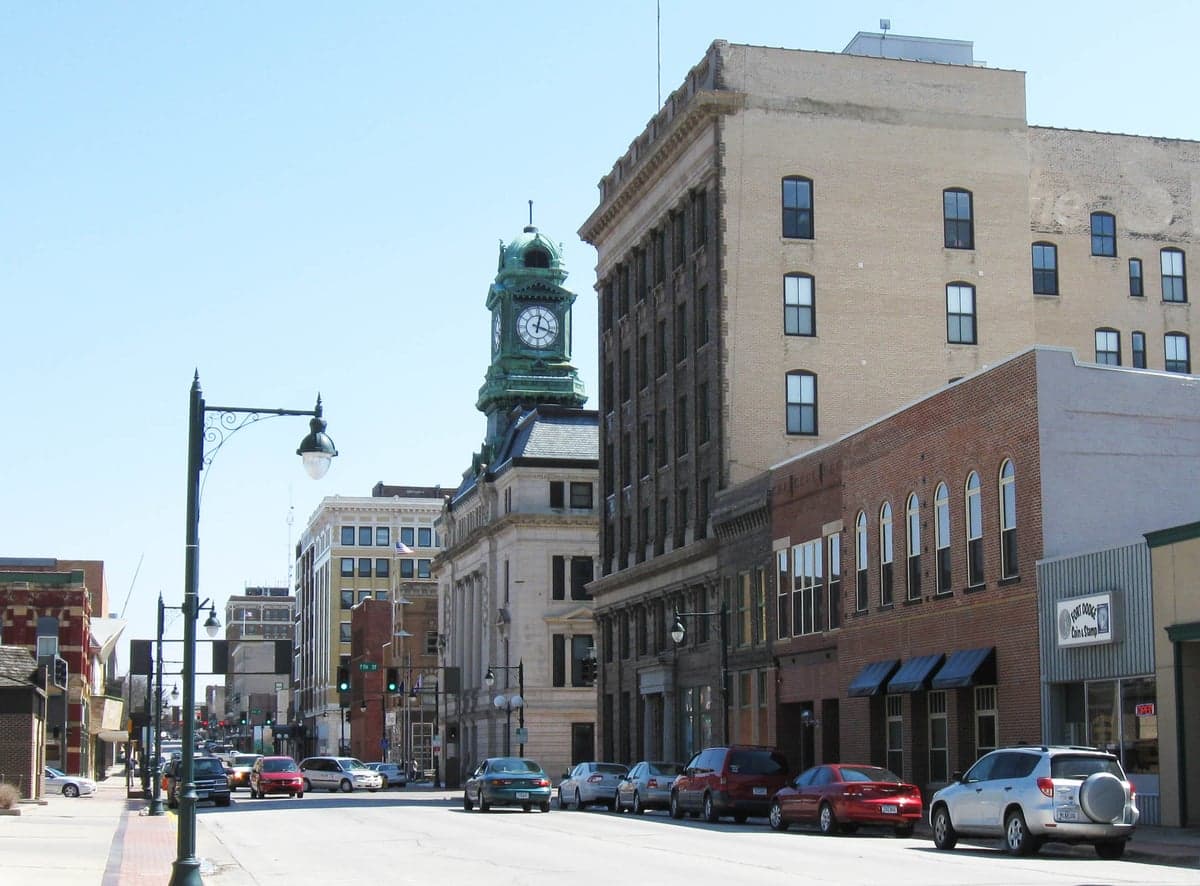
Photo: Wikipedia
Quality of Life in Fort Dodge, IA
A high quality of life with strong walkability, manageable living costs, healthy neighborhood signals, and solid amenity access.
What does Quality of Life tell us?
Quality of Life blends cost of living, nearby amenities, socioeconomic signals, and neighborhood character. City-level scores represent the whole municipality; individual neighborhoods can differ.
What does this tell us?
Quality of Life blends cost of living, nearby amenities, socioeconomic signals, and neighborhood character. City-level scores represent the whole municipality; individual neighborhoods can differ.
Cost of Living
42% below national average
The Real Cost of Living in Fort Dodge, IA for 2026
| Tier | Individual | Family (4) |
|---|---|---|
| Survival | $12k | $23k |
| Comfortable | $25k | $37k |
| Luxury | $101k+ | $156k+ |
| Elite (Top 5%) | $119k+ | $184k+ |
168%
The Area Signal
A metric tracking the socioeconomic signals of the area.


Hobbies
Explore the areaGroceries
3 within 10 miles
Gas
0 within 10 miles
Hospital
3 within 20 miles
Airport
MCI — Kansas City International
Post Office
USPS — Humboldt, IA
Critical Amenities
Quality-of-Life Analysis
Fort Dodge, Iowa, offers a notably low cost of living that attracts a mix of working-class families, retirees, and young professionals seeking affordability without sacrificing access to essential services. With a cost-of-living index of 58—42 percent below the national average—the area stands out as one of the most budget-friendly communities in north-central Iowa. The population skews slightly older than the state median, reflecting a stable, long-term resident base, though recent years have seen an influx of workers drawn to the region’s manufacturing and healthcare sectors.
How housing costs and everyday expenses compare to nearby cities
Housing in Fort Dodge is dramatically cheaper than in larger Iowa metros like Des Moines or Ames. The median home value sits at $128,900, roughly half the statewide median of $260,000, while the median rent of $764 is about 30 percent lower than the national average. This affordability extends to utilities, groceries, and transportation—gas prices and car insurance rates consistently rank below state averages. The average commute of 17.9 minutes is shorter than both the Iowa average (19.5 minutes) and the national average (26.4 minutes), reducing daily transportation costs and freeing up time for residents. Compared to nearby Webster City or Humboldt, Fort Dodge offers more rental options and a wider range of home prices, making it a practical choice for first-time buyers and downsizers alike.
What daily life is like for families: schools, parks, and local amenities
Fort Dodge’s daily rhythm centers on a compact downtown with a mix of local restaurants, retail, and community events like the annual Frontier Days festival. The Fort Dodge Community School District operates seven elementary schools, two middle schools, and Fort Dodge Senior High, with a student-teacher ratio of roughly 15:1. For higher education, Iowa Central Community College provides associate degrees and workforce training programs that feed directly into local employers like Fort Dodge Correctional Facility and Decker Truck Line. Outdoor recreation is anchored by the 1,200-acre Brushy Creek State Recreation Area, 15 minutes south, offering hiking, fishing, and camping. The city also maintains over 20 public parks, including the 80-acre Oleson Park with its swimming pool and sports fields. Healthcare access is solid, with UnityPoint Health – Fort Dodge and a network of clinics serving the region.
This combination of low costs, short commutes, and adequate amenities makes Fort Dodge a strong fit for budget-conscious families, remote workers, and retirees who prioritize financial breathing room over urban excitement. The trade-off is a slower pace and fewer entertainment options than larger cities, but for those who value affordability, community stability, and access to outdoor recreation, the area delivers a practical, low-stress quality of life.

Crime in Fort Dodge, IA
Higher crime rates than 63% of comparable U.S. locations.
Violent CrimeViolent Crime Analysis
Property CrimeProperty Crime Analysis
Crime Analysis
Fort Dodge, Iowa, reports a violent crime rate of 932 incidents per 100,000 residents and a property crime rate of 2,820.2 per 100,000, placing it among the higher-crime communities in the state. These figures, drawn from the most recent FBI Uniform Crime Reporting data, indicate that safety conditions in this north-central Iowa city warrant careful consideration for anyone evaluating relocation. The city's crime profile is shaped by a combination of socioeconomic factors and local justice system policies that directly affect public safety outcomes.
Crime in context
Fort Dodge's violent crime rate is roughly 2.5 times the national average and significantly exceeds the Iowa state average of approximately 280 per 100,000. Property crime in Fort Dodge also runs well above state norms, with the city's rate nearly double the Iowa average of about 1,500 per 100,000. When compared to similar-sized Iowa communities like Mason City (violent crime ~400 per 100K) or Storm Lake (~350 per 100K), Fort Dodge stands out as an outlier. The city's location in Webster County, which has a history of progressive judicial appointments and district attorney policies emphasizing diversion and reduced incarceration, contributes to a legal environment where repeat offenders face limited consequences. This approach, while intended to reduce recidivism, often results in more criminals remaining on the street, directly undermining victim safety and public confidence in the justice system.
What residents experience
Residents report that property crimes—particularly burglary, theft from vehicles, and vandalism—are the most common daily concerns. The city's property crime rate of 2,820.2 per 100,000 translates to roughly one property crime every 3.5 hours across the city's population of about 25,000. Violent offenses, while less frequent, include aggravated assault, robbery, and occasional incidents involving weapons. Local news outlets regularly cover cases where individuals arrested for violent crimes are released on minimal bond or given deferred judgments, a pattern consistent with the progressive prosecutorial philosophy in the region. This cycle erodes trust in law enforcement and leaves many residents feeling that the system prioritizes offender rehabilitation over public protection.
Neighborhood-level variation
Safety conditions are not uniform across Fort Dodge. The southwest and northwest quadrants, particularly areas near the Crossroads Mall and along 5th Avenue South, see higher concentrations of property crime and drug-related activity. The historic residential districts east of the Des Moines River, including the Oak Hill and Country Club neighborhoods, report lower crime rates and stronger neighborhood watch participation. The area immediately surrounding Iowa Central Community College benefits from campus security patrols and generally experiences fewer incidents. Prospective residents should examine block-level crime maps and consult with the Fort Dodge Police Department's community liaison office to identify specific street-level risks. Choosing a home in the city's lower-crime pockets can substantially reduce exposure to the broader safety challenges that define Fort Dodge's current environment.
* Values derived from national, state, county, city and local statistics and may differ in a specific area. Last updated: 2026-04-19T09:24:08.000Z
Narrative content on this page is AI-generated and may contain mistakes. Verify any details that matter before acting on them.
ReloMaps may earn a commission from affiliate links at no extra cost to you.

