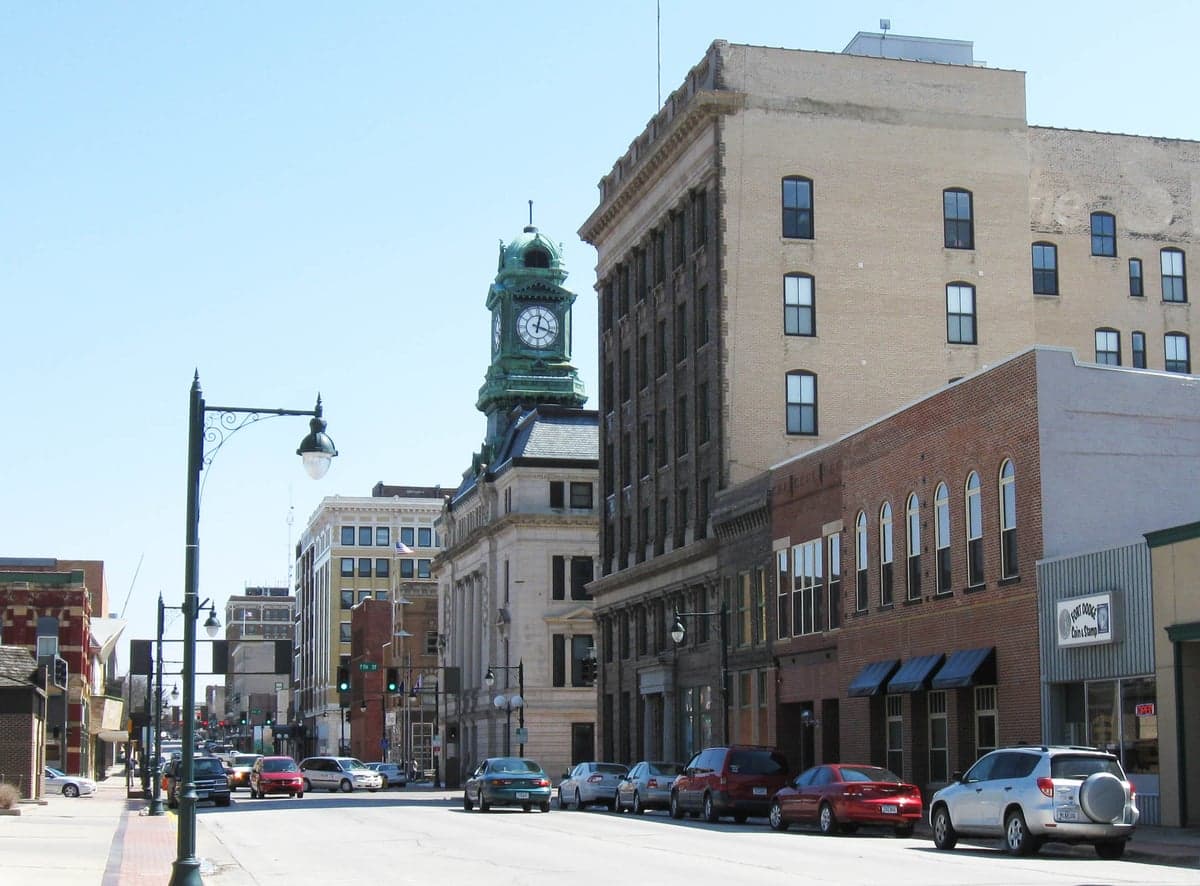
Photo: Wikipedia
Political ClimatePolitical Climate in Fort Dodge, IA
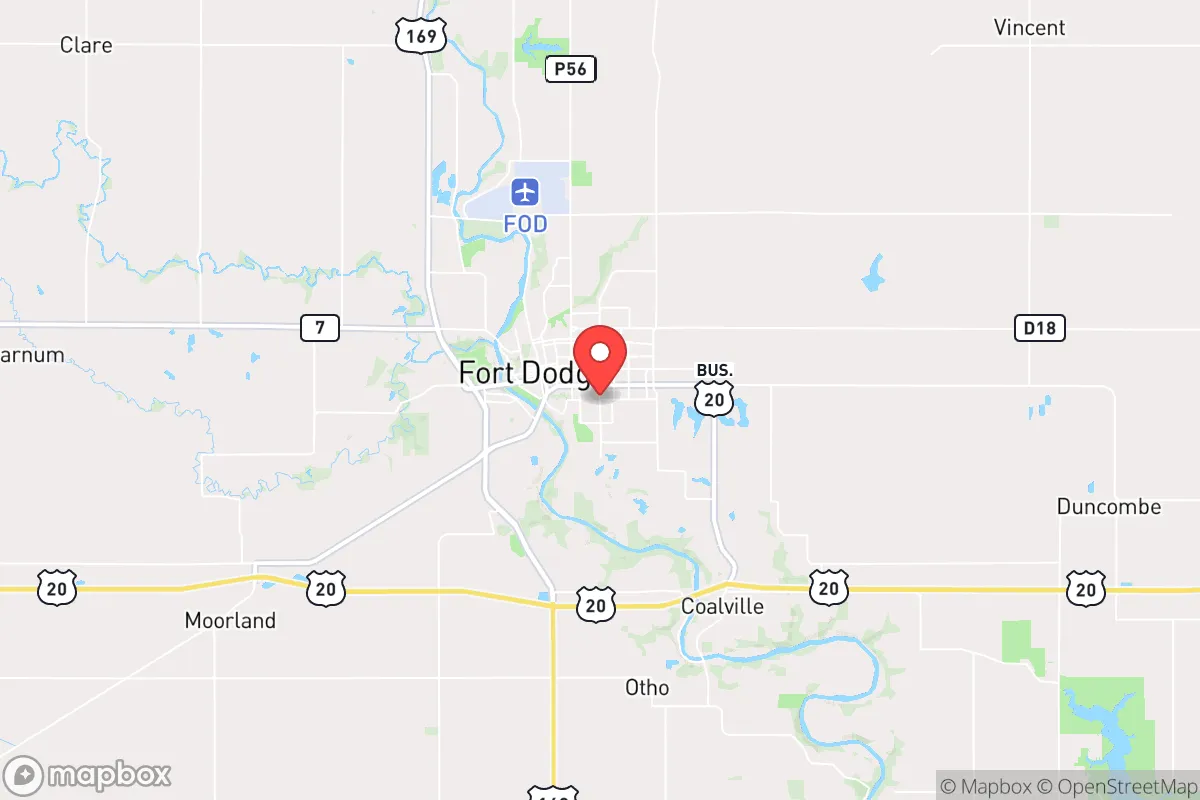
District shown is the primary district for this city’s centroid. Cities may span multiple districts.
Local Political AnalysisPolitical Analysis of Fort Dodge, IA
Fort Dodge sits in Webster County, which has been a reliably conservative stronghold for decades, with a Cook PVI of R+15 that puts it well to the right of the national average. If you’ve lived here as long as I have, you remember when the town was even more unified in its values—folks didn’t think twice about personal responsibility, hard work, and keeping government out of your backyard. Lately, though, you can feel the winds shifting, especially as younger families move in from Des Moines or Ames, bringing with them a more progressive outlook that doesn’t always sit well with the old guard. The local elections have gotten tighter, and while the county still votes red by a comfortable margin, the trajectory is something to keep an eye on if you value limited government and local control.
How it compares
Compared to the surrounding towns, Fort Dodge is actually a bit of a moderate island in a sea of deep red. Head east to Webster City or south to Boone, and you’ll find even stronger conservative majorities—places where the idea of a tax hike or new regulation is dead on arrival. But drive an hour southeast to Ames, home of Iowa State University, and you’re in a completely different world: a progressive bubble where government programs and social engineering are embraced. Fort Dodge sits right in the middle, and that’s where the tension comes from. The city council has seen a few more progressive voices in recent years, pushing for things like diversity initiatives and zoning changes that feel like overreach to many of us who just want to be left alone. It’s not a full-blown culture war yet, but the contrast with the rural towns around us is getting sharper.
What this means for residents
For the average resident, the political climate here means you still have a lot of freedom to live your life without too much interference—for now. Property taxes are reasonable compared to the bigger cities, and there’s no appetite for the kind of heavy-handed mandates you see in places like Des Moines or Iowa City. But the creeping influence of progressive ideology is real: you’ll see it in school board meetings where critical race theory or gender ideology gets debated, or in city hall discussions about “equity” programs that sound an awful lot like picking winners and losers. The local economy is still driven by agriculture and manufacturing, which keeps things grounded, but the cultural shift is something to watch. If you’re a conservative who values personal freedoms, you’ll find plenty of like-minded neighbors here, but you’ll also need to stay engaged to keep the government from overstepping.
One thing that sets Fort Dodge apart is its stubborn independence—there’s a long history here of people solving their own problems without waiting for a handout or a new regulation. The local gun culture is strong, with plenty of hunters and sport shooters, and the Second Amendment is still respected without much fuss. But the recent push for “safe storage” ordinances and mental health reporting requirements has raised eyebrows among those of us who see it as a slippery slope. The bottom line is that Fort Dodge is still a good place for someone who wants to live free, but you’ve got to be willing to speak up at town hall meetings and vote in every local election. The future depends on whether the old values of self-reliance and limited government can hold the line against the progressive tide that’s washing over so many other parts of Iowa.

State Political ClimatePolitical Climate in Iowa
State Political AnalysisPolitical Environment in the State
Iowa has been a reliably Republican state in presidential elections since 2016, but its political identity is more complex than a simple red-state label suggests. The state’s overall partisan lean has shifted rightward over the past decade, with Republicans now holding unified control of the governorship and both legislative chambers, but this masks a deep urban-rural split and a recent history of competitive statewide races. For a conservative considering relocation, Iowa offers a solidly conservative policy environment at the state level, but the political climate varies dramatically depending on where you land — from the deep-red rural counties to the increasingly progressive urban cores.
Urban vs. rural divide
The political map of Iowa is a textbook case of the urban-rural divide. The state’s two largest metros — Des Moines and Iowa City — are the primary engines of Democratic votes. Polk County (Des Moines) and Johnson County (Iowa City) consistently deliver double-digit margins for Democrats, with Johnson County often exceeding +30 points. These areas are home to the state’s largest universities, corporate headquarters, and a growing professional class. In contrast, the rest of the state is overwhelmingly Republican. Counties like Sioux, Plymouth, and Lyon in the northwest routinely vote +40 to +50 points Republican. The 2020 election saw Trump win Iowa by 8.3 points, but the map was stark: he won 93 of 99 counties. The six counties he lost were all urban or college towns — Polk, Johnson, Story (Ames), Black Hawk (Waterloo), Linn (Cedar Rapids), and Wapello (Ottumwa). Suburbs like Ankeny and Waukee in the Des Moines metro are politically mixed, trending slightly right but with a growing libertarian-leaning independent streak. For a conservative, the safest bet is any county outside the I-35/I-80 corridor, but even in the suburbs, the political culture is more pragmatic than ideological.
Policy environment
Iowa’s policy environment is a conservative’s dream in many respects. The state has a flat income tax rate of 3.8% (down from 8.98% in 2021) with a path to a flat 3.5% by 2026, and no inheritance tax. Property taxes are moderate, with a median effective rate of 1.4%. The regulatory posture is business-friendly, with right-to-work laws and no state-level minimum wage above the federal $7.25. Education policy has been a major battleground: in 2023, Governor Kim Reynolds signed a universal school choice bill (HF 68) allowing any family to use state funds for private school tuition, a major win for parental rights. Healthcare is mixed — Iowa expanded Medicaid under the Affordable Care Act, but the state has also pursued work requirements for able-bodied adults. Election laws tightened in 2021 with SF 413, which shortened early voting, required voter ID, and limited drop boxes. For a conservative, the policy trajectory is clearly in the right direction, though the Medicaid expansion remains a point of contention among limited-government advocates.
Trajectory & freedom
Iowa is becoming more free in several key areas, particularly fiscal and educational freedom. The 2023 tax reform package (HF 2317) accelerated income tax cuts and eliminated the inheritance tax entirely. On gun rights, Iowa became a permitless carry state in 2021 (HF 756), allowing any law-abiding adult to carry a concealed firearm without a permit. The state also passed a “Stand Your Ground” law in 2022 (SF 2369). On medical freedom, Iowa passed a ban on COVID-19 vaccine mandates for state employees and contractors in 2023 (HF 889), and a law prohibiting mask mandates in schools (HF 847). However, there are concerning trends. The state has not passed a full ban on vaccine mandates for private employers, and the governor’s emergency powers remain broad — a flashpoint during the pandemic. Property rights are generally strong, with no statewide rent control and a relatively low property tax burden, but local zoning in urban areas can be restrictive. The overall trajectory is positive for personal liberty, but vigilance is needed on emergency powers and local overreach.
Civil unrest & political movements
Iowa has seen relatively little civil unrest compared to coastal states, but there have been notable flashpoints. The 2020 Black Lives Matter protests in Des Moines and Iowa City were largely peaceful, but there were isolated incidents of property damage and clashes with police. The state’s immigration politics are relatively quiet — Iowa is not a border state, and sanctuary city policies are virtually nonexistent. However, the 2023 legislative session saw a bill (HF 648) that would allow state law enforcement to enforce federal immigration law, though it did not pass. Election integrity has been a hot topic: the 2020 election in Iowa was widely considered secure, but the 2021 election law changes (SF 413) were driven by concerns over ballot security. The most visible political movement in recent years has been the parental rights movement, which successfully pushed for the school choice bill and curriculum transparency laws. There is also a growing libertarian presence, particularly in rural areas, that pushes back on both parties on issues like property rights and drug policy. For a new resident, the political climate is generally calm, but the culture war over education and COVID mandates remains a live issue.
Projection
Over the next 5-10 years, Iowa is likely to become more Republican and more conservative, but with a growing libertarian and independent streak. The key demographic trend is the continued out-migration of young, college-educated voters from rural areas to Des Moines and Iowa City, which will deepen the urban-rural divide. However, the state is also seeing an influx of conservatives from Illinois, Minnesota, and California, drawn by lower taxes and a more freedom-friendly environment. This in-migration is concentrated in the suburbs of Des Moines and in smaller cities like Cedar Rapids and Council Bluffs. The Republican Party’s dominance is likely to continue, but internal tensions between establishment conservatives and the more populist, libertarian wing will grow. The biggest wild card is the state’s aging population — Iowa has one of the oldest median ages in the country, and younger voters tend to be more libertarian on social issues. If the state can retain its young people and attract more families, the political culture will remain center-right but with a stronger emphasis on individual liberty. If not, the urban areas will become more progressive, and the rural areas will become even more conservative, creating a more polarized state.
Bottom line for a new resident: If you’re a conservative looking for a state that respects your tax dollars, your gun rights, and your parental authority, Iowa is a strong choice. The state-level policy environment is clearly on your side, and the political culture outside the urban cores is welcoming. But don’t expect a monolithic red state — the Des Moines and Iowa City metros are increasingly progressive, and the culture war over education and COVID will continue. Choose your county carefully, and you’ll find a community that values freedom, hard work, and common sense. Just be prepared for cold winters and a political climate that, while conservative, is still shaped by the pragmatic, independent spirit of the Midwest.
* Values derived from national, state, county, city and local statistics and may differ in a specific area. Last updated: 2026-04-19T09:24:08.000Z
Narrative content on this page is AI-generated and may contain mistakes. Verify any details that matter before acting on them.
ReloMaps may earn a commission from affiliate links at no extra cost to you.

