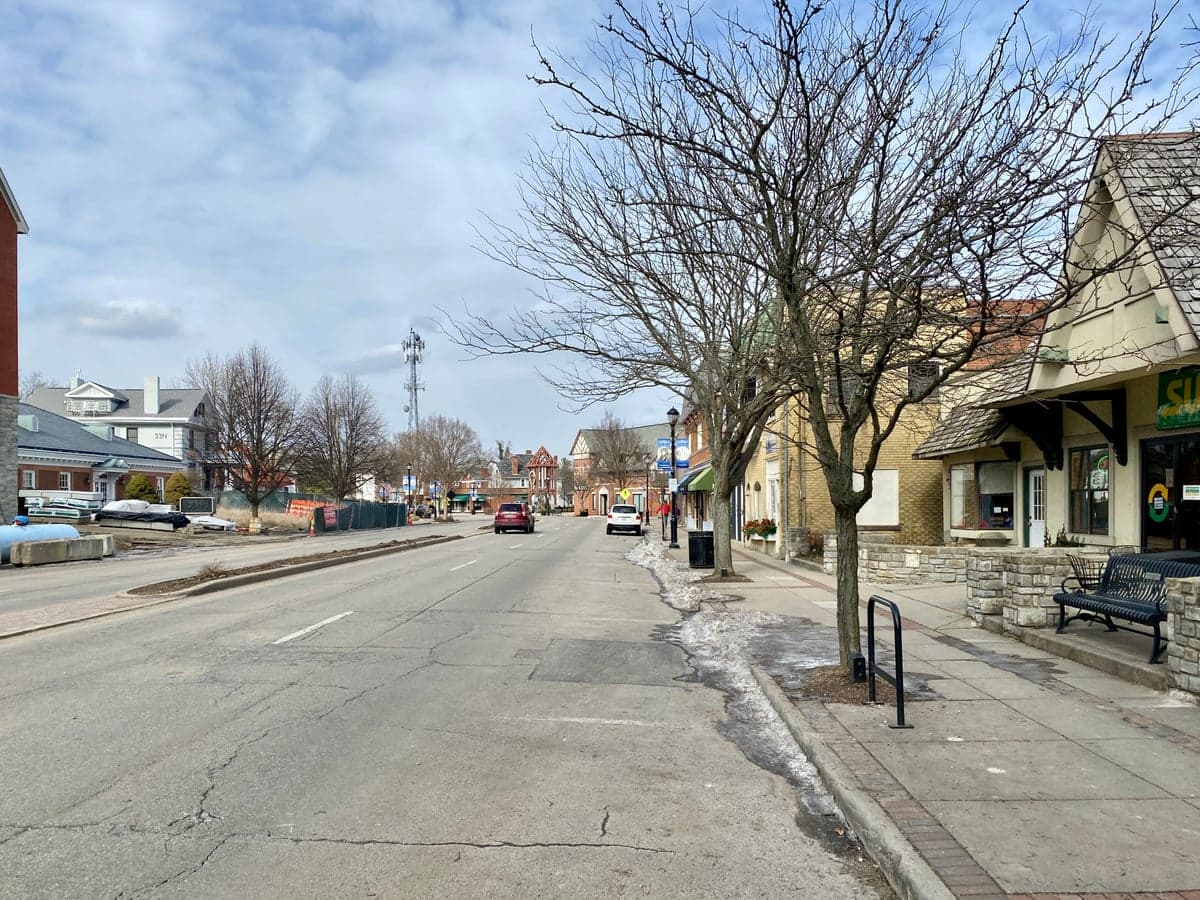
Photo: Wikipedia
Demographics of Fort Thomas, KY
Affluence Level in Fort Thomas, KY
An upper-middle-class area. Household wealth, education levels, and homeownership run ahead of national benchmarks.
People of Fort Thomas, KY
The people of Fort Thomas, Kentucky, today number 17,242 and form one of the most stable, highly educated, and culturally homogeneous communities in the Cincinnati metro area. With a population that is 90.1% white, a foreign-born share of just 1.2%, and a college attainment rate of 55.6%, the city projects an identity rooted in historic settlement patterns, military heritage, and deliberate suburban preservation. Fort Thomas is not a place of rapid demographic churn; it is a city where generational continuity, civic investment, and a strong sense of place define daily life.
How the city was settled and grew
Fort Thomas was not a frontier settlement but a planned military and residential community that emerged in the late 19th century. The U.S. Army established the Newport Barracks in the 1840s, but the permanent military post that became Fort Thomas was constructed between 1887 and 1890 on a plateau overlooking the Ohio River. The original population was drawn by the fort itself: Army officers, enlisted men, and the civilian contractors and merchants who served them. The Tower Park neighborhood, built around the fort's parade grounds, housed officer families and remains one of the city's most architecturally distinguished areas, with large Victorian and Colonial Revival homes. The South Fort Thomas district developed as a working-class enclave for railroad workers and tradesmen who commuted to Cincinnati via the L&N Railroad. By 1914, the city had incorporated, and its population was overwhelmingly native-born white, with small pockets of German and Irish immigrants who worked as domestic servants and laborers. The Highland Park neighborhood, platted in the 1910s, attracted middle-class families with its streetcar line and modest bungalows. The city's growth plateaued after World War II, as the fort's role diminished and suburban development shifted to neighboring communities.
Modern era (post-1965)
After the 1965 Hart-Cellar Act, Fort Thomas experienced virtually none of the immigration-driven diversification seen in larger cities. The foreign-born population remains at 1.2%, and the city's racial composition has shifted only marginally. The Woods of Fort Thomas subdivision, developed in the 1970s and 1980s, attracted white-collar professionals and executives from Cincinnati and Northern Kentucky, reinforcing the city's upper-middle-class character. The Midway District, centered on Fort Thomas Avenue, became a commercial and civic hub but did not absorb any significant immigrant or minority population. The small Black population (1.9%) is largely concentrated in older rental housing near the former fort grounds, while the Hispanic share (2.6%) and East/Southeast Asian share (0.6%) are dispersed across the city without forming distinct ethnic enclaves. The Indian subcontinent population (0.2%) is negligible. Fort Thomas effectively suburbanized as a white, college-educated, family-oriented community, with housing values and school quality acting as de facto filters that maintained demographic continuity.
The future
The population trajectory of Fort Thomas points toward continued stability and slow homogenization, not diversification. The city's housing stock—dominated by single-family homes with limited new construction—constrains in-migration. The foreign-born share is unlikely to rise significantly, as the city lacks the rental density, transit connections, or ethnic institutions that attract immigrant communities. The small Hispanic and East/Southeast Asian populations are likely to grow incrementally through professional migration tied to Cincinnati's healthcare and finance sectors, but they will remain dispersed rather than forming enclaves. The Riverbend area, a newer development along the Ohio River, may attract some younger families and empty-nesters, but its high price point will reinforce the city's demographic profile. The next 10-20 years will likely see Fort Thomas become slightly older and more expensive, with the college-educated share rising above 60% and the white share remaining above 85%. The city is not tribalizing into distinct ethnic neighborhoods; it is consolidating as a high-amenity, low-diversity suburb.
For someone moving in now, Fort Thomas offers a predictable, well-resourced environment where demographic change is measured in decades, not years. The city's identity as a historic military town turned elite suburb is secure, and its population will continue to be defined by educational attainment, homeownership, and civic engagement rather than by ethnic or cultural transformation. This is a place for those who value stability and continuity over diversity and dynamism.

* Values derived from national, state, county, city and local statistics and may differ in a specific area. Last updated: 2026-04-21T10:44:03.000Z
Narrative content on this page is AI-generated and may contain mistakes. Verify any details that matter before acting on them.
ReloMaps may earn a commission from affiliate links at no extra cost to you.

