

Photo: Wikipedia
Political ClimatePolitical Climate in Fort Thomas, KY
District shown is the primary district for this city’s centroid. Cities may span multiple districts.
Local Political AnalysisPolitical Analysis of Fort Thomas, KY
Fort Thomas has long been a rock-solid conservative community, and the numbers back that up with a Cook PVI of R+18. That means this town votes about 18 points more Republican than the national average, and it’s not just a fluke—it’s a tradition that’s held steady for decades. You’ll see it in local elections, school board races, and even the way folks talk about taxes and property rights around here. But like a lot of places in Northern Kentucky, there’s been a slow, creeping shift in the air over the last five or ten years, and it’s worth keeping an eye on if you value the kind of personal freedom and limited government that made this area a great place to raise a family.
How it compares
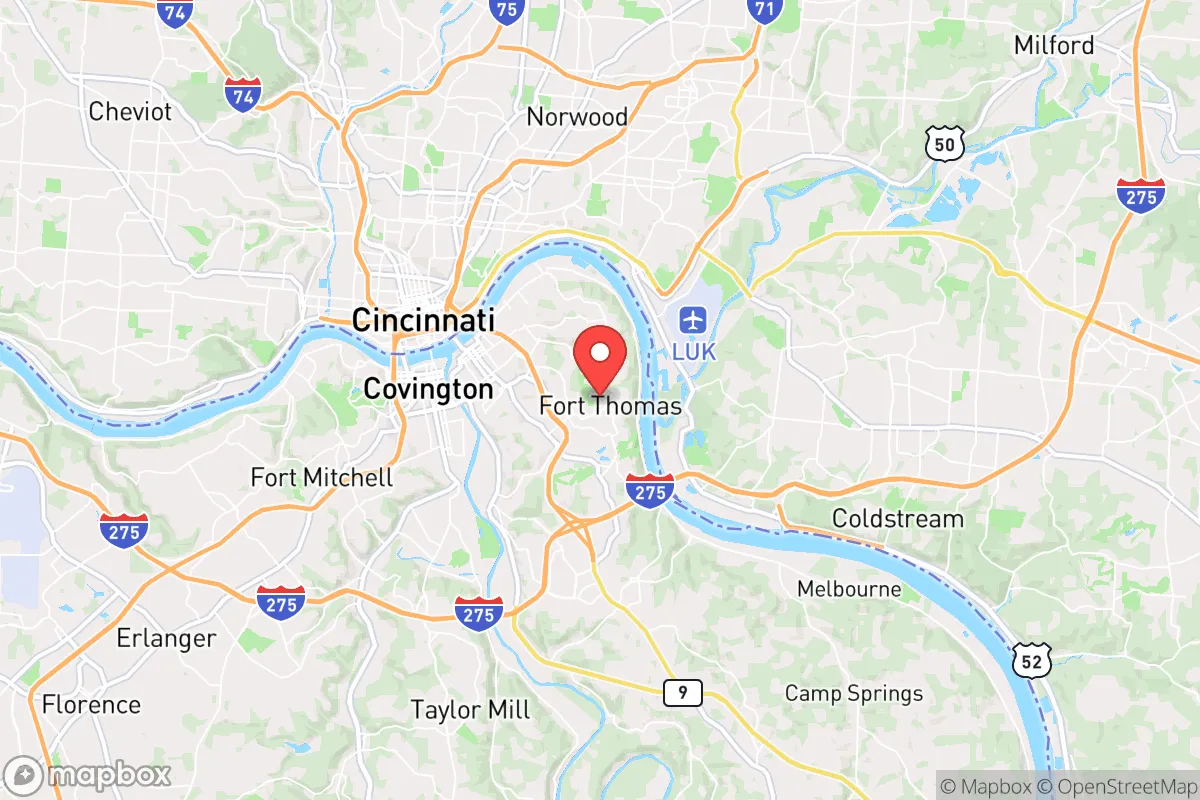
When you stack Fort Thomas up against its neighbors, the contrast is pretty stark. Head just a few miles west into Cincinnati, and you’re in a deep-blue urban stronghold where progressive policies on everything from zoning to policing are the norm. Even closer, Covington and Newport have been trending leftward, especially among younger transplants drawn to the riverfront development. Fort Thomas, though, has held the line. It’s more like the smaller towns to the south—think Alexandria or Independence—where conservative values still carry the day. But here’s the thing: those towns are growing fast, and with growth comes new voices. Some of those voices are pushing for higher taxes, more regulations on homeowners, and a bigger role for government in daily life. That’s the kind of overreach that should give any long-time resident pause.
What this means for residents
For the people who actually live here, the political climate shapes everything from your property taxes to your kids’ school curriculum. Fort Thomas has historically kept government lean—low tax rates, minimal red tape on small businesses, and a school system that focused on basics without a lot of ideological baggage. But there are signs that’s changing. You’ve got local boards and commissions that are starting to mirror the progressive playbook you see in bigger cities: talk of equity audits, diversity mandates, and environmental regulations that sound good on paper but end up costing you time and money. If you’re someone who believes your home and your family are your own business, not the government’s, these trends are a real concern. The good news is that voter turnout here is high, and the conservative base is still strong—but it takes active participation to keep the pendulum from swinging too far.
One cultural distinction worth noting: Fort Thomas has a strong sense of community pride that’s rooted in self-reliance, not government programs. You see it in the local sports leagues, the church groups, and the way neighbors help each other out without waiting for a city initiative. That’s the kind of freedom that’s worth protecting. In the long term, if the area can resist the urge to copy the policies of Cincinnati or Lexington, it’ll stay a place where personal rights come first. But if the progressive push gains more traction—especially in school board and city council races—you could see a slow erosion of the very things that make Fort Thomas feel like home. Keep your eyes on the local elections, and don’t assume the old ways will stick around without a fight.

State Political ClimatePolitical Climate in Kentucky
State Political AnalysisPolitical Environment in the State
Kentucky has been a reliably Republican state for over two decades, with a partisan lean that has only deepened since the turn of the century. The state voted for Donald Trump by a 26-point margin in 2024, up from 15 points in 2016, and Republicans now hold supermajorities in both chambers of the General Assembly, all but one of the state’s congressional seats, and every statewide office except the auditor. This wasn’t always the case — Kentucky was a Democratic stronghold in state and local races as recently as the 1990s, but a combination of cultural realignment, rural resentment of federal overreach, and the nationalization of politics has turned the Bluegrass State into one of the most solidly red states in the nation.
Urban vs. rural divide
The political map of Kentucky is a textbook example of the urban-rural split that defines American politics today. The two major population centers — Louisville (Jefferson County) and Lexington (Fayette County) — are the only reliably blue areas in the state. Louisville voted for Joe Biden by 20 points in 2020 and Harris by 18 in 2024, while Lexington went blue by about 12 points. These cities are home to the state’s largest universities, most of its corporate headquarters, and a growing population of younger, more diverse residents. Outside of these two islands, the rest of the state is deeply red. Northern Kentucky (Boone, Kenton, Campbell counties) has become a Republican stronghold as suburban Cincinnati voters have shifted right, while the Lexington suburbs like Georgetown and Nicholasville are now solidly red. The eastern coal fields — places like Pikeville, Hazard, and Prestonsburg — were once Democratic bastions but have flipped hard to the GOP, voting 70-80% Republican in recent cycles. Bowling Green and Owensboro in the west are reliably red, while Paducah and Murray lean Republican but with a more moderate streak. The only county that flipped from red to blue between 2016 and 2024 was Fayette County, driven by Lexington’s growth; no other county moved leftward.
Policy environment
Kentucky’s policy environment is aggressively conservative, with a focus on limiting government overreach and protecting individual freedoms. The state has a flat income tax that was cut from 5% to 4% in 2024, with a path to elimination by 2029. There is no state property tax, and sales tax is a low 6%. The regulatory climate is business-friendly, with right-to-work laws and tort reform that have made the state attractive to manufacturers and logistics firms. On education, Kentucky has a robust school choice movement — the General Assembly passed a charter school law in 2022 and expanded the state’s education savings account program in 2024, allowing parents to use tax dollars for private school tuition and homeschooling expenses. Healthcare policy is a mixed bag: the state expanded Medicaid under the Affordable Care Act in 2014, but Governor Andy Beshear (a Democrat) has been unable to push through a public option or other progressive reforms against the Republican supermajority. Election laws are moderately restrictive — voter ID is required, early voting is limited to three weeks, and absentee voting requires an excuse. Kentucky does not have automatic voter registration or same-day registration, which conservatives argue protects election integrity.
Trajectory & freedom
Kentucky is moving in a direction that many conservatives would call more free, particularly on gun rights, parental rights, and taxation. The state passed constitutional carry (permitless concealed carry) in 2019, and in 2023 it enacted a law prohibiting local governments from enforcing federal gun regulations — a direct challenge to federal overreach. On parental rights, Kentucky passed a Parents’ Bill of Rights in 2022 that requires schools to notify parents about curriculum changes and allows them to opt their children out of sex education. The state also banned gender transition procedures for minors in 2023, overriding a veto from Governor Beshear. Medical freedom saw a win with the passage of a law in 2024 that prohibits employers from requiring COVID-19 vaccines as a condition of employment. Property rights were strengthened by a 2021 law limiting the use of eminent domain for private economic development. The only area where freedom has arguably contracted is on abortion: Kentucky has a near-total ban with no exceptions for rape or incest, which passed via a trigger law in 2019 and was upheld by a 2022 ballot measure. For conservatives who prioritize life, this is a positive; for those who prioritize medical autonomy, it’s a restriction. Overall, the trajectory is toward lower taxes, fewer regulations, and more protection of individual and parental rights.
Civil unrest & political movements
Kentucky has seen relatively little civil unrest compared to larger states, but there have been notable flashpoints. The 2020 protests in Louisville following the death of Breonna Taylor were among the largest in the country, with weeks of demonstrations, property damage, and a heavy police presence. The city remains a focal point for racial justice activism, and the local Democratic leadership has pushed for police reform, though the Republican legislature has blocked most of it. On the right, the state has a strong Second Amendment movement, with groups like the Kentucky Gun Owners Association holding regular rallies at the state capitol. Immigration politics are less visible here than in border states, but there is a growing concern about illegal immigration in the Louisville and Lexington metro areas, where the foreign-born population has increased. There have been no sanctuary city policies adopted in Kentucky, and the state passed a law in 2023 requiring local law enforcement to cooperate with federal immigration authorities. Election integrity controversies have been minimal — the 2020 election in Kentucky was widely seen as secure, though some conservative activists have pushed for hand-counting of ballots, which the legislature has not adopted. Secession or nullification rhetoric is rare, but the 2023 law nullifying federal gun regulations is a notable example of state-level resistance to federal authority.
Projection
Over the next 5-10 years, Kentucky is likely to become even more conservative, driven by two trends: the continued exodus of liberals from rural areas to Louisville and Lexington, and the in-migration of conservatives from higher-tax states like Illinois, California, and New York. The state’s population growth is concentrated in the red suburbs of Georgetown, Richmond, and Elizabethtown, while the blue urban cores are growing more slowly. The Republican supermajority is unlikely to be threatened — the only competitive statewide race in 2024 was the auditor’s race, which the GOP won by 4 points. The state’s flat tax will likely be eliminated entirely by 2029, and school choice will continue to expand. The only wild card is the possibility of a moderate Republican or conservative Democrat winning the governorship in 2027, but even then, the legislature will remain firmly in GOP hands. For someone moving in now, expect a state that is increasingly aligned with traditional conservative values: low taxes, strong gun rights, parental control over education, and a government that is skeptical of federal overreach.
Bottom line for a new resident: If you’re looking for a state where your tax dollars aren’t funding progressive social experiments, where your Second Amendment rights are protected, and where your kids’ education is under your control, Kentucky is a solid bet. The urban areas are blue, but they’re small and shrinking relative to the rest of the state. You’ll find a welcoming community in the suburbs and rural areas, a low cost of living, and a government that generally stays out of your way. Just be prepared for the summer humidity and the fact that the state’s biggest city, Louisville, still has a ways to go on crime and governance.
* Values derived from national, state, county, city and local statistics and may differ in a specific area. Last updated: 2026-04-21T10:44:03.000Z
Narrative content on this page is AI-generated and may contain mistakes. Verify any details that matter before acting on them.
ReloMaps may earn a commission from affiliate links at no extra cost to you.

