
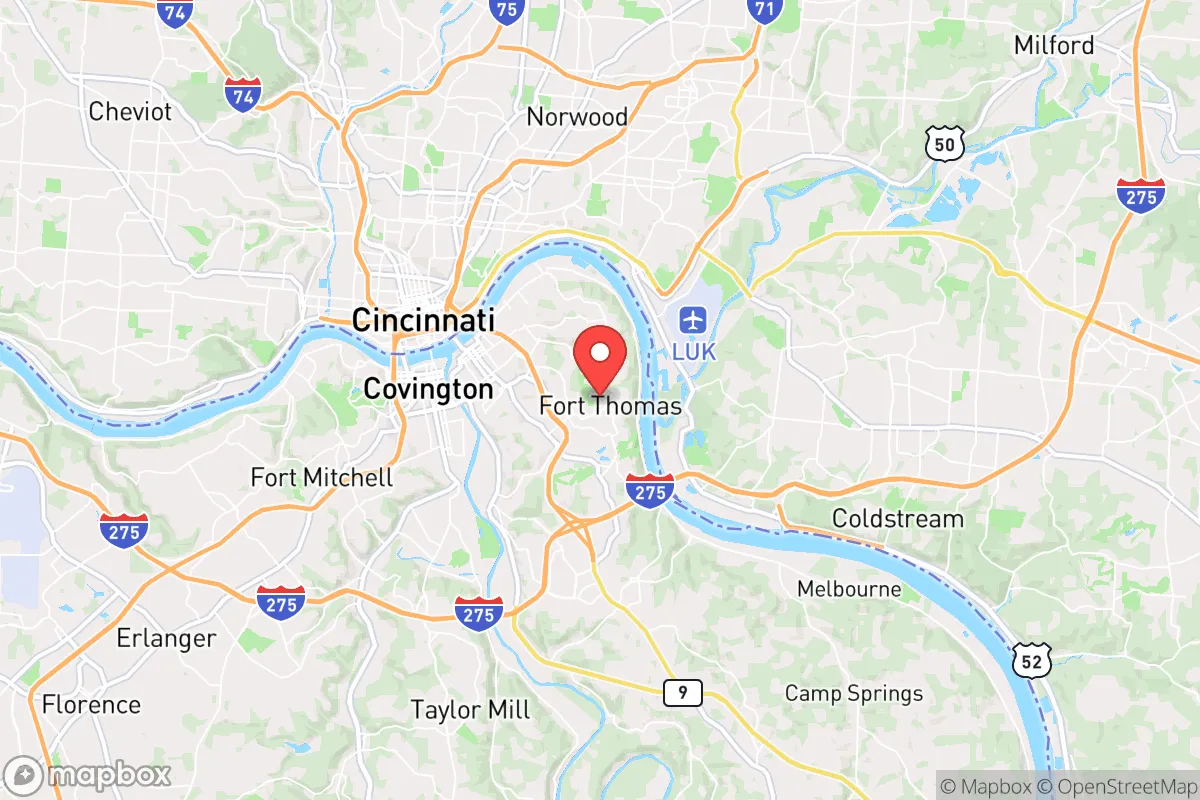
Photo: Wikipedia
Personal Sovereignty in Fort Thomas, KY
Viable for self-reliance. Generally workable, though some barriers may limit total independence.
What does Personal Sovereignty tell us?
Personal Sovereignty measures your capacity for self-reliance and independence with minimal government friction. Higher scores mean fewer barriers between you and the way you want to live... but it assumes you have the space you need and good neighbors.
What does this tell us?
Personal Sovereignty measures your capacity for self-reliance and independence with minimal government friction. Higher scores mean fewer barriers between you and the way you want to live... but it assumes you have the space you need and good neighbors.
State Policy
Energy independence: Importer (60% of energy produced in-state)
Personal Liberty
Homesteading

Personal Liberty Analysis
Fort Thomas, Kentucky, offers a notably high degree of personal sovereignty for those seeking to live with minimal government interference, particularly when compared to the regulatory-heavy environments of neighboring Ohio and the broader urban corridor. This small, historic city in Campbell County sits within a state that has deliberately positioned itself as a haven for individual rights, from firearm ownership to medical autonomy, while maintaining a relatively low tax burden. For the survivalist or prepper, the key trade-off is clear: you gain substantial legal freedom and a community with a strong sense of self-reliance, but you must accept that you are still within a suburban framework with zoning and density constraints that limit full-scale off-grid independence. The overall autonomy environment here is best described as "defensible suburban liberty"—strong on paper rights and low on fiscal overreach, but requiring strategic property selection to maximize self-sufficiency.
Tax burden and regulatory posture: How Kentucky’s low-tax framework protects your income and property
Kentucky’s tax structure is a major draw for those wary of government confiscation of earnings. The state imposes a flat personal income tax rate of 4.0% as of 2026, down from 5% in 2023, with a statutory path toward eventual elimination. This is significantly lower than Ohio’s progressive rates, which can exceed 4.75% for higher earners, and far below the 10%+ brackets in states like California or New York. Property taxes in Campbell County are among the lowest in the region, with an effective rate around 0.85% of assessed value—roughly half the national average. Fort Thomas itself has no city income tax, unlike many Ohio municipalities that levy 1.5–2.5% on residents. The regulatory posture is equally favorable: Kentucky is a right-to-work state with minimal business licensing hurdles, and Campbell County has no overlay zoning that would restrict things like backyard workshops, small-scale livestock, or rainwater collection. The state’s limited government philosophy means fewer permits for home-based businesses and less bureaucratic friction for property modifications. For the prepper, this translates to more money retained for gear, supplies, and land improvements, and fewer government officials with a say in how you use your property.
Self-defense and gun law specifics: Constitutional carry and stand-your-ground protections
Fort Thomas sits in a state that has aggressively expanded self-defense rights. Kentucky is a constitutional carry state—no permit is required to carry a concealed firearm for anyone legally allowed to possess one. This is a bedrock liberty for those who view personal security as a non-negotiable right. The state also has a stand-your-ground law with no duty to retreat in any place you are lawfully present, which provides strong legal protection for defensive use of force. Castle doctrine is codified, meaning your home, vehicle, and occupied structure are legally presumed as locations where deadly force is justified against unlawful intrusion. Local gun culture in Fort Thomas is robust but not aggressive; the city has a police department that generally respects Second Amendment rights, and there are no local ordinances that exceed state law—no magazine bans, no "assault weapon" restrictions, and no waiting periods. The nearest major city, Cincinnati, is just across the Ohio River and has far more restrictive policies, but Kentucky law preempts local gun control, so Fort Thomas residents are shielded from that encroachment. For the survivalist, this means you can maintain a fully stocked armory without fear of sudden legislative bans, and you can carry openly or concealed without bureaucratic permission.
Self-reliance and homesteading viability: Lot sizes, zoning, and off-grid feasibility in a suburban setting
This is where Fort Thomas reveals its primary limitation for the hardcore prepper. The city is a dense, historic suburb with typical lot sizes ranging from 0.1 to 0.3 acres in the older neighborhoods, though some larger parcels exist near the hillsides and along the Ohio River. Zoning is predominantly R-1 (single-family residential), which permits gardens, small sheds, and even chickens (with a permit), but prohibits livestock like goats, pigs, or cattle. Off-grid feasibility is low within city limits: the city requires connection to municipal water and sewer, and solar panels are allowed but must meet aesthetic guidelines. Rainwater collection is legal but limited to non-potable uses. For serious homesteading—think substantial food production, water independence, or energy autonomy—you would need to look outside city limits into unincorporated Campbell County or neighboring Pendleton County, where lot sizes jump to 1–5 acres and zoning is virtually nonexistent. However, Fort Thomas does offer a strong base for suburban self-reliance: you can grow a significant vegetable garden, keep a few chickens, install a backup generator, and store supplies in a basement or detached garage. The city’s walkability and proximity to parks (like Tower Park) also reduce dependence on vehicle travel for daily needs. The trade-off is clear: you get legal freedom and low taxes, but you must accept the constraints of a built-up environment.
Personal liberties: Parental rights, medical autonomy, speech, and property protections
Kentucky has become a battleground for personal liberties, and the state’s recent legislative trends favor individual sovereignty. Parental rights are strongly protected: Kentucky law requires parental consent for minors to receive most medical treatments, and the state has passed laws prohibiting school districts from hiding a child’s health or gender-related information from parents. This is a significant factor for families concerned about government overreach into child-rearing. Medical autonomy is similarly robust—Kentucky has no vaccine mandate for adults, no mask mandates in effect, and a broad religious exemption for any medical procedure. The state also has a Right to Try law for experimental treatments and a medical freedom law that prohibits discrimination based on vaccination status. Free speech is protected by both the state constitution and a 2023 law that prevents social media platforms from censoring political speech (though this faces legal challenges). Property rights are strong: Kentucky is a "private property rights" state with laws limiting eminent domain abuse, and there are no statewide rent control or landlord licensing schemes. For the survivalist, this means you can speak your mind without fear of government retaliation, make medical decisions for your family without state interference, and use your property as you see fit—within the zoning constraints noted above. The city of Fort Thomas itself is politically moderate but leans conservative, with a city council that has resisted progressive overreach on issues like housing mandates and environmental regulations.
Overall, Fort Thomas offers a high degree of personal sovereignty relative to the surrounding region, particularly when stacked against Ohio, Illinois, or the East Coast. The combination of constitutional carry, low taxes, strong parental rights, and minimal regulatory burden creates a legal environment where a self-reliant individual can operate with few government constraints. The main compromise is the suburban density, which limits full-scale homesteading but still allows for meaningful self-sufficiency. For the prepper or survivalist who values legal freedom over acreage, Fort Thomas is a solid choice—especially as a base for acquiring rural property nearby. If you are looking for a place where the government largely stays out of your life, your wallet, and your gun safe, this is one of the better options in the Ohio River Valley.

* Values derived from national, state, county, city and local statistics and may differ in a specific area. Last updated: 2026-04-21T10:44:03.000Z
Narrative content on this page is AI-generated and may contain mistakes. Verify any details that matter before acting on them.
ReloMaps may earn a commission from affiliate links at no extra cost to you.

