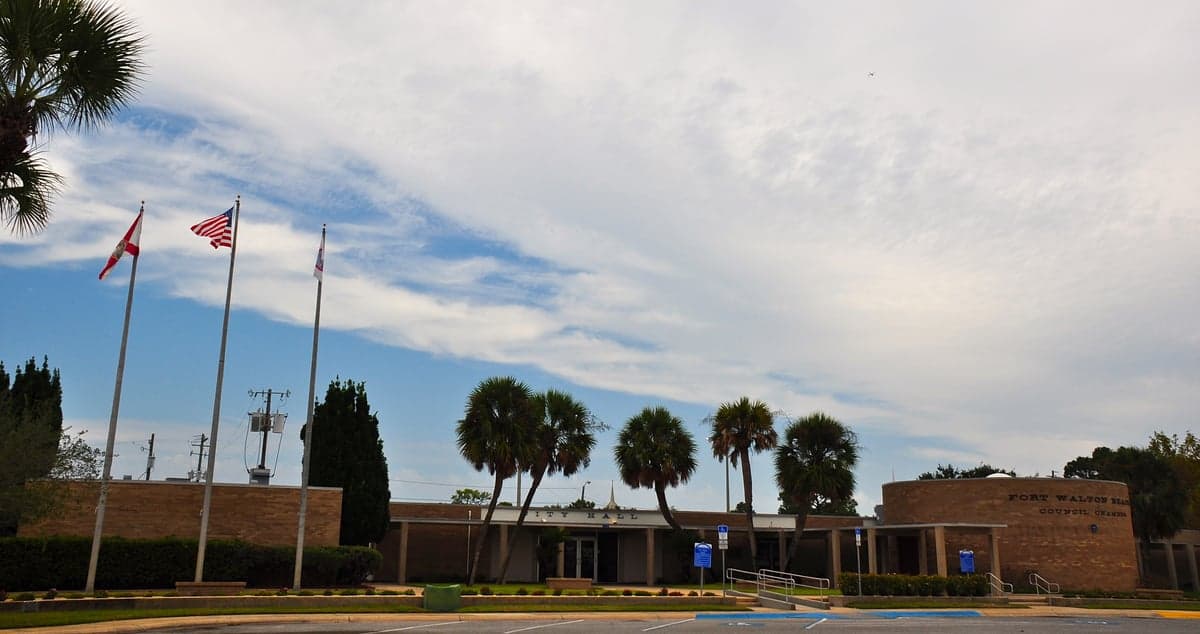
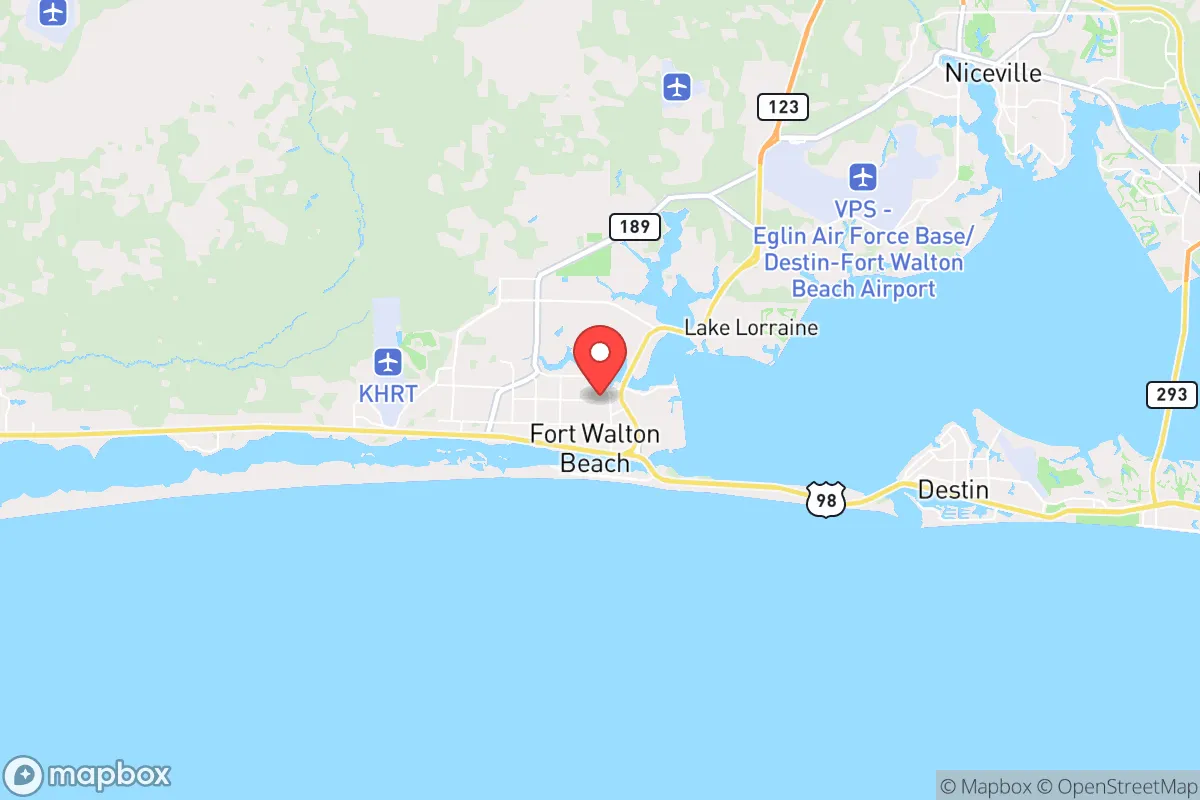
Photo: Wikipedia
Demographics of Fort Walton Beach, FL
Affluence Level in Fort Walton Beach, FL
A middle-class area roughly in line with national averages across income, home values, education, and employment.
People of Fort Walton Beach, FL
Fort Walton Beach today is a compact, family-oriented city of 20,956 residents where White non-Hispanic residents make up 64.8% of the population, with significant minority communities including 12.5% Black, 11.5% Hispanic, 4.4% East/Southeast Asian, and 0.8% Indian (subcontinent) residents. The city is notably less diverse than neighboring Okaloosa County as a whole, with a foreign-born share of just 5.3% and a college-educated rate of 27.8% that trails the national average. Its population identity is shaped by deep military ties to Eglin Air Force Base and Hurlburt Field, creating a transient but patriotic character where many residents are either active-duty personnel, veterans, or defense contractors. The city feels distinctly suburban and mid-sized, with a lower density than nearby Destin and a stronger sense of local, non-tourist community.
How the city was settled and grew
Fort Walton Beach is a genuine 20th-century creation, with no colonial or antebellum history. The area was originally inhabited by the Creek and Choctaw peoples, but the modern city began with the construction of Camp Walton in 1915 as a temporary World War I training site. The first permanent settlers were drawn by the 1920s land boom and the opening of the Brooks Bridge in 1935, which connected the barrier island to the mainland. The defining population wave came during and after World War II, when the establishment of Eglin Field (now Eglin Air Force Base) in 1935 and Hurlburt Field in 1942 brought thousands of military personnel and their families. These early military families settled primarily in the Kenwood neighborhood, a historic district of modest mid-century homes built between 1940 and 1960, and in the Ocean City area, which grew as a working-class enclave for base employees. The city was officially incorporated in 1941, and its population exploded from just 500 in 1940 to over 12,000 by 1960, almost entirely driven by the military-industrial complex. A smaller but notable wave of civilian retirees and small-business owners arrived in the 1950s and 1960s, drawn by the warm climate and affordable beachfront property, settling in the Santa Rosa Sound waterfront area and the Plews & Pate subdivision, a planned community built in the 1950s for non-military professionals.
Modern era (post-1965)
After the 1965 Hart-Cellar Act, Fort Walton Beach saw modest diversification, but the city never experienced the large-scale immigration that reshaped many other Sun Belt cities. The Black population grew steadily through the 1970s and 1980s, concentrated in the Ferry Road corridor and the Beal Parkway area, where African American families—many with military or civil-service backgrounds—established stable neighborhoods. Hispanic residents began arriving in noticeable numbers during the 1990s and 2000s, primarily from Puerto Rico and Mexico, drawn by construction and hospitality jobs tied to the growing tourism economy; they settled mostly in the Cinco Bayou area and along the Racetrack Road corridor. The East/Southeast Asian community (4.4%) is almost entirely composed of Filipino and Vietnamese families connected to the military—many are spouses of service members or retired veterans—and they are concentrated in the Kenwood and Ocean City neighborhoods near the base gates. The Indian (subcontinent) population (0.8%) is small and professional, largely employed in healthcare and engineering at the base or at nearby hospitals, and does not form a distinct ethnic enclave. The city's overall foreign-born share (5.3%) is low compared to the national average of 13.7%, reflecting the fact that most population growth has come from domestic military transfers rather than international migration.
The future
Fort Walton Beach is likely to remain a predominantly White, military-anchored city over the next 10–20 years, but with gradual diversification driven by the same forces. The Hispanic share is projected to grow steadily, possibly reaching 15–18% by 2040, as second-generation families age into the housing market and new arrivals fill service-sector roles. The East/Southeast Asian population will likely plateau or grow slowly, tied directly to military recruitment and retention patterns. The Black population share is stable and may decline slightly as younger Black families move to more affordable inland areas like Crestview. The city is not tribalizing into distinct ethnic enclaves—neighborhoods remain relatively integrated by military rank and income rather than race—but the Ferry Road area is becoming more visibly Hispanic, while Kenwood retains its military-family character. The biggest demographic wildcard is the potential for Eglin and Hurlburt to gain or lose major missions in future defense budget cycles; a base realignment could sharply alter the city's population trajectory. For now, Fort Walton Beach is becoming a slightly more diverse, still heavily military suburb where newcomers—especially those with base connections—will find a stable, family-oriented community with modest but real ethnic variety.
For a conservative-leaning individual or family moving to Fort Walton Beach today, the city offers a population that is patriotic, transient, and service-oriented, with a demographic profile that is changing slowly and predictably. The military presence ensures a steady influx of like-minded families, while the growing Hispanic and Asian communities add cultural texture without dramatic social disruption. The city is not becoming a melting pot in the traditional sense, but rather a military hub where diversity is present but secondary to the shared identity of service and stability.

* Values derived from national, state, county, city and local statistics and may differ in a specific area. Last updated: 2026-04-19T06:58:07.000Z
Narrative content on this page is AI-generated and may contain mistakes. Verify any details that matter before acting on them.
ReloMaps may earn a commission from affiliate links at no extra cost to you.

