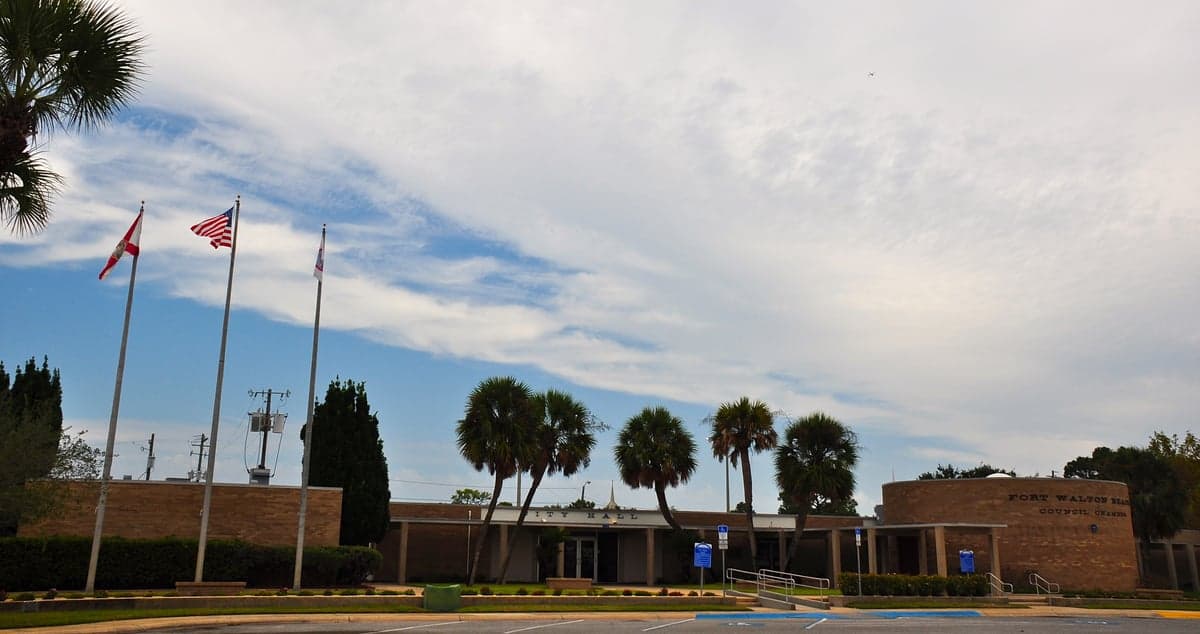
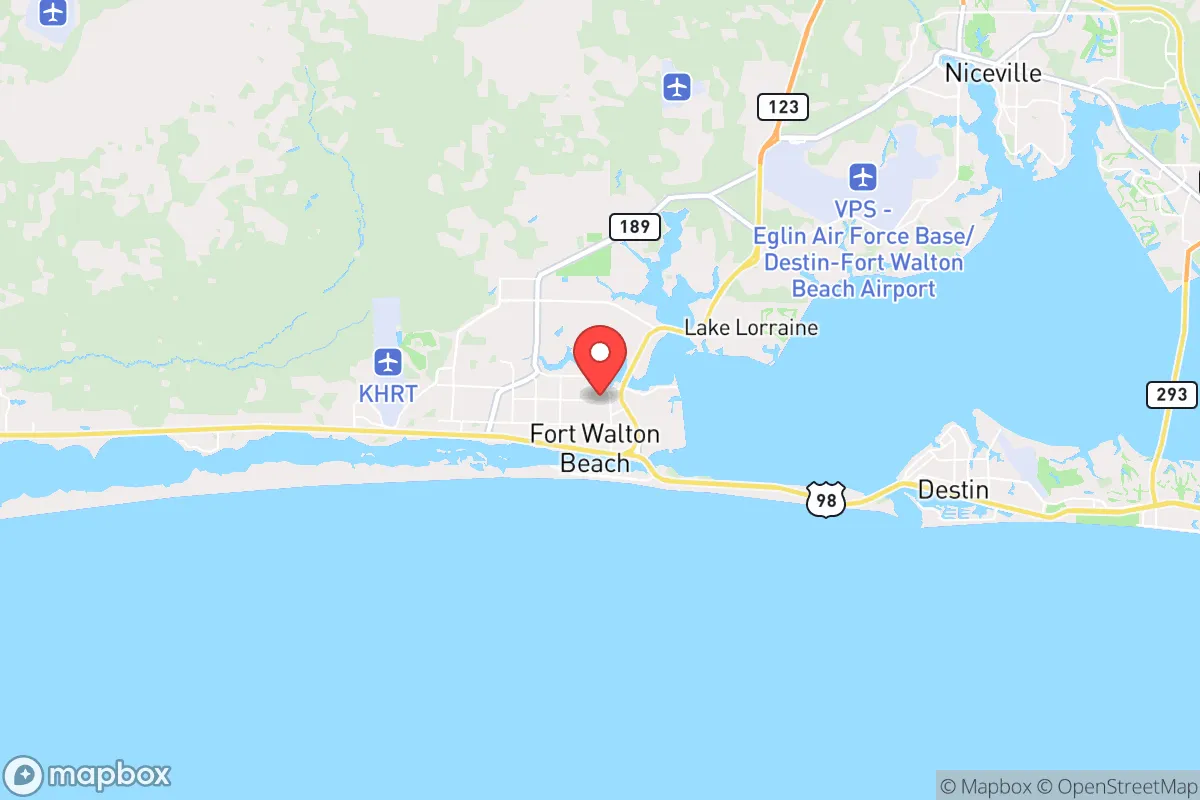
Photo: Wikipedia
Political ClimatePolitical Climate in Fort Walton Beach, FL
District shown is the primary district for this city’s centroid. Cities may span multiple districts.
Inherited from parent state — no local data available.
Local Political AnalysisPolitical Analysis of Fort Walton Beach, FL
Fort Walton Beach has long been a solidly conservative community, and that hasn't changed much. The area's Cook Partisan Voting Index (PVI) of R+18 tells you everything you need to know about the baseline here—this is a place where folks generally believe in limited government, personal responsibility, and keeping the feds out of local business. Over the last decade, the political lean has held steady, though you'll notice a slow creep of progressive ideas filtering in from the more transient military and tourist populations. It's not a flip, but it's a shift worth watching if you value the traditional freedoms that made this stretch of the Panhandle a great place to raise a family.
How it compares
Compared to nearby cities, Fort Walton Beach is actually a bit of a moderate outlier in an otherwise deeply red region. Drive 15 minutes east to Destin, and you'll find a similar conservative vibe, though Destin's tourism economy brings in more out-of-state influence and a slightly more libertarian-leaning crowd. Head west to Navarre or south to the unincorporated areas of Santa Rosa County, and you're in some of the most reliably Republican territory in Florida—places where the R+18 PVI looks almost liberal by comparison. The real contrast comes if you go north to Crestview or DeFuniak Springs, where the rural, agricultural base makes Fort Walton Beach's mix of military families and beachside retirees seem almost cosmopolitan. The biggest political tension locally isn't between parties—it's between the old-school, leave-us-alone conservatives and a newer wave of transplants who want to bring bigger government solutions to local problems, like stricter beach regulations or more county-level oversight on property rights.
What this means for residents
For the average person living here, the political climate means you generally get to live your life without too much government interference—for now. Property taxes remain relatively low, zoning is still fairly permissive, and you won't find the kind of overreaching ordinances you see in places like Tallahassee or Miami. But there are warning signs. The city council and county commission have seen a few close votes on issues like short-term rental restrictions and mask mandates during the pandemic, which should raise eyebrows for anyone who believes local government should stay out of your personal choices. The school board has also become a battleground, with some pushing for more progressive curriculum changes that would have been unthinkable here a decade ago. If you're the kind of person who values the Second Amendment, school choice, and the freedom to run your small business without a stack of permits, Fort Walton Beach is still a safe bet—but you need to stay engaged in local elections to keep it that way.
Culturally, Fort Walton Beach has always been a place where people wave from their trucks and look out for their neighbors, and that hasn't changed. The biggest policy distinction you'll notice is the strong military presence—Eglin Air Force Base and Hurlburt Field dominate the local economy and culture, which reinforces a patriotic, pro-defense mindset that keeps most progressive social experiments at arm's length. You won't see the kind of radical housing policies or police defunding efforts you'd find in bigger Florida cities. The long-term trajectory depends on who moves in next. If the area continues to attract conservative-leaning retirees and military families, the R+18 lean will hold. But if the developers keep building high-density rentals and drawing in a younger, more transient workforce from blue states, you could see the political needle drift in a direction that threatens the personal freedoms that make this place worth defending.

State Political ClimatePolitical Climate in Florida
State Political AnalysisPolitical Environment in the State
Florida has transformed from a classic swing state into a solidly Republican-leaning powerhouse over the past two decades, with a registered Republican voter advantage of over 500,000 as of 2026 and a 2024 presidential margin of roughly +13 points for the GOP. The dominant coalition is a mix of conservative retirees, Hispanic voters (especially Cuban-Americans and Venezuelans in Miami-Dade), and transplants from blue states seeking lower taxes and fewer restrictions. This shift accelerated sharply after 2020, driven by Governor Ron DeSantis’s aggressive policy agenda and a massive influx of new residents from New York, California, and Illinois who were fleeing pandemic-era lockdowns and rising crime.
Urban vs. rural divide
The political map of Florida is starkly divided between its booming conservative interior and its shrinking liberal coastal cities. The I-4 corridor—stretching from Tampa through Lakeland to Orlando—remains the ultimate battleground, but even here, the GOP has made inroads. Miami-Dade County, once a Democratic stronghold, flipped to Trump in 2020 and again in 2024, driven by Cuban and Venezuelan voters who associate Democrats with socialism. Meanwhile, Jacksonville (Duval County) has trended right as suburban growth in places like St. Johns County (the most conservative county in the state) overwhelms the urban core. The Panhandle—Pensacola, Panama City, Tallahassee’s surrounding rural areas—is deeply red, with many precincts voting 70-80% Republican. The blue islands are shrinking: Miami Beach, Orlando proper, Gainesville (home to UF), and Tallahassee (state capital) remain Democratic strongholds, but they’re surrounded by a sea of red suburbs. The biggest surprise is Broward and Palm Beach counties—once reliably blue—where Republican registration has grown steadily, especially in suburbs like Parkland and Wellington.
Policy environment
Florida’s policy environment is a deliberate counterweight to high-tax, high-regulation states. There is no state income tax, which is the single biggest draw for relocating families and businesses. Property taxes are moderate (around 0.8% of assessed value), and the state has a 6% sales tax. Regulatory reform under DeSantis has slashed permitting times for new homes and businesses, making it easier to build than in almost any other large state. Education policy is a flashpoint: the state’s Parental Rights in Education Act (HB 1557, often called the “Don’t Say Gay” law) prohibits classroom instruction on sexual orientation and gender identity in grades K-3, and has been expanded to all grades. School choice is robust, with universal Education Savings Accounts available to all students. On healthcare, Florida did not expand Medicaid under the ACA, and the state has banned COVID-19 vaccine mandates for private employers and government workers. Election laws were tightened after 2020, with stricter voter ID requirements, limits on drop boxes, and a ban on ballot harvesting—all designed to increase confidence in election integrity. The state also preempted local governments from enacting their own gun control ordinances, ensuring uniform Second Amendment protections statewide.
Trajectory & freedom
Florida is unambiguously moving toward greater personal freedom across multiple dimensions, though critics argue some policies restrict certain groups. Gun rights expanded significantly in 2023 with permitless carry (HB 543), allowing any law-abiding adult to carry a concealed firearm without a permit. Property rights were strengthened by the “Live Local Act,” which preempts local zoning to allow more housing density near commercial corridors, reducing NIMBY obstruction. Medical autonomy was protected by a ban on COVID-19 vaccine passports and a law prohibiting discrimination against unvaccinated individuals. Parental rights were codified with the “Don’t Say Gay” expansion and a law requiring schools to notify parents of any changes in a child’s mental or physical health—a direct challenge to woke school policies. On the downside, the state has increased penalties for homeless camping (HB 1365) and restricted drag shows in public spaces (HB 1423), which some see as government overreach into lifestyle choices. Overall, the trajectory is toward fewer taxes, less regulation, and more individual choice in education, healthcare, and self-defense.
Civil unrest & political movements
Florida has seen relatively little civil unrest compared to blue states, but flashpoints exist. The 2020 Black Lives Matter protests in Miami, Orlando, and Jacksonville were large but mostly peaceful, with property damage concentrated in downtown Miami. The state responded by passing the Combating Public Disorder Act (HB 1), which enhanced penalties for rioting and protected monuments. Immigration politics are front and center: Governor DeSantis signed the strongest anti-sanctuary city law in the nation (SB 1718), requiring E-Verify for all employers and banning local governments from providing sanctuary policies. This led to a brief but tense standoff with Martha’s Vineyard when the state transported migrants there. Election integrity remains a hot-button issue: the state’s Office of Election Crimes and Security, created in 2022, has prosecuted dozens of cases of voter fraud, mostly involving felons who voted illegally. Progressive activist groups like the Florida Rising and Dream Defenders have organized against the parental rights laws and the anti-riot law, but their influence is limited by the state’s conservative supermajority. A new resident would notice the absence of the kind of street-level political conflict common in California or Oregon—Florida’s politics are fought in the legislature, not the streets.
Projection
Over the next 5-10 years, Florida will likely become even more conservative, driven by demographic trends. The state is adding roughly 1,000 new residents per day, most from blue states, and these transplants tend to be conservative-leaning or at least libertarian-leaning on fiscal issues. The Hispanic vote, especially among Cubans, Venezuelans, and Nicaraguans, is solidifying as a Republican bloc. The biggest wild card is climate change: rising sea levels and stronger hurricanes could eventually slow migration to coastal areas, but inland cities like Ocala, Lakeland, and Gainesville are booming as alternatives. Politically, expect the GOP to hold a supermajority in the legislature through at least 2032, and the governorship to remain Republican unless a moderate Democrat emerges. The biggest risk is that the state’s success attracts so many new residents that housing costs rise and infrastructure strains, potentially creating a backlash. But for now, the trajectory is clear: Florida is the reddest large state in the country and getting redder.
For a new resident, the bottom line is this: Florida offers a political environment where your taxes stay low, your kids’ education is parent-directed, your Second Amendment rights are protected, and your local government cannot impose lockdowns or vaccine mandates. The trade-off is that you’ll live in a state where the culture wars are fought openly and aggressively—if you value traditional values and personal responsibility, you’ll feel at home. If you’re looking for a place where the government stays out of your life and your wallet, Florida is the closest thing to it in the contiguous United States. Just be prepared for the heat—both the weather and the politics.
* Values derived from national, state, county, city and local statistics and may differ in a specific area. Last updated: 2026-04-19T06:58:07.000Z
Narrative content on this page is AI-generated and may contain mistakes. Verify any details that matter before acting on them.
ReloMaps may earn a commission from affiliate links at no extra cost to you.

