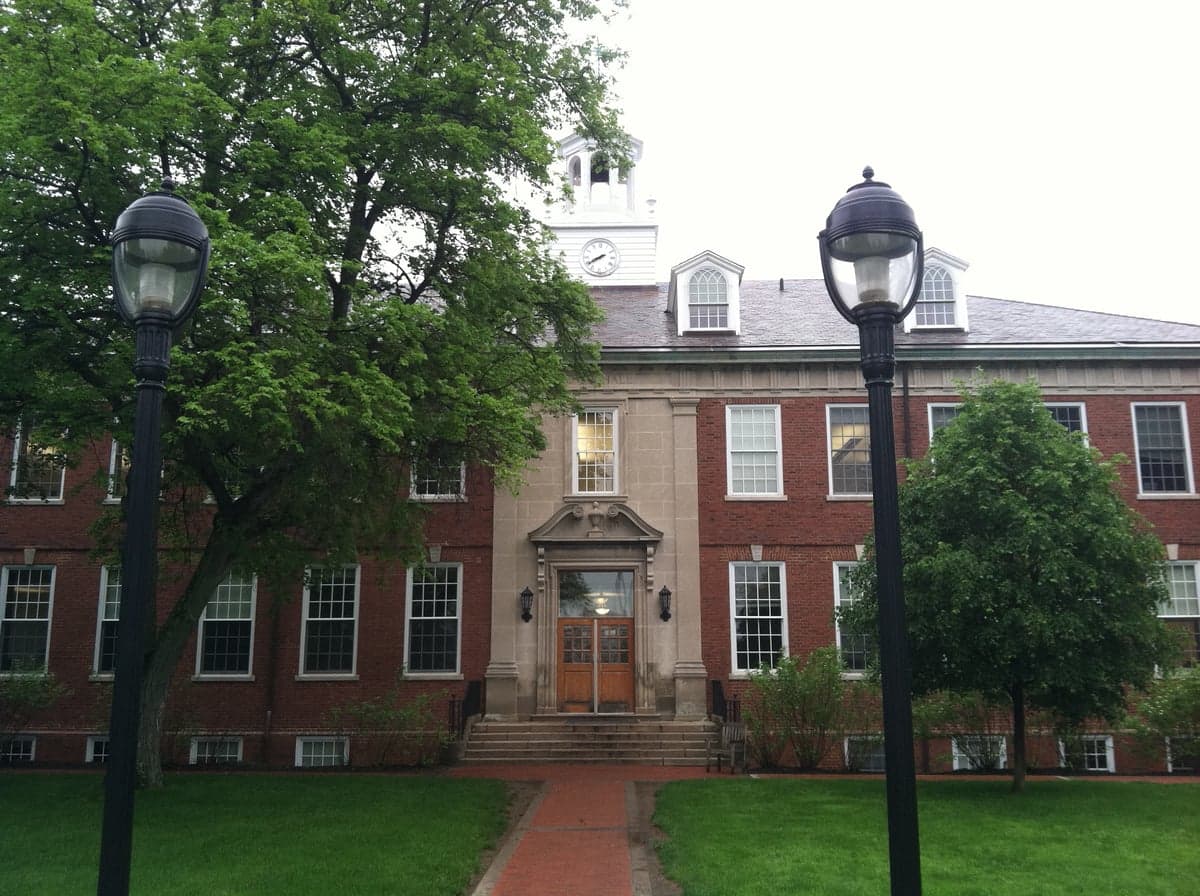
Photo: Wikipedia
Demographics of Fox Chapel, PA
Affluence Level in Fox Chapel, PA
A wealthy area with high-earning, well-educated households. Incomes, home values, and educational attainment meaningfully outpace national averages.
Census doesn't track above $250K
People of Fox Chapel, PA
The people of Fox Chapel, Pennsylvania, today form one of the most highly educated and affluent communities in the Pittsburgh region, with a population of 5,264 that is 87.1% white and marked by an unusually high concentration of professionals, executives, and academics. The borough is overwhelmingly native-born — just 0.7% foreign-born — and its character is defined by large wooded lots, low density, and a deliberate quiet that sets it apart from the surrounding urban core. Distinctive identity markers include a strong sense of local governance, deep ties to Pittsburgh’s corporate and medical institutions, and a population that has remained remarkably stable in its demographic composition for decades.
How the city was settled and grew
Fox Chapel was not a product of early American settlement or industrial boom. The area remained sparsely populated farmland and forest through the 19th century, part of Indiana Township and O’Hara Township. The first significant wave of residents arrived in the early 20th century, drawn by the construction of the Fox Chapel Golf Club (opened 1923) and the Pittsburgh & Lake Erie Railroad’s Fox Chapel station. These amenities attracted wealthy Pittsburgh industrialists — names like Mellon, Heinz, and Scaife — who built country estates along Squaw Run Road and Old Fox Chapel Road. The borough was formally incorporated in 1934, carved out of Indiana Township specifically to create a low-tax, low-regulation enclave for the city’s business elite. The original neighborhoods — Fox Chapel Golf Club area and Squaw Run Valley — were built by and for this cohort, with large stone and brick homes set on multi-acre lots. A second wave came after World War II, as Pittsburgh’s expanding corporate sector (U.S. Steel, Gulf Oil, Westinghouse) brought executives and engineers to the area. These families settled in newer subdivisions like Harts Run and Dorseyville, which offered more modest (but still substantial) homes within the same school district. The borough’s population peaked at roughly 5,500 in the 1970s and has since held steady, with little new construction due to strict zoning and large minimum lot sizes.
Modern era (post-1965)
The post-1965 era brought minimal demographic change to Fox Chapel compared to the rest of Allegheny County. The borough’s high property values and lack of rental housing effectively limited in-migration to upper-income households, and the foreign-born share never rose above 1%. The most notable shift has been the gradual arrival of East/Southeast Asian and Indian-subcontinent families, drawn by the region’s universities and medical centers. Today, East/Southeast Asian residents make up 4.0% of the population, and Indian-subcontinent residents account for 1.5%. These households have concentrated in the Fox Chapel Road corridor and the Harts Run area, where newer homes and proximity to the Fox Chapel Area School District — consistently ranked among Pennsylvania’s top public schools — are the primary draws. The Hispanic share (4.5%) is small and largely composed of professional families rather than labor migrants. The Black population remains at 0.0%, a figure that reflects both the borough’s historical exclusion and its current economic barriers to entry. The borough’s white share (87.1%) has declined only modestly from the 95%+ levels of the 1970s, and the change is driven entirely by Asian and Indian in-migration, not by any broad diversification.
The future
Fox Chapel’s population is likely to remain stable in size but slowly diversify at the upper margins. The borough has no land for large-scale development, and its zoning code — requiring minimum lot sizes of one to three acres — ensures that new construction will remain limited to infill and teardowns. The East/Southeast Asian and Indian-subcontinent shares are expected to grow gradually, as second-generation professionals from Pittsburgh’s universities and hospitals seek the same school district and low-crime environment that drew earlier waves. The white share will continue to edge downward, but the borough will remain overwhelmingly native-born and English-speaking. The Hispanic share is unlikely to rise significantly, as the borough lacks the rental housing and service-sector jobs that attract Hispanic migrants elsewhere in Allegheny County. The Black population is not projected to increase absent a major shift in housing affordability or policy. Fox Chapel is not homogenizing — it is already highly homogeneous — but it is slowly tribalizing into distinct enclaves: the old-stock families in Squaw Run Valley, the corporate professionals in Harts Run, and the newer Asian and Indian households along Fox Chapel Road. These groups share the same schools and civic institutions but maintain separate social networks.
For someone moving in now, Fox Chapel offers a stable, low-turnover community with exceptional schools and minimal demographic flux. The trade-off is a social environment that can feel insular and a housing market that demands significant capital. The borough is not becoming more diverse in any broad sense, but it is becoming more globally connected at the top of the income scale. If you value predictability, privacy, and a school system that consistently ranks in the top 1% of Pennsylvania, Fox Chapel delivers exactly that — and will continue to do so for the foreseeable future.

* Values derived from national, state, county, city and local statistics and may differ in a specific area. Last updated: 2026-04-27T14:32:23.000Z
Narrative content on this page is AI-generated and may contain mistakes. Verify any details that matter before acting on them.
ReloMaps may earn a commission from affiliate links at no extra cost to you.

