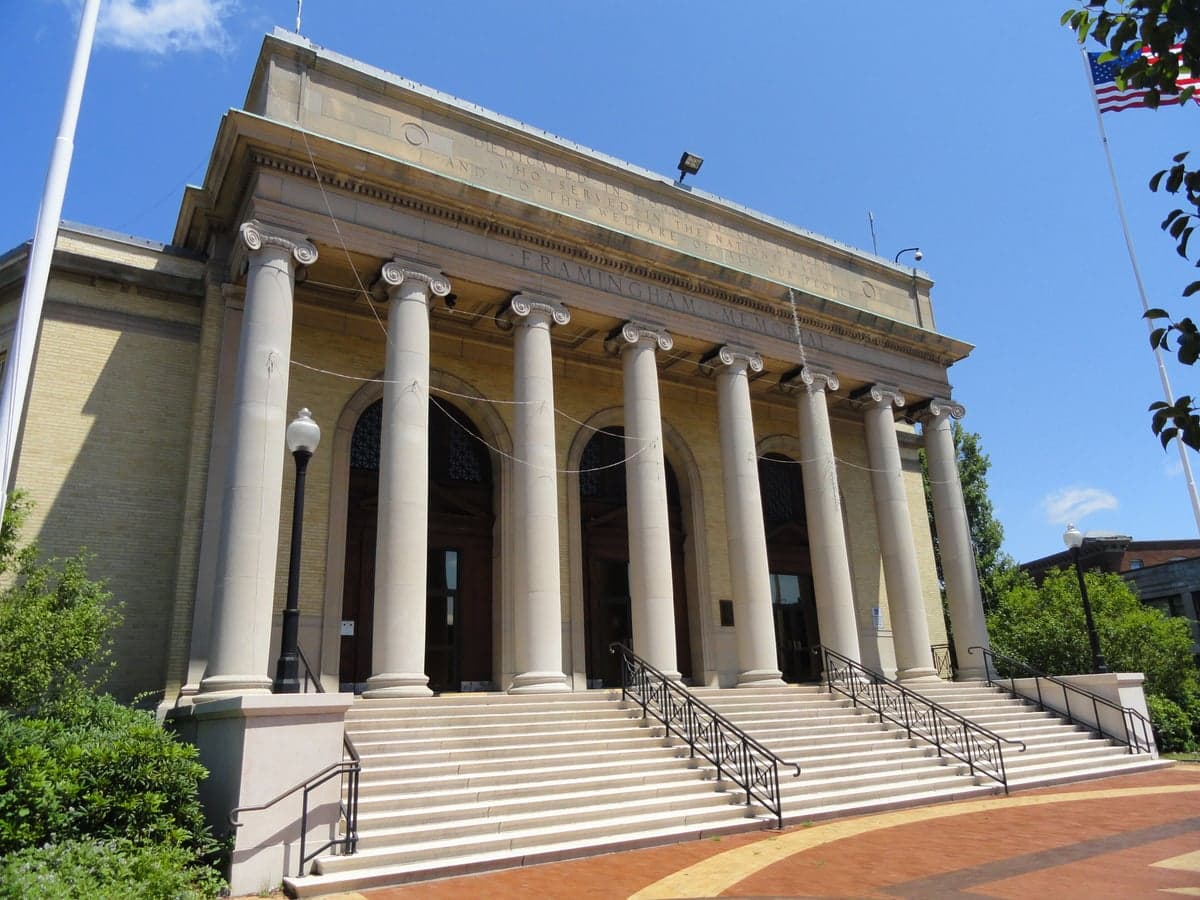
Photo: Wikipedia
Personal Sovereignty in Framingham, MA
Viable for self-reliance. Generally workable, though some barriers may limit total independence.
What does Personal Sovereignty tell us?
Personal Sovereignty measures your capacity for self-reliance and independence with minimal government friction. Higher scores mean fewer barriers between you and the way you want to live... but it assumes you have the space you need and good neighbors.
What does this tell us?
Personal Sovereignty measures your capacity for self-reliance and independence with minimal government friction. Higher scores mean fewer barriers between you and the way you want to live... but it assumes you have the space you need and good neighbors.
State Policy
Energy independence: Importer (5% of energy produced in-state)
Personal Liberty
Homesteading

Personal Liberty Analysis
Framingham, Massachusetts presents a challenging environment for personal sovereignty, particularly for those with a survivalist or prepper mindset who prioritize autonomy over government oversight. While the city offers some practical advantages like access to resources and a diverse economy, its location within a state with some of the nation's most restrictive gun laws, high tax burdens, and expansive regulatory reach significantly limits individual freedom. For a conservative-leaning individual or family weighing relocation, Framingham represents a trade-off: you gain proximity to employment and infrastructure, but you cede substantial control over your property, self-defense, and daily life to state and local authorities. This analysis breaks down the specific sovereignty factors that matter most for strategic relocation.
Tax burden and regulatory posture: What you pay and what you can't do
Massachusetts imposes a heavy tax and regulatory load that directly impacts personal sovereignty. The state's income tax is a flat 5.0% on all earned income, with no standard deduction for most filers, meaning you pay from the first dollar earned. Property taxes in Framingham are moderate for the state—around $14.50 per $1,000 of assessed value—but combined with a state sales tax of 6.25% and high excise taxes on vehicles and fuel, the total effective tax rate is among the highest in the nation. For a prepper, this means less disposable income to invest in supplies, land, or self-reliance projects. The regulatory posture is equally aggressive: Massachusetts has a strict building code, extensive environmental regulations (including the Wetlands Protection Act), and a state-level energy code that can complicate off-grid modifications. Permitting for anything beyond minor repairs is slow and costly, and the state's Right-to-Farm laws are weak compared to rural states, meaning neighbors can easily challenge agricultural activities like keeping chickens or bees. The state also mandates health insurance coverage under the Massachusetts Health Connector, with penalties for non-compliance, further reducing personal medical autonomy.
Self-defense and gun law specifics: What you can and cannot own
For anyone prioritizing self-defense, Framingham sits in one of the most restrictive legal environments in the country. Massachusetts requires a License to Carry (LTC) for any handgun, and the issuing authority—the Framingham Police Department—has significant discretion. While the city is generally shall-issue for LTCs, the process is invasive: you must complete a state-approved firearms safety course, submit fingerprints, provide references, and undergo a background check that can take months. The state bans so-called "assault weapons" by name and feature, effectively prohibiting AR-15s and similar platforms that are standard for preppers. Magazine capacity is capped at 10 rounds, and you cannot purchase ammunition online without a license. Open carry is effectively illegal, and transporting firearms requires them to be unloaded and locked in a separate container from ammunition. Stand-your-ground laws do not exist; Massachusetts imposes a duty to retreat if safely possible before using deadly force. For a survivalist, this means your home defense options are limited to a manually operated shotgun or a low-capacity handgun, and any defensive use of force will face intense legal scrutiny. The state also has a "red flag" law (ERPO) that allows police to seize firearms based on a complaint without a criminal conviction, a significant erosion of due process.
Self-reliance and homesteading viability: Lot sizes, zoning, and off-grid feasibility
Framingham is a densely developed suburb of Boston, with a population density of over 2,500 people per square mile. Typical residential lot sizes range from 0.1 to 0.5 acres, with most single-family homes on quarter-acre parcels. Zoning is primarily R-1 (single-family residential) with strict setback requirements, meaning any significant homesteading activity is legally constrained. Keeping chickens is allowed on lots over 20,000 square feet (about half an acre) with a permit, but roosters are banned, and slaughtering animals on-site is prohibited. Beekeeping is allowed with registration, but neighbors can file nuisance complaints. Gardening is unrestricted, but the small lot size limits food production to a few raised beds. Off-grid feasibility is essentially zero: the city requires connection to municipal water and sewer for any habitable structure, and solar panels must be grid-tied with net metering approval from the utility (Eversource). Rainwater collection is technically allowed but limited to 250 gallons per property without a permit, and composting toilets are not permitted for primary residences. For a prepper seeking true self-reliance, Framingham is a poor fit—you would need to look to rural towns in central or western Massachusetts for acreage and looser zoning.
Personal liberties: Parental rights, medical autonomy, speech, and property
Personal liberties in Framingham are constrained by state-level policies that prioritize collective mandates over individual choice. On parental rights, Massachusetts has some of the strongest vaccine mandates in the country: children must receive all state-required immunizations to attend public or private school, with medical exemptions only (no religious or philosophical exemptions). The state also has a comprehensive sex education law that requires schools to teach LGBTQ-inclusive curriculum, which some conservative parents view as an infringement on their values. Medical autonomy is limited by the state's health insurance mandate and its strict COVID-era policies, which included mask mandates, business closures, and vaccine requirements for healthcare workers that lasted longer than in most states. The state also has a "right to die" law for terminal patients, but it requires multiple physician approvals and a 15-day waiting period. Free speech is protected under the First Amendment, but Massachusetts has a strict anti-SLAPP law that can be used to silence critics, and the state's hate crime laws enhance penalties for speech deemed threatening. Property rights are weak: the state has a robust eminent domain power, and the Massachusetts Historical Commission can restrict alterations to buildings in designated historic districts (Framingham has several). The city also has a rent control overlay district for some multifamily properties, and a "just cause" eviction ordinance that limits a landlord's ability to remove tenants, reducing property control for owners.
Overall, Framingham offers a low level of personal sovereignty compared to most of the United States, especially for those with a survivalist or prepper mindset. The combination of high taxes, restrictive gun laws, dense zoning, and state-mandated health and education policies creates an environment where individual autonomy is secondary to collective regulation. For a conservative-leaning individual or family, this city might work as a temporary base for employment or education, but it is not a place to build long-term self-reliance. If you value the ability to defend yourself with standard firearms, raise your own food, opt out of mandates, and control your property without bureaucratic interference, you will find far more freedom in states like New Hampshire, Maine, or the rural Midwest. Framingham is a trade-off: you get the economic opportunities of the Boston metro, but you pay for them with your personal sovereignty.

* Values derived from national, state, county, city and local statistics and may differ in a specific area. Last updated: 2026-05-01T02:57:55.000Z
Narrative content on this page is AI-generated and may contain mistakes. Verify any details that matter before acting on them.
ReloMaps may earn a commission from affiliate links at no extra cost to you.

