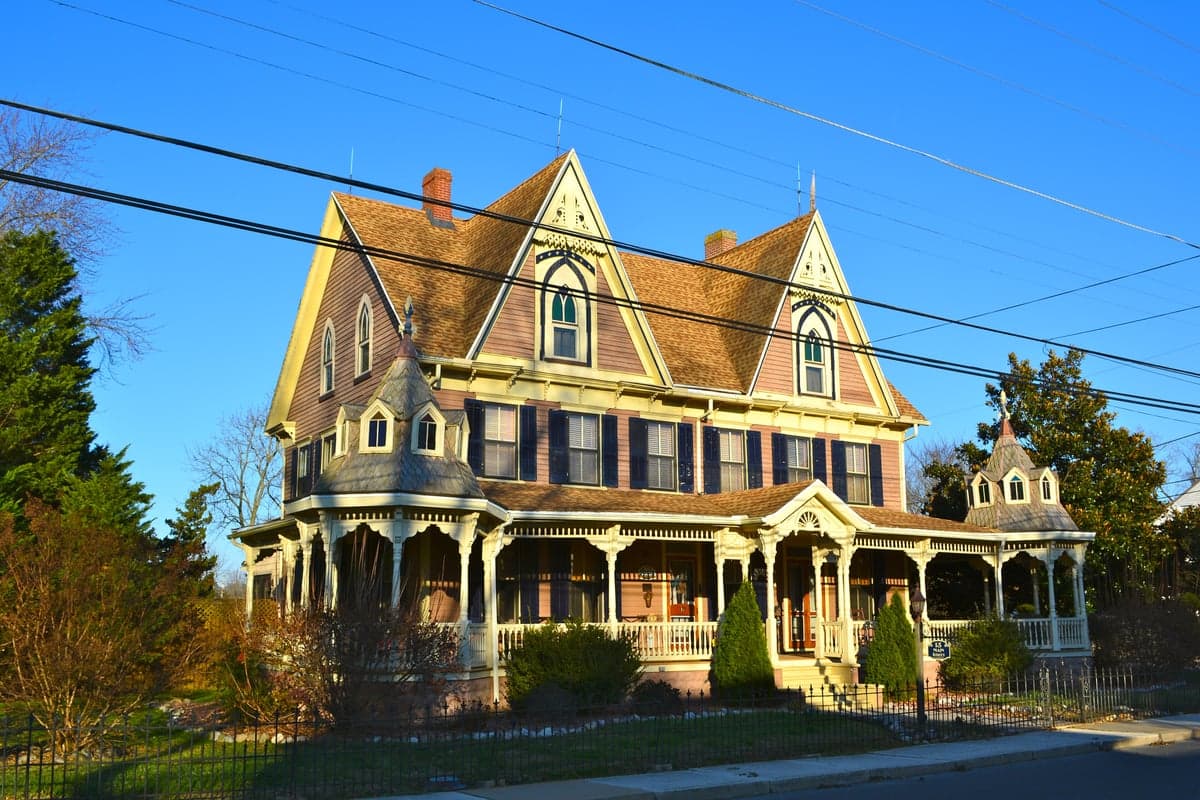
Photo: Wikipedia
Demographics of Frankford, DE
Affluence Level in Frankford, DE
A middle-class area roughly in line with national averages across income, home values, education, and employment.
People of Frankford, DE
Frankford, Delaware, is a small, densely populated town of 883 residents where Hispanic and Black communities now form the majority, creating a distinctive multicultural identity in rural Sussex County. With a foreign-born population of 17.7% and a low college attainment rate of 15.9%, Frankford’s people are predominantly working-class, rooted in agriculture and service industries. The town’s character is shaped by its history as a railroad stop and farming hub, now evolving into a diverse, family-oriented community with a strong sense of local identity.
How the city was settled and grew
Frankford’s original population was drawn by the railroad and fertile farmland in the mid-19th century. The town was officially incorporated in 1883, serving as a shipping point for peaches, strawberries, and poultry. Early settlers were primarily white farmers of English and German descent, who built the Historic Downtown Frankford district around the railroad depot. This area, centered on Main Street and Railroad Avenue, remains the town’s historic core, with many original homes and commercial buildings still standing. A second wave of white settlers arrived in the early 1900s, establishing the West Side neighborhood along West Street and Church Street, where modest single-family homes were built for railroad workers and farm laborers. By 1950, Frankford’s population was nearly entirely white, with a small Black community concentrated in the South Frankford area near the town’s southern boundary, where African American families worked as farmhands and domestic workers on surrounding poultry and vegetable farms.
Modern era (post-1965)
The post-1965 immigration reforms and the decline of the poultry industry reshaped Frankford’s population dramatically. Beginning in the 1970s, Hispanic immigrants—primarily from Mexico and Central America—arrived to work in the region’s expanding poultry processing plants, such as those in nearby Millsboro and Georgetown. They settled in the East Frankford neighborhood, along East Street and the area around the former railroad tracks, where affordable rental housing and mobile home parks provided entry points. By 2000, the Hispanic share of Frankford’s population had risen sharply, and it now stands at 48.4%, making it the largest ethnic group. The Black population also grew during this period, increasing from a small historic base to 30.5% today, with many families moving into the North Frankford area near the town’s northern limits, where newer subdivisions and manufactured homes were built. The white population, once dominant, has declined to 18.1%, with many long-time white families moving to more rural parts of Sussex County or to nearby Ocean View and Bethany Beach. The Central Frankford district, around the intersection of Main Street and Route 20, now reflects the town’s diversity, with Hispanic-owned bodegas, Black churches, and a mix of housing types. East/Southeast Asian residents make up 1.9% of the population, a small but stable presence, while Indian-subcontinent residents are 0.0%.
The future
Frankford’s population is likely to continue its trend toward Hispanic majority, driven by ongoing immigration and higher birth rates among Hispanic families. The town’s low cost of housing and proximity to coastal employment centers in Ocean City, Maryland, and Rehoboth Beach make it attractive to working-class families, but the lack of college-educated residents (15.9%) and limited local job growth may slow in-migration. The Black population appears stable, while the white population is expected to continue a gradual decline as older residents age out and younger whites choose larger towns or suburbs. The town is not tribalizing into distinct enclaves; instead, neighborhoods like East Frankford and North Frankford are becoming more mixed, with Hispanic and Black families living side by side. The foreign-born share, currently 17.7%, may plateau as second-generation Hispanic residents become native-born and assimilate into the broader community. Over the next 10–20 years, Frankford will likely remain a small, working-class town with a Hispanic majority, a strong Black minority, and a small white presence—a place where diversity is the norm, not the exception.
For someone moving in now, Frankford offers an affordable, family-oriented environment with a strong sense of community, but limited economic opportunities and a low college attainment rate mean that career advancement may require commuting to larger employment centers. The town is becoming a stable, multicultural working-class community, distinct from the more affluent coastal towns nearby.

* Values derived from national, state, county, city and local statistics and may differ in a specific area. Last updated: 2026-04-29T20:57:14.000Z
Narrative content on this page is AI-generated and may contain mistakes. Verify any details that matter before acting on them.
ReloMaps may earn a commission from affiliate links at no extra cost to you.

