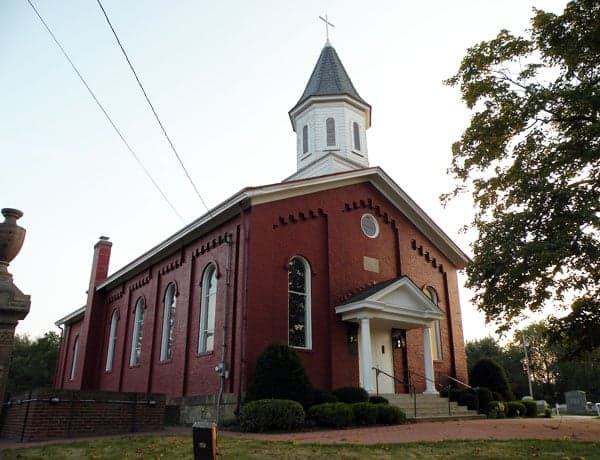
Photo: Wikipedia
Demographics of Franklin Park, PA
Affluence Level in Franklin Park, PA
An upper-middle-class area. Household wealth, education levels, and homeownership run ahead of national benchmarks.
People of Franklin Park, PA
Franklin Park, Pennsylvania, is a small borough of 15,273 residents that has transformed from a quiet farming crossroads into one of the most highly educated and ethnically diverse communities in Allegheny County. With 75.2% of adults holding a college degree and a foreign-born population of 6.2%, the borough is defined by its concentration of professionals, particularly in technology and healthcare, who have been drawn by the proximity to Pittsburgh and the quality of the North Allegheny School District. The population is predominantly white (77.8%), but the most distinctive demographic marker is a robust Indian-subcontinent community that makes up 9.6% of residents, alongside a smaller East/Southeast Asian population of 4.2%. This is not a transient or tourist town; it is a stable, family-oriented suburb where property values and school rankings drive the character of daily life.
How the city was settled and grew
Franklin Park was originally part of a 1700s land grant tract known as the "Depreciation Lands," surveyed to compensate Revolutionary War soldiers. The area remained sparsely populated through the 19th century, with a handful of farms and crossroads hamlets. The first real settlement cluster was around the intersection of Brandt School Road and Nicholson Road, an area still referred to locally as Old Franklin Park, where German and Scots-Irish farming families built the earliest homes and the first one-room schoolhouse. A second early node developed along Wexford Road near the present-day border with Wexford, where a grist mill and blacksmith shop served the surrounding farmsteads. The borough was not formally incorporated until 1932, and for decades it remained a rural township of fewer than 1,000 people. The first significant growth wave came after World War II, when returning veterans and their families sought affordable land outside Pittsburgh. Builders developed modest ranch homes and Cape Cods in what is now the Franklin Park West neighborhood, between Brandt School Road and the northern borough line. These homes attracted a wave of white ethnic families—Italian, Polish, and Slovak—who had been living in Pittsburgh's older industrial neighborhoods and wanted yard space and better schools.
Modern era (post-1965)
The 1965 Hart-Cellar Act had little immediate effect on Franklin Park, as the borough remained overwhelmingly white through the 1970s and 1980s. The real demographic shift began in the 1990s, driven by two forces: the expansion of the North Allegheny School District's reputation and the growth of Pittsburgh's healthcare and technology sectors. The first Indian-subcontinent families began moving into the Franklin Park East neighborhood, a cluster of larger homes built in the 1980s and 1990s along Nicholson Road and surrounding cul-de-sacs. These were primarily professionals—engineers, doctors, and IT managers—employed at UPMC, Bayer, and the growing tech corridor along Route 28. By the 2000s, the Indian community had become the borough's largest non-white group, and its concentration shifted toward the newer developments in the Franklin Park North section, near the intersection of Brandt School and Babcock Boulevard, where custom-built homes on larger lots became available. The East/Southeast Asian population, smaller at 4.2%, is more dispersed but has a visible cluster in the Franklin Park South area, near the border with McCandless, where many families with children in the North Allegheny system settled. The Black and Hispanic populations remain very small (2.7% and 2.0% respectively) and are not concentrated in any single neighborhood. The white population, while still the majority, has aged in place in the older sections—particularly in the Franklin Park West ranch homes and the original Old Franklin Park farmhouse lots—while younger white families have been priced out of the newer subdivisions.
The future
The population trajectory of Franklin Park points toward continued ethnic diversification, but within a framework of economic and educational homogeneity. The Indian-subcontinent community is not plateauing; it is growing, driven by chain migration from established families and by the borough's reputation as one of the few Pittsburgh suburbs where a large Indian population already exists, making it a magnet for new arrivals. The East/Southeast Asian population is likely to grow more slowly, as it lacks the same critical mass. The white population is declining slightly as older residents pass away or move to retirement communities and are not fully replaced by younger white families, who often cannot afford the median home price of approximately $450,000. The borough is not tribalizing into hostile enclaves; rather, it is becoming a place where distinct ethnic groups live side by side in the same subdivisions, united by a shared commitment to the school district and property values. The next 10 to 20 years will likely see the Indian-subcontinent share rise toward 15-18%, the white share fall to around 70%, and the other groups remain stable. The borough will remain a high-cost, high-education suburb, not a melting pot in the traditional sense, but a place where economic status matters more than ethnic background.
For someone moving in now, Franklin Park offers a stable, safe, and academically intense environment where the population is becoming more diverse but remains unified by professional ambition and family priorities. The borough is not becoming a hip, urbanized enclave; it is solidifying its identity as a top-tier Pittsburgh suburb where the primary common language is the school district's test scores. New residents should expect a community that is welcoming to educated professionals of any background, but where the cost of entry—both financial and social—is high.

* Values derived from national, state, county, city and local statistics and may differ in a specific area. Last updated: 2026-05-01T10:35:29.000Z
Narrative content on this page is AI-generated and may contain mistakes. Verify any details that matter before acting on them.
ReloMaps may earn a commission from affiliate links at no extra cost to you.

