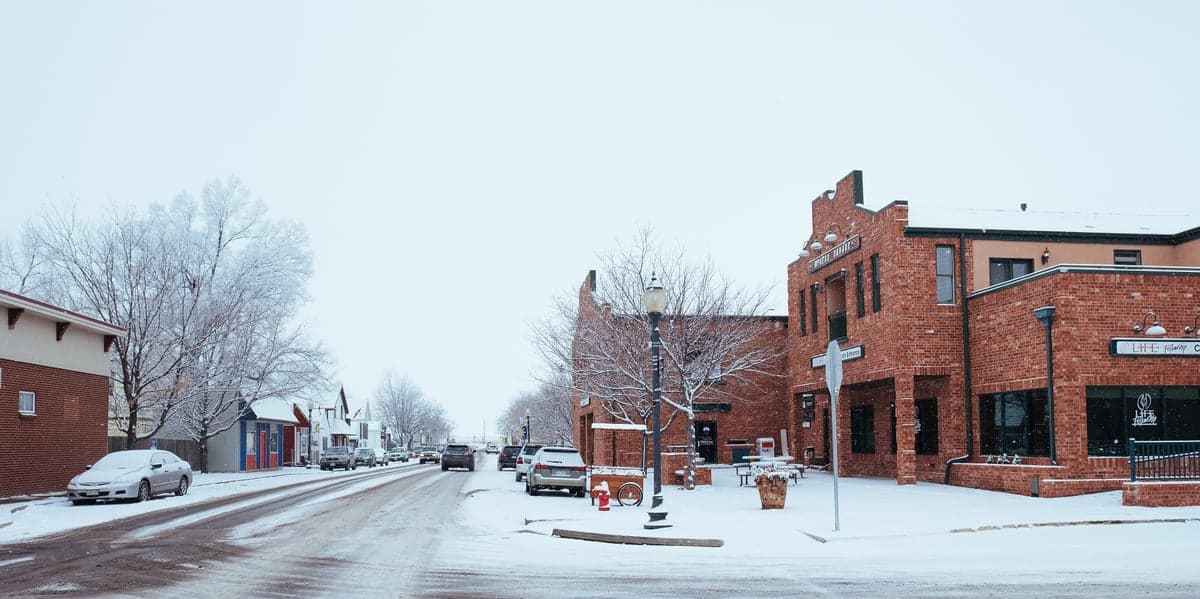
Photo: Wikipedia
Personal Sovereignty in Frederick, CO
Viable for self-reliance. Generally workable, though some barriers may limit total independence.
What does Personal Sovereignty tell us?
Personal Sovereignty measures your capacity for self-reliance and independence with minimal government friction. Higher scores mean fewer barriers between you and the way you want to live... but it assumes you have the space you need and good neighbors.
What does this tell us?
Personal Sovereignty measures your capacity for self-reliance and independence with minimal government friction. Higher scores mean fewer barriers between you and the way you want to live... but it assumes you have the space you need and good neighbors.
State Policy
Energy independence: Net exporter (110% of energy produced in-state)
Personal Liberty
Homesteading

Personal Liberty Analysis
Frederick, Colorado, offers a mixed but increasingly constrained environment for personal sovereignty, where the town’s small-town character and proximity to rural Weld County provide some buffer against the more aggressive regulatory impulses seen in Boulder or Denver, but state-level mandates and a growing local government apparatus steadily erode the autonomy that survivalist and prepper-minded individuals seek. The town sits in a state where the balance of power has tilted heavily toward centralized control, making Frederick a location that demands constant vigilance rather than passive acceptance. For those prioritizing self-reliance, the key is understanding that while the land itself may offer space, the legal and political framework is actively hostile to the kind of unfettered personal freedom that was once a given in rural Colorado.
Tax burden and regulatory posture in Frederick and Weld County
Colorado’s overall tax burden is moderate by national standards, but the state’s regulatory posture is where the real friction lies for sovereignty-minded residents. Frederick’s property tax rate, governed by Weld County, sits around 0.6% of assessed value, which is lower than many Front Range communities, but the state’s Gallagher Amendment repeal in 2020 has allowed residential property taxes to rise more freely, and annual reassessments have pushed valuations up sharply since 2022. Sales tax in Frederick is 8.3%, combining the state’s 2.9% rate with Weld County’s 1.1% and the town’s 4.3% — a notable bite on every purchase. More concerning than the rates themselves is the regulatory creep: Colorado’s strict land-use laws, including the 2023 Senate Bill 23-213, have given the state government unprecedented authority to override local zoning for housing density, which directly threatens the rural character that drew many to Frederick in the first place. The state’s energy mandates, including the 2019 Climate Action Plan targeting 100% renewable electricity by 2040, have already led to restrictions on natural gas hookups in new construction, a move that preppers see as a direct attack on energy independence. For those who value keeping more of their earnings and making their own choices about property use, Frederick’s local government is less intrusive than Boulder County’s, but the state-level apparatus is a constant source of overreach.
Self-defense and gun law specifics in Frederick and Colorado
Colorado’s gun laws have tightened significantly since 2013, and Frederick residents must navigate a patchwork of state and local restrictions that undermine the right to keep and bear arms. The state requires a background check for all firearm transfers, including private sales, and the 2023 law raising the minimum purchase age to 21 for all firearms was a direct infringement on the rights of adults under that age. Magazine capacity is capped at 15 rounds for handguns and 10 for long guns, a restriction that preppers view as dangerously limiting for defensive scenarios. Colorado is a “shall-issue” state for concealed carry permits, but the process requires an approved training course and a fee, and the permit is not recognized by several neighboring states. Frederick itself has not enacted its own gun control ordinances beyond state law, but the town’s proximity to Boulder County — which has some of the strictest local gun laws in the state, including bans on certain semi-automatic firearms — means that residents must be acutely aware of jurisdictional boundaries. The state’s “red flag” law, passed in 2019, allows for extreme risk protection orders that can result in firearms being seized without a criminal conviction, a tool that critics argue is ripe for abuse by vindictive neighbors or overzealous officials. For the survivalist, this means that maintaining a defensive capability in Frederick requires strict legal compliance and a willingness to challenge state overreach through organizations like the Colorado State Shooting Association.
Self-reliance and homesteading viability in Frederick
Frederick’s zoning and lot sizes offer some of the best opportunities for self-reliance within commuting distance of Denver, but the window is narrowing. The town’s agricultural zoning allows for lots as large as 5 acres in some areas, particularly in the unincorporated parts of Weld County that border Frederick, where residents can keep livestock, maintain gardens, and even construct outbuildings without the intense permitting seen in more urbanized counties. However, the town’s 2024 comprehensive plan pushes for higher-density development, and new subdivisions are increasingly limited to quarter-acre lots that make serious homesteading impractical. Water rights are a critical issue: Frederick relies on a mix of groundwater and purchased water from the Colorado-Big Thompson Project, and the town’s water rates have risen 40% since 2020, making self-sufficient rainwater collection or well drilling a more attractive but legally complicated alternative. Colorado law allows rainwater collection only for properties with a well permit or those on a domestic water system, and the state’s strict water rights doctrine means that any significant agricultural use requires a separate water right. Off-grid living is technically possible in Weld County, but the county’s building codes require compliance with the International Residential Code, and the state’s energy codes mandate certain efficiency standards that can make a fully self-sufficient cabin difficult to permit. For the prepper, the best strategy is to buy land in the unincorporated areas west of Frederick, where zoning is looser and the county’s enforcement is less aggressive, but even there, the state’s environmental regulations on septic systems and well drilling add layers of bureaucracy.
Personal liberties in Frederick: parental rights, medical autonomy, speech, and property
Parental rights in Colorado have been under sustained assault, and Frederick families must contend with a state government that has increasingly asserted authority over children’s education and medical decisions. The 2023 law requiring schools to allow students to use names and pronouns without parental consent is a direct violation of the family’s right to guide their children’s development, and the state’s comprehensive sex education mandate, which begins in kindergarten, removes parental opt-out options for certain materials. Medical autonomy is similarly constrained: Colorado’s vaccine mandates for school attendance, while not as strict as California’s, still require a complex exemption process, and the state’s 2023 law allowing minors to consent to certain medical procedures without parental knowledge is a clear overreach. Free speech protections in Frederick are generally strong, as the town has not enacted the kind of “hate speech” ordinances seen in some cities, but the state’s social media regulation efforts and the increasing politicization of public libraries mean that the cultural environment is shifting. Property rights are the most concerning area: Colorado’s 2021 law limiting short-term rentals has been used to restrict how homeowners can use their own property, and the state’s “just cause” eviction requirements, passed in 2024, limit a landlord’s ability to remove tenants, effectively creating a property right for renters that supersedes that of owners. For the sovereignty-minded, Frederick’s local government is less aggressive than Boulder’s, but the state’s preemption of local control means that even a conservative town cannot fully protect its residents from progressive mandates.
Overall, Frederick offers a relative sanctuary compared to the urban centers of the Front Range, but it is far from the bastion of personal sovereignty that preppers and survivalists might hope for. The town’s rural zoning and lower tax burden provide a foundation for self-reliance, but the state’s relentless expansion of regulatory authority — from gun control to parental rights to property use — means that residents must be proactive in defending their freedoms. Compared to areas like Wyoming or eastern Colorado’s Kiowa County, Frederick is a compromise: closer to employment and resources, but with a government that is increasingly comfortable telling you how to live. For those willing to fight for their autonomy at the ballot box and in the courts, Frederick can work, but it is not a place to let your guard down.

* Values derived from national, state, county, city and local statistics and may differ in a specific area. Last updated: 2026-05-01T00:51:00.000Z
Narrative content on this page is AI-generated and may contain mistakes. Verify any details that matter before acting on them.
ReloMaps may earn a commission from affiliate links at no extra cost to you.

