Photo: Wikipedia
Demographics of Fredericksburg, VA
Affluence Level in Fredericksburg, VA
A middle-class area roughly in line with national averages across income, home values, education, and employment.
People of Fredericksburg, VA
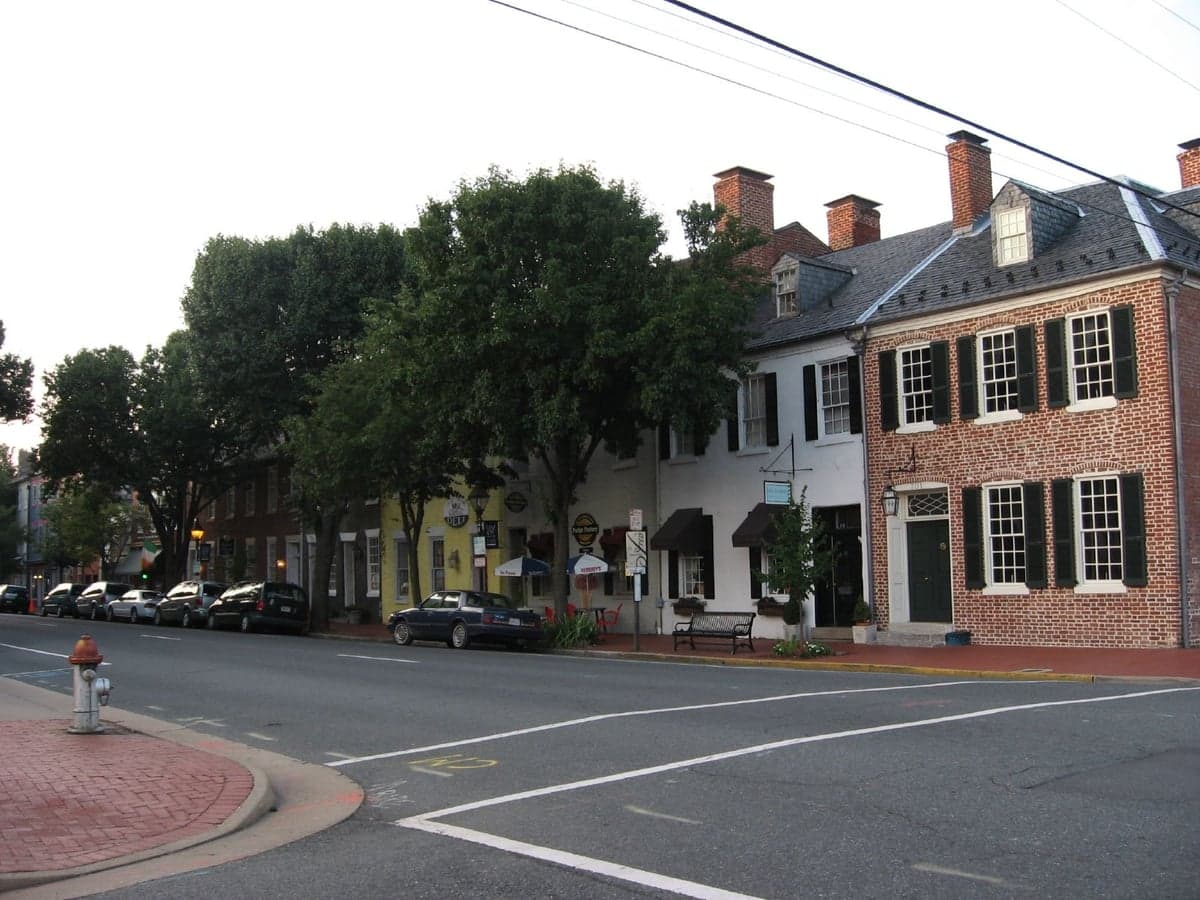
The people of Fredericksburg, Virginia today form a compact, historically layered community of 28,383 residents, characterized by a 55.6% white majority alongside significant Black (19.8%) and Hispanic (12.4%) populations, with a notable 7.9% foreign-born share. The city is denser and more diverse than surrounding Spotsylvania and Stafford counties, with 46.8% of adults holding a college degree—a figure that reflects the influence of the University of Mary Washington and a growing professional class. Distinctive identity markers include a strong preservationist ethos in the historic downtown, a visible military-connected population tied to nearby Marine Corps Base Quantico, and a palpable tension between long-standing Black neighborhoods and newer, whiter suburban infill.
How the city was settled and grew
Fredericksburg was founded in 1728 as a port town on the Rappahannock River, drawing its earliest white settlers—mostly English and Scots-Irish merchants, planters, and artisans—through tobacco trade and land grants from the Crown. The original grid, laid out by surveyor George Washington, centered on what is now the Historic Downtown district, where 18th-century warehouses and townhouses still line Sophia and Caroline Streets. Enslaved Africans arrived in large numbers from the 1730s onward, working the tobacco plantations that ringed the town; by 1790, enslaved people made up roughly half the local population. After the Civil War, freedmen established the Mayfield and Dixon Street neighborhoods east of the railroad tracks, which remain predominantly Black communities today. A second wave of white in-migration came in the late 19th and early 20th centuries, driven by railroad expansion and the establishment of the Fredericksburg Normal School (now UMW), which drew educators and administrators to the College Heights area west of the downtown core.
Modern era (post-1965)
The 1965 Hart-Cellar Act had a modest but measurable effect on Fredericksburg: the foreign-born share rose from under 2% in 1970 to 7.9% today, with the largest influx coming from East and Southeast Asia (3.1% of the city's population) and a smaller Indian-subcontinent community (0.6%). These groups concentrated in the Braehead and Kenmore neighborhoods, drawn by affordable postwar housing stock and proximity to I-95. Domestic in-migration accelerated after 1980, as Washington, D.C. commuters and military families from Quantico pushed into the city's northern edge, particularly the Lafayette Boulevard corridor and the Idlewild subdivision. The Hispanic population grew from negligible levels in 1990 to 12.4% today, largely through labor migration into construction and hospitality; many settled in the Rappahannock Landing area and along the Route 1 commercial strip. The Black population, once a majority in the 1960s, declined to 19.8% as middle-class Black families moved to Spotsylvania County, while white in-migration from the D.C. suburbs kept the city's white share at 55.6%.
The future
Fredericksburg's population is trending toward further diversification, but the pattern is one of distinct enclaves rather than wholesale integration. The Hispanic and East/Southeast Asian communities are growing steadily, with the foreign-born share projected to reach 10-12% by 2035, driven by continued service-sector demand and family reunification. The white population is aging in place in Historic Downtown and College Heights, while younger white families increasingly choose Spotsylvania or Stafford over the city's older housing stock. The Black population is plateauing, with outmigration to the suburbs balanced by some return of retirees to Mayfield and Dixon Street. The Indian-subcontinent community remains small (0.6%) and is unlikely to grow significantly without a major employer shift, as most tech and medical professionals prefer the D.C. suburbs. The city is not homogenizing—neighborhoods like Mayfield and Braehead remain ethnically distinct—but the overall trend is toward a more polyglot, service-oriented population that is less tied to the city's historic identity.
For a conservative-leaning mover considering Fredericksburg, the city offers a stable, historically rooted community with a growing diversity that is still manageable in scale. The population is becoming more Hispanic and Asian, but at a gradual pace that avoids the rapid demographic churn seen in larger D.C. suburbs. The key trade-off is between the walkable, historic character of downtown and the higher taxes and older infrastructure of the city core, versus the newer, more homogeneous subdivisions in the surrounding counties. Fredericksburg is becoming a denser, more cosmopolitan small city—but one where long-standing Black and white neighborhoods still define the social map.

* Values derived from national, state, county, city and local statistics and may differ in a specific area. Last updated: 2026-05-01T04:39:42.000Z
Narrative content on this page is AI-generated and may contain mistakes. Verify any details that matter before acting on them.
ReloMaps may earn a commission from affiliate links at no extra cost to you.

