
Photo: Wikipedia
Demographics of Gadsden, AL
Affluence Level in Gadsden, AL
A low-income area with significant economic hardship. Household wealth and educational attainment are well below national averages.
People of Gadsden, AL
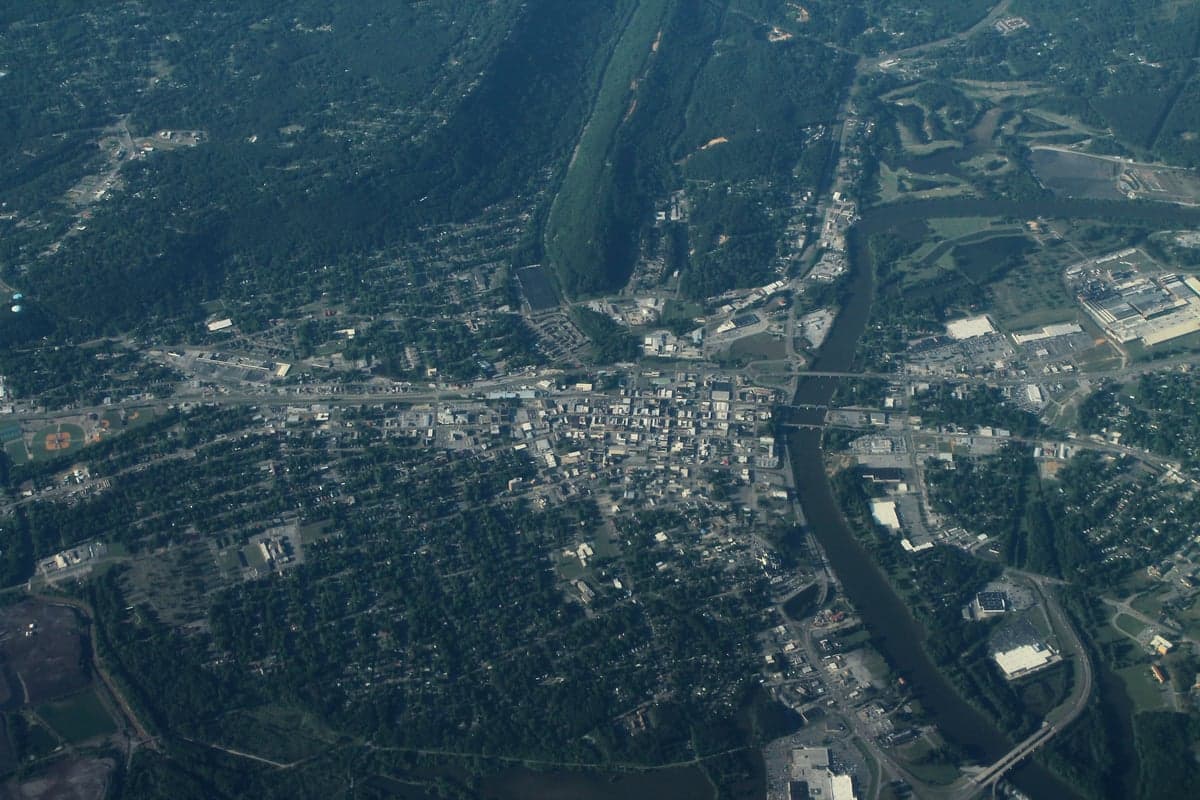
The people of Gadsden, Alabama today form a city of 33,617 residents defined by a near-even split between white (49.8%) and Black (36.8%) populations, with a growing Hispanic community (9.1%) and a very small East/Southeast Asian presence (0.8%). The foreign-born share stands at just 2.7%, well below the national average, and only 14.8% of adults hold a college degree—reflecting a historically industrial, blue-collar workforce. Gadsden’s identity remains rooted in its manufacturing past, with a population density of roughly 1,100 people per square mile that gives it a compact, small-city feel along the Coosa River. For a conservative-leaning reader, the city offers a racially diverse but culturally traditional Southern environment where church attendance, family ties, and local sports remain central to daily life.
How the city was settled and grew
Gadsden was founded in 1846 on land originally inhabited by the Cherokee, who were forcibly removed during the Trail of Tears in the 1830s. The city’s early white settlers were primarily Scots-Irish and English farmers from Georgia and the Carolinas, drawn by fertile river bottomlands and the promise of cotton agriculture. The arrival of the Alabama and Tennessee River Railroad in the 1850s transformed Gadsden into a regional shipping hub, and the post-Civil War era brought a second wave: freed Black families who settled in what became known as East Gadsden, a historically Black neighborhood along the river’s eastern bank where many descendants still live today. The industrial boom of the early 20th century—anchored by the Goodyear Tire & Rubber Company plant opening in 1929—drew a third wave of white Appalachian migrants from nearby counties and a smaller number of Italian and Greek immigrants who clustered in the South Gadsden district near the downtown mills. By 1950, Gadsden’s population had swelled to over 40,000, making it one of Alabama’s largest industrial cities, with a workforce overwhelmingly employed in tire manufacturing, steel fabrication, and textile mills.
Modern era (post-1965)
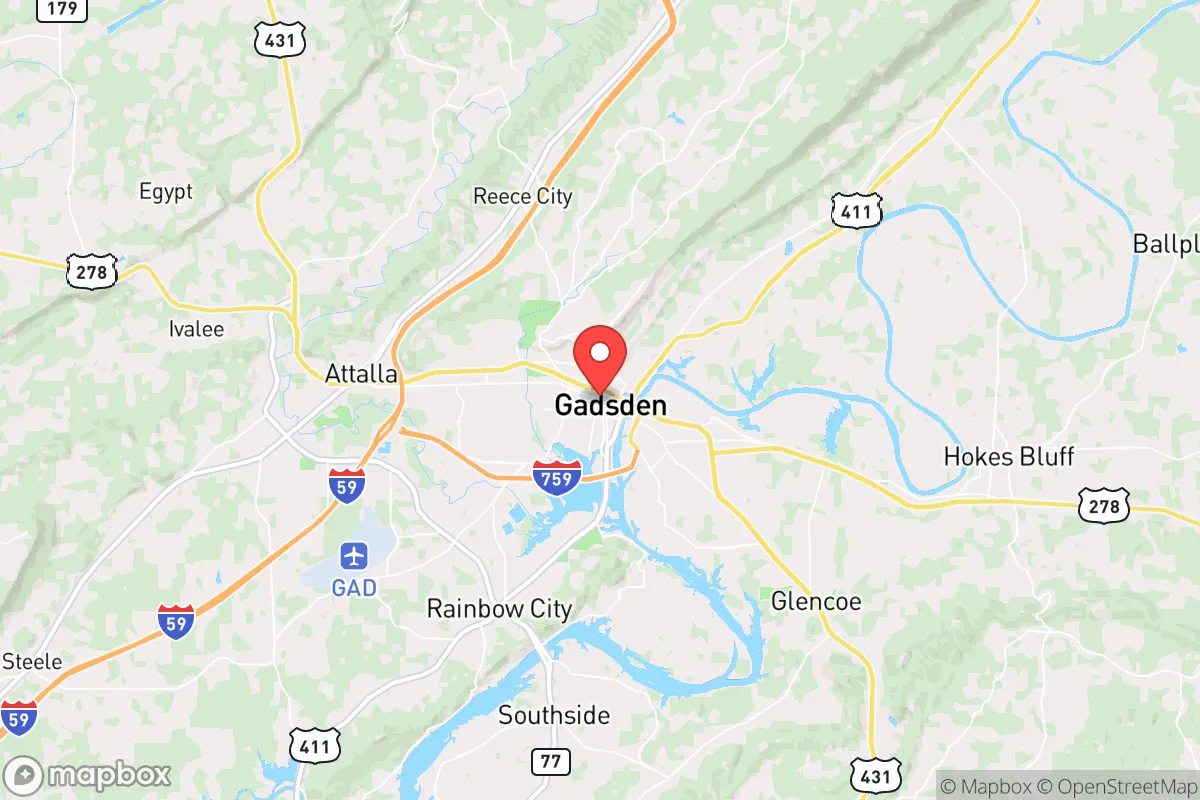
The post-1965 period brought significant demographic change. The 1965 Hart-Cellar Act had little direct effect on Gadsden—the foreign-born share remains tiny—but domestic migration reshaped the city. White flight to suburban areas accelerated after school desegregation in the 1970s, with many white families moving to the Rainbow City and Attalla areas just outside Gadsden’s city limits, while Black families expanded into previously white neighborhoods like North Gadsden and Walnut Park. The Hispanic population began growing in the 1990s, driven by Mexican and Central American workers recruited by poultry processing plants and construction firms; they concentrated in the West Gadsden corridor near U.S. Highway 411, where small tiendas and Spanish-language churches now dot the commercial strip. The Asian population remains negligible at 0.8%, consisting of a few dozen Vietnamese and Korean families who arrived in the 1980s and 1990s, mostly as small business owners in the restaurant and nail salon trades. The Indian-subcontinent population is effectively zero. The Goodyear plant closure in 2008 was a demographic shock, triggering a net population loss of roughly 5,000 residents over the following decade as younger workers left for Huntsville, Birmingham, or out of state.
The future
Gadsden’s population is projected to continue a slow decline, with the 2020 census showing 33,617 residents—down from 36,856 in 2010. The city is homogenizing in some respects: the white and Black shares have stabilized near parity, while the Hispanic share is growing modestly, likely reaching 12-14% by 2035 through both new immigration and higher birth rates. The East/Southeast Asian population will likely remain below 1%, as there is no existing community anchor or employer pipeline to attract further migration. The college-educated share is rising slowly, driven by a small influx of remote workers and retirees attracted to low housing costs—median home values around $120,000—but Gadsden remains a high-school-education city. The most likely future is a tri-ethnic white-Black-Hispanic composition, with the three groups living in distinct neighborhoods: white families in the suburban fringe, Black families in East Gadsden and North Gadsden, and Hispanic families in West Gadsden. Assimilation is occurring gradually, with second-generation Hispanic youth attending local schools and identifying as Southerners, but the city’s low immigration rate means change will be incremental rather than transformative.
For someone moving in now, Gadsden is becoming a more diverse but still deeply traditional Southern manufacturing town—a place where racial lines are visible in neighborhood geography but daily life is neighborly and church-centered. The population is aging and shrinking, but the low cost of living and strong local identity offer stability for families who value community over career mobility. The city’s future hinges on whether new employers can replace the lost industrial base, or whether the slow bleed of young adults to larger metros will continue.

* Values derived from national, state, county, city and local statistics and may differ in a specific area. Last updated: 2026-04-19T18:52:08.000Z
Narrative content on this page is AI-generated and may contain mistakes. Verify any details that matter before acting on them.
ReloMaps may earn a commission from affiliate links at no extra cost to you.

