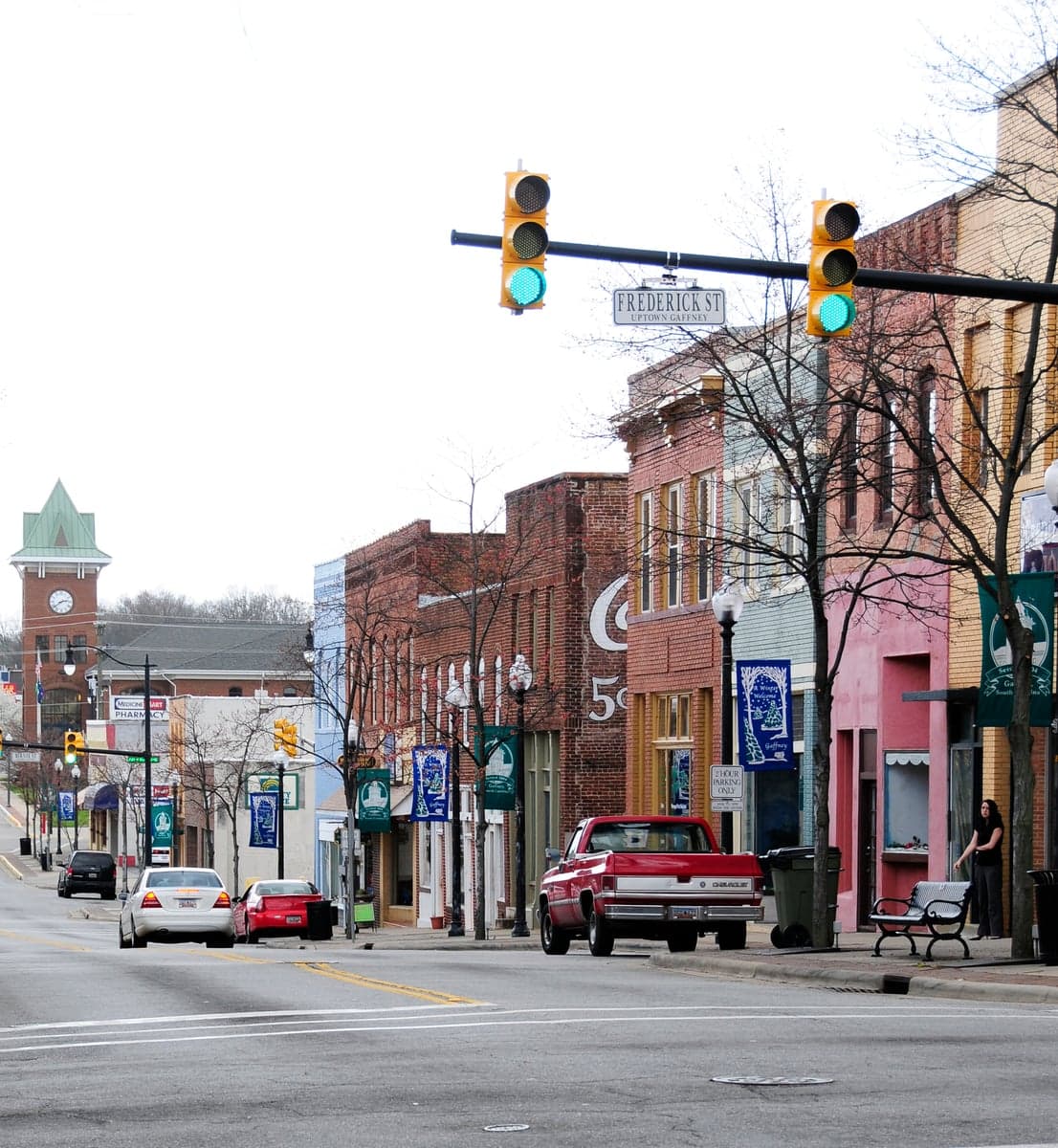
Photo: Wikipedia
Demographics of Gaffney, SC
Affluence Level in Gaffney, SC
A below-average socioeconomic profile. Incomes, home values, and educational attainment trail the U.S., with higher poverty and unemployment.
People of Gaffney, SC
The people of Gaffney, South Carolina today number 12,612, forming a nearly evenly split Black (40.9%) and White (42.3%) community with a small but growing Hispanic population (6.9%) and a very low foreign-born share of 3.9%. The city is denser than its Cherokee County surroundings, with a distinctly working-class character—only 21.8% of adults hold a bachelor's degree—and a strong textile-mill heritage that still shapes its neighborhoods and civic identity. Gaffney is a place where old mill-village loyalties and newer suburban subdivisions coexist, creating a community that is both rooted and slowly diversifying.
How the city was settled and grew
Gaffney was founded in the 1870s as a railroad depot town, named after Michael Gaffney, a local merchant who donated land for the tracks. The original settlers were predominantly Scots-Irish and English farmers moving down from the North Carolina Piedmont, drawn by cheap land along the Broad River. The real population boom came after 1900 with the rise of the textile industry. Cotton mills—including the Gaffney Manufacturing Company and later the Hamrick Mills—sprouted along the railroad corridor, and each mill built its own company housing. Limestone Street and the West End neighborhoods were built by and for these mill workers, almost entirely White families from the surrounding rural counties. Meanwhile, Black families who arrived for domestic and service work settled in the East Gaffney and South Gaffney districts, often in smaller, less formal housing clusters near the mill edges. By 1950, Gaffney was a classic Southern mill town: majority White, heavily unionized in the textile trades, and sharply segregated by race and neighborhood.
Modern era (post-1965)
The post-1965 era brought two major shifts. First, the Civil Rights movement and the end of legal segregation opened up housing and jobs, but Gaffney did not experience the large-scale suburban White flight seen in larger Southern cities. Instead, the textile industry's long decline—accelerated after the 1990s—hit all groups hard. Many White families left for Charlotte or Spartanburg, while Black families increasingly moved into formerly White mill-village homes in Limestone Street and the West End, making those neighborhoods more mixed. Second, the Hispanic population began arriving in the 1990s and 2000s, drawn by agricultural work (peaches, soybeans) and construction jobs. Today, Hispanic residents (6.9%) are concentrated in northern Gaffney near the Highway 29 corridor and in mobile-home parks on the outskirts, forming a small but visible community. The Asian population is negligible (0.0% East/Southeast Asian; 0.6% Indian subcontinent), and the foreign-born share (3.9%) remains well below the national average. The city's college-educated share (21.8%) is low, reflecting the loss of white-collar jobs and the difficulty of attracting professionals to a small, post-industrial town.
The future
Gaffney's population is slowly homogenizing in some ways and diversifying in others. The White and Black shares are converging toward parity, with the White share declining slightly and the Black share stable. The Hispanic share is growing, but from a small base, and is likely to reach 10-12% by 2035 if current trends hold. The city is not tribalizing into distinct enclaves—neighborhoods like Limestone Street and the West End are becoming more integrated by race, though income divides remain. The biggest demographic risk is out-migration of young adults, who leave for college or jobs in Charlotte (45 minutes north) and rarely return. The next 10-20 years will likely see Gaffney become a slightly more diverse, older, and poorer community, with the Hispanic share rising but the overall population flat or declining slightly. New subdivisions on the north side near I-85 may attract some commuters, but the city lacks the job base to draw significant in-migration.
Gaffney is becoming a more racially balanced but economically stagnant small city, where the old mill-village neighborhoods are slowly integrating and a small Hispanic community is taking root. For a conservative-leaning mover, this means a place with deep community roots, low cost of living, and a stable, slow-changing population—but also limited economic opportunity and a need to be comfortable in a nearly evenly split Black and White town with a modest but growing Hispanic presence.

* Values derived from national, state, county, city and local statistics and may differ in a specific area. Last updated: 2026-04-29T20:59:22.000Z
Narrative content on this page is AI-generated and may contain mistakes. Verify any details that matter before acting on them.
ReloMaps may earn a commission from affiliate links at no extra cost to you.

