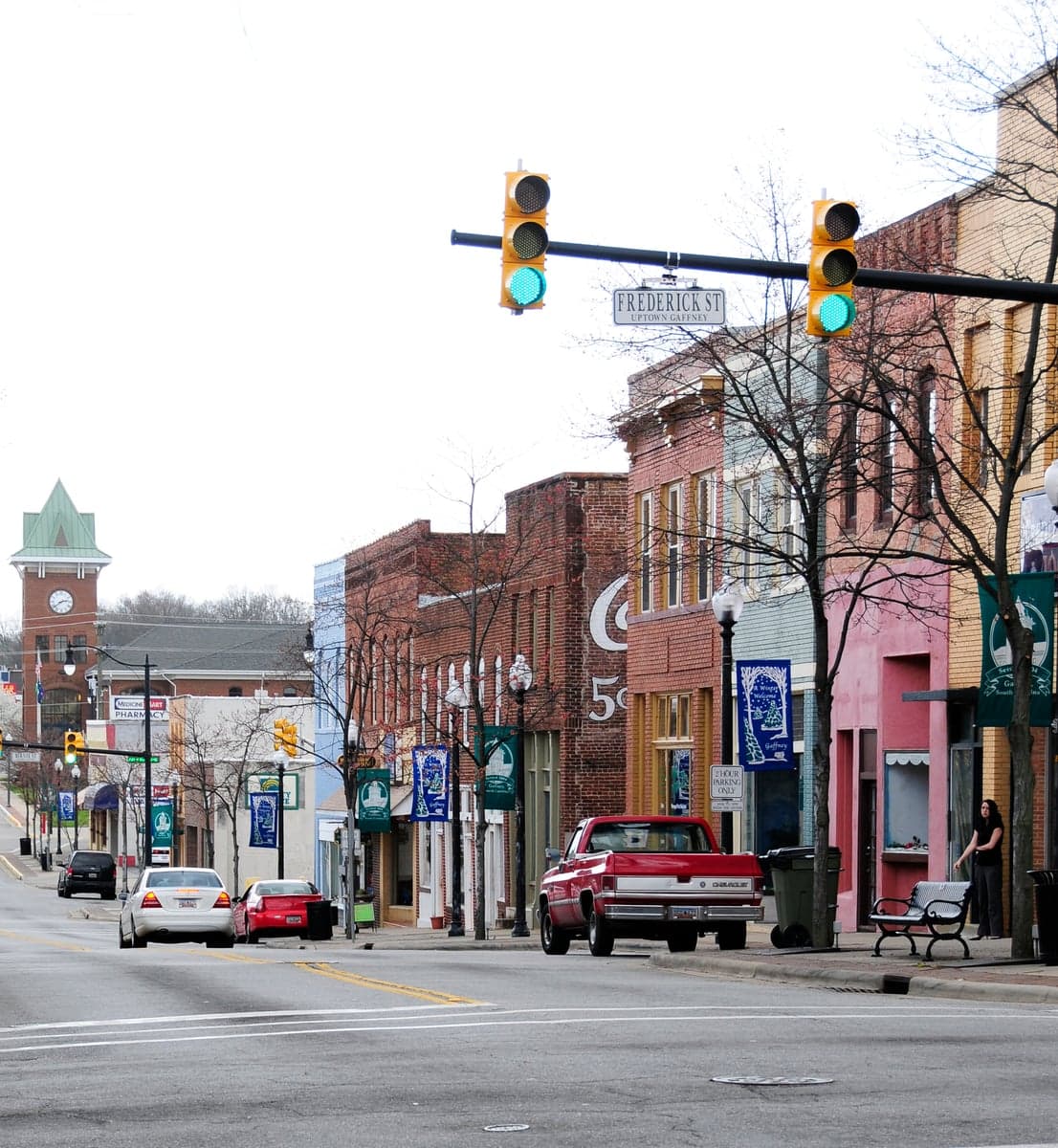
Photo: Wikipedia
Political ClimatePolitical Climate in Gaffney, SC
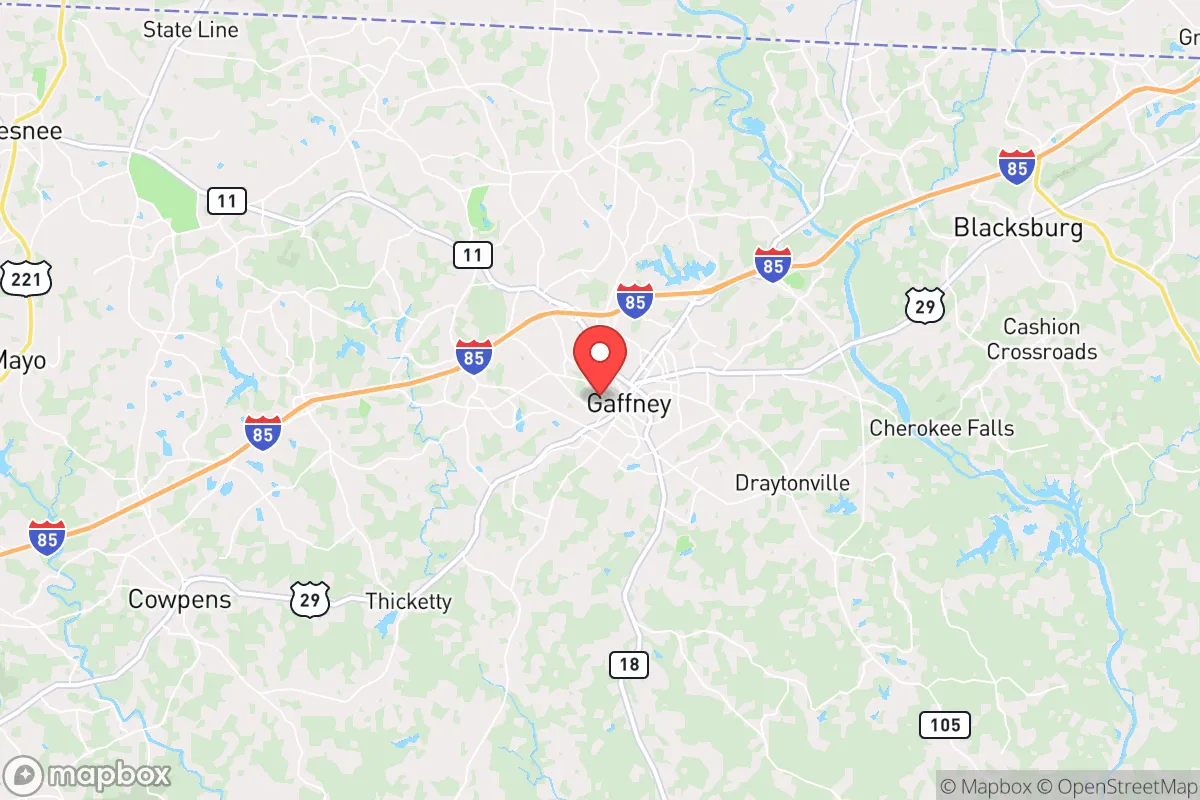
District shown is the primary district for this city’s centroid. Cities may span multiple districts.
Local Political AnalysisPolitical Analysis of Gaffney, SC
Gaffney, South Carolina, has long been a rock-solid conservative stronghold, and that’s not changing anytime soon. The area’s Cook Partisan Voting Index (PVI) of R+11 tells you everything you need to know—this isn’t a purple district or a swing county; it’s deep red territory where Republican candidates routinely win by double digits. If you’re looking for a place where traditional values and limited government still hold sway, Gaffney is about as steady as it gets, though you can feel the pressure from nearby cities like Spartanburg and Greenville creeping in with more progressive ideas.
How it compares
When you stack Gaffney up against its neighbors, the contrast is stark. Head south to Spartanburg, and you’ll find a city that’s been trending bluer over the last decade, with a growing young professional class and more Democratic votes in local races. Greenville, while still conservative overall, has seen a noticeable shift toward moderate and even progressive policies, especially on zoning and social issues. Gaffney, by contrast, remains a place where folks vote their conscience on Second Amendment rights, school choice, and lower taxes—without apology. The surrounding Cherokee County is even more conservative than the city itself, with rural precincts routinely voting 70-80% Republican. That’s a far cry from the more mixed results you’d see in parts of York County or even Union County to the east.
What this means for residents
For the people who live here, the political climate translates into a daily life that feels less burdened by government overreach. You won’t see the kind of heavy-handed regulations or progressive social experiments that are popping up in bigger cities. Property taxes stay reasonable, and there’s a general trust that local officials will keep their noses out of your business—whether it’s how you run your small farm, what church you attend, or how you choose to homeschool your kids. That said, there’s a growing unease among longtime residents as they watch nearby areas adopt policies that feel like they’re testing the limits of personal freedom. The concern is that if Gaffney isn’t careful, the same progressive drift could start showing up in school board meetings or county commission votes, especially as more people move in from out of state looking for cheaper housing but bringing different political baggage.
One thing that sets Gaffney apart culturally is its deep-rooted sense of community and self-reliance. You won’t find the kind of divisive identity politics that dominate national headlines here—people are more likely to judge you by your character than your party affiliation. But there’s also a quiet wariness about any shift toward progressive ideology, whether it’s in the form of critical race theory creeping into the local school curriculum or new zoning rules that feel like a backdoor way to control property rights. The long-term outlook is cautiously optimistic: as long as Gaffney holds the line on its conservative values and doesn’t let outside influences dilute its character, it’ll remain a place where freedom and common sense still matter. But if the trend lines from Spartanburg and Greenville are any indication, staying vigilant is the price of keeping it that way.

State Political ClimatePolitical Climate in South Carolina
State Political AnalysisPolitical Environment in the State
South Carolina has long been a reliably red state, with a solid Republican lean that has only deepened over the past two decades. The GOP holds supermajorities in both chambers of the state legislature, and the state has voted Republican in every presidential election since 1980, with margins typically in the high single to low double digits. The dominant coalition is a mix of traditional conservatives, evangelical Christians, and a growing number of fiscally conservative transplants from the Northeast and Midwest. Over the last 10-20 years, the state has shifted rightward on most cultural and economic issues, though the coastal and urban areas have seen some blueing, creating a sharper urban-rural divide than in the past.
Urban vs. rural divide
The political map of South Carolina is a classic tale of two states. The rural Upstate and the Lowcountry's inland counties are deeply red, with places like Greenville, Spartanburg, and Anderson anchoring the conservative vote. These areas are dominated by manufacturing, agriculture, and a strong evangelical presence, and they reliably deliver 65-75% of the vote for Republican candidates. In contrast, the coastal metros—Charleston and Myrtle Beach—have become more competitive as transplants and tourism dollars have poured in. Charleston County, once reliably red, now often votes Democratic in statewide races, driven by the city's booming tech and hospitality sectors and an influx of younger, more progressive residents. Columbia, the capital, is a purple island in the middle of the state, with Richland County (home to the University of South Carolina) leaning Democratic while surrounding Lexington County remains deeply red. The rural black belt counties along the I-95 corridor, like Orangeburg and Sumter, are heavily Democratic but have low turnout, meaning their influence is muted in statewide elections.
Policy environment
South Carolina's policy environment is broadly conservative, with a strong emphasis on low taxes and limited regulation. The state has a flat income tax rate of 6.2% (with a scheduled phase-down to 6.0% by 2025), and no estate or inheritance tax. Property taxes are among the lowest in the nation, thanks to a 2006 law that capped annual increases. The regulatory climate is business-friendly, with a right-to-work law and a tort reform system that limits lawsuit abuse. On education, the state has expanded school choice through charter schools and a new Education Scholarship Account program (2023) that allows parents to use public funds for private school tuition. Healthcare policy is more mixed: the state did not expand Medicaid under the ACA, but it has a robust telehealth system and a growing number of direct primary care practices. Election laws are strict: voter ID is required, and the state has a 30-day residency requirement for registration. There is no early voting in the traditional sense, though absentee voting is available with an excuse. The state also passed a 2021 law banning drop boxes and limiting absentee ballot assistance, which has been praised by conservatives for election integrity.
Trajectory & freedom
South Carolina is trending toward more personal freedom in several key areas, though not without some concerning backsliding. On gun rights, the state passed constitutional carry in 2024, allowing law-abiding citizens to carry a concealed firearm without a permit—a major win for Second Amendment advocates. Parental rights were strengthened with the 2023 Parents' Bill of Rights, which requires schools to notify parents of any medical or mental health services offered to their children and prohibits classroom instruction on sexual orientation or gender identity in K-5. Medical autonomy took a hit with the 2023 near-total abortion ban (with exceptions for rape, incest, and life of the mother), which many conservatives see as a protection of life but some libertarians view as government overreach. Property rights remain strong, with no statewide rent control and a relatively straightforward eminent domain process. Taxation is trending downward, with the flat tax phase-down and a 2022 law that exempted military pensions from state income tax. However, the state's heavy reliance on sales tax (6% state rate, plus local add-ons) means low-income residents bear a disproportionate burden. The biggest freedom concern is the state's restrictive alcohol laws—no Sunday sales before 1 PM in many counties, and a state-run liquor distribution system that limits competition.
Civil unrest & political movements
South Carolina has seen relatively little civil unrest compared to other states, though there have been flashpoints. The 2015 Charleston church shooting sparked a movement to remove the Confederate flag from the Statehouse grounds, which was accomplished that year after a contentious debate. More recently, the 2020 Black Lives Matter protests in Charleston and Columbia were largely peaceful, though there were isolated incidents of property damage. On the right, the state has a strong grassroots conservative movement, with groups like the South Carolina Freedom Caucus pushing for stricter election laws and school curriculum transparency. Immigration politics are relatively quiet, as the state has no sanctuary cities and a 2011 law (SB 20) that requires law enforcement to check immigration status during traffic stops. There has been some secessionist rhetoric from fringe groups, but it has no mainstream traction. Election integrity remains a hot topic: the 2020 election saw no major scandals in the state, but the 2021 voting law was passed in response to widespread concerns about federal overreach. A new resident would notice that political signs and bumper stickers are common, but the culture is generally polite—people disagree without being disagreeable, at least in public.
Projection
Over the next 5-10 years, South Carolina is likely to remain a red state, but the margins could tighten as in-migration continues. The state is one of the fastest-growing in the nation, with most newcomers coming from blue states like New York, New Jersey, and California. Many of these transplants are fiscally conservative but socially moderate, which could push the state toward a more libertarian-leaning Republicanism. The coastal metros will continue to blue, but the Upstate and rural areas will remain deeply red, meaning the overall partisan balance may shift only slightly. The biggest wildcard is the state's growing Hispanic population, which is still small (about 6%) but could become a swing vote in a decade. The state's conservative policy environment is likely to persist, with further tax cuts, school choice expansion, and continued resistance to Medicaid expansion. However, the state's aging infrastructure and growing population will put pressure on roads, schools, and healthcare, which could lead to a push for more government spending—a tension that conservatives will need to manage carefully.
For a new resident, the bottom line is this: South Carolina offers a high degree of personal freedom, low taxes, and a culture that respects traditional values. You'll find a welcoming community of like-minded conservatives, especially in the Upstate and rural areas. But don't expect a libertarian paradise—the state still has its share of government overreach, particularly in alcohol regulation and healthcare. If you're moving here, get involved in local politics early, because the growth is changing the state fast, and the direction it takes will depend on who shows up. The schools are decent but vary widely by district, so do your homework on where you buy. Overall, it's a solid bet for someone looking to escape the chaos of blue states, but keep an eye on the coastal metros—they're where the political battles of the next decade will be fought.
* Values derived from national, state, county, city and local statistics and may differ in a specific area. Last updated: 2026-04-29T20:59:22.000Z
Narrative content on this page is AI-generated and may contain mistakes. Verify any details that matter before acting on them.
ReloMaps may earn a commission from affiliate links at no extra cost to you.

