
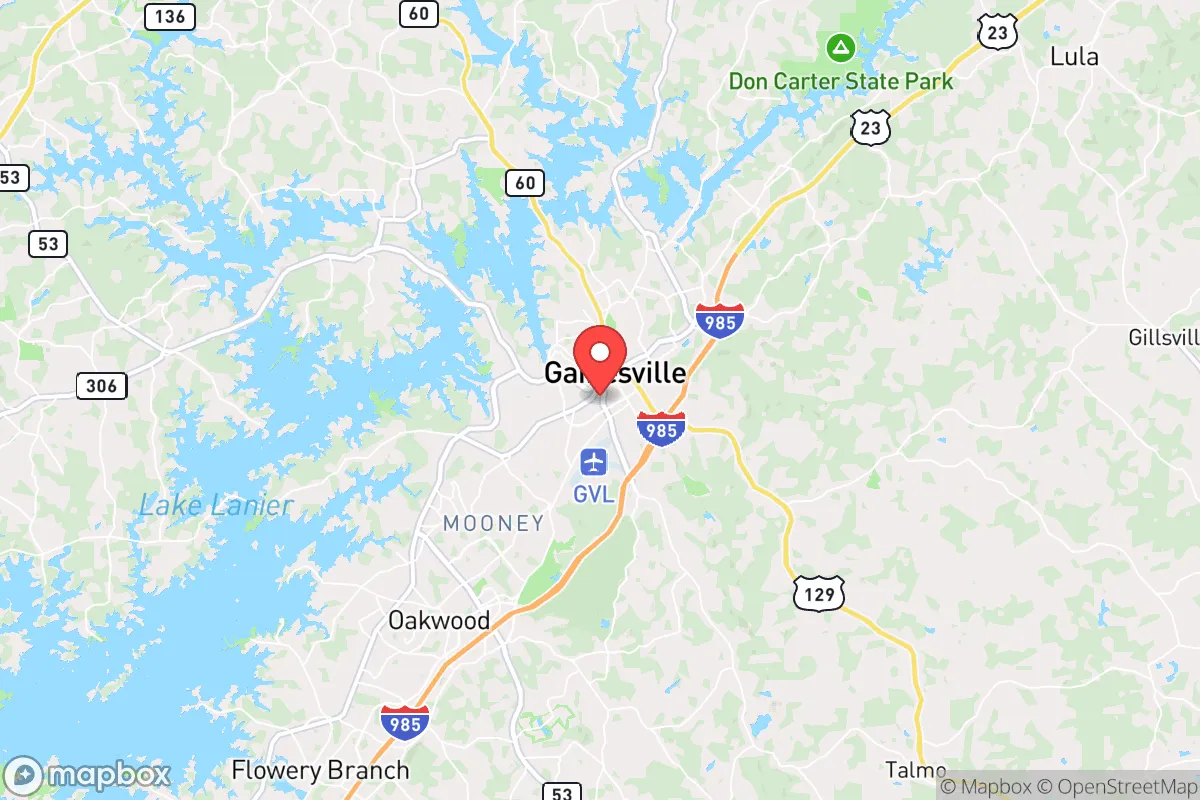
Photo: Wikipedia
Personal Sovereignty in Gainesville, GA
Viable for self-reliance. Generally workable, though some barriers may limit total independence.
What does Personal Sovereignty tell us?
Personal Sovereignty measures your capacity for self-reliance and independence with minimal government friction. Higher scores mean fewer barriers between you and the way you want to live... but it assumes you have the space you need and good neighbors.
What does this tell us?
Personal Sovereignty measures your capacity for self-reliance and independence with minimal government friction. Higher scores mean fewer barriers between you and the way you want to live... but it assumes you have the space you need and good neighbors.
State Policy
Energy independence: Importer (12% of energy produced in-state)
Personal Liberty
Homesteading

Personal Liberty Analysis
Gainesville, Georgia offers a notably high degree of personal sovereignty compared to most of the United States, driven primarily by Georgia’s strong state-level preemption laws and a local culture that values self-reliance over government intervention. For the survivalist or prepper mindset, this area presents a strategic balance: you are close enough to a major metro (Atlanta, ~50 miles south) for supply runs and economic opportunity, but far enough into the Hall County foothills to operate with minimal bureaucratic friction. The key question is whether the state’s legal framework and local enforcement culture actually back up the rhetoric of freedom — and in Gainesville, the answer is largely yes, with a few caveats around zoning and medical autonomy worth understanding before you move.
Tax burden and regulatory posture: how Georgia compares to high-control states
Georgia’s tax structure is deliberately designed to reward productive behavior and punish government dependency, which aligns directly with a prepper’s desire to keep more of what they earn. The state income tax is a flat 5.49% as of 2026, with no progressive brackets that penalize higher earners or side-hustle income from a home-based business or land improvement. Property taxes in Hall County average around 0.87% of assessed value, which is below the national average and significantly lower than states like New York (1.72%) or Illinois (2.07%). The state’s regulatory posture is equally favorable: Georgia is a right-to-work state, meaning no forced union membership, and it has no state-level occupational licensing requirements for dozens of trades that other states mandate. For someone looking to build a workshop, start a small manufacturing operation, or run a firearms-related business from their property, the permitting process in Hall County is straightforward and typically takes weeks, not months. The one regulatory friction point is environmental permitting for significant land alteration — if you plan to dig a large pond or clear more than an acre of forest, you will need a soil erosion permit from the county, but these are issued routinely and cost under $200. Compared to states like California or Oregon, where similar activities can trigger years of review, Gainesville feels like a regulatory free zone.
Self-defense and gun law specifics: what the Second Sanctuary means in practice
Hall County is a Second Amendment Sanctuary jurisdiction, and the local sheriff’s office takes that designation seriously. Georgia is a constitutional carry state as of 2022 — no permit is required to carry a concealed firearm for anyone legally allowed to possess one. For those who want the reciprocity benefits of a permit, Hall County issues Georgia Weapons Carry Licenses (WCL) with a typical turnaround of 30-45 days, and the process involves a simple background check and fingerprinting, no training requirement or psychological evaluation. The state’s Stand Your Ground law is among the strongest in the country: there is no duty to retreat in any place where you are lawfully present, and the law explicitly covers vehicles and workplaces. For preppers concerned about home defense, Georgia law also provides civil immunity for lawful self-defense shootings, meaning you cannot be sued by the attacker or their family if the use of force is justified. Magazine capacity is unrestricted, and there are no state-level bans on any type of firearm, including NFA items like suppressors and short-barreled rifles, provided you comply with federal law. The practical reality in Gainesville is that gun ownership is the norm, not the exception — you will see firearms displayed openly in vehicles and businesses, and law enforcement is generally supportive of armed citizens. The only restriction to be aware of is that carrying in certain government buildings (courthouses, post offices) remains prohibited, and private businesses can post signage to exclude firearms, though this is rare in the area.
Self-reliance and homesteading viability: lot sizes, zoning, and off-grid feasibility
Gainesville’s zoning code is a mixed bag for the serious homesteader, but the unincorporated areas of Hall County offer genuine off-grid potential. Inside the city limits, minimum lot sizes are typically 0.25 to 0.5 acres, and the city enforces building codes that require connection to municipal water and sewer — meaning no well or septic system is allowed. However, once you move outside the city limits into Hall County’s rural zoning districts, the minimum lot size jumps to 1 acre for a single-family home, and many parcels are available in the 5-20 acre range. The county allows private wells and septic systems as a matter of right, provided you pass standard health department tests for water quality and percolation. Solar panels are explicitly permitted by county code with no HOA-style restrictions, and several local installers specialize in grid-tied systems with battery backup. The biggest limitation for off-grid living is that the county requires a permanent dwelling with a minimum of 600 square feet — you cannot legally live in a tiny house on wheels, a shipping container, or a converted shed as a primary residence. However, you can build a pole barn or workshop first and then construct a small cabin or manufactured home on the same property. Rainwater collection is legal and encouraged, with no state-level restrictions on cisterns. For those wanting to raise livestock, Hall County allows up to four chickens per acre without a permit, and goats, sheep, and cattle are permitted on parcels of 2 acres or more. The county’s agricultural exemption for property tax is generous: if you have 5 acres or more and generate at least $1,000 in annual agricultural income (selling eggs, honey, timber, or livestock), your property taxes drop significantly. This is a concrete path to reducing your tax burden while building genuine self-sufficiency.
Personal liberties: parental rights, medical autonomy, speech, and property
Georgia has become a battleground for parental rights, and the current legal landscape in Gainesville strongly favors family autonomy. The state’s Parental Bill of Rights, enacted in 2022, gives parents the explicit legal authority to direct the upbringing, education, and healthcare of their children, including the right to opt out of any school curriculum or medical treatment they find objectionable. Hall County Schools have been notably cooperative with parents on issues of library book content and gender-related policies, and the school board is elected and responsive to conservative concerns. On medical autonomy, Georgia does not have a state-level vaccine mandate for adults, and the COVID-19 emergency orders were terminated in 2021 with no lingering restrictions. However, the state does require certain childhood vaccinations for school attendance, with only medical and religious exemptions available — philosophical exemptions are not recognized. For those concerned about future public health overreach, Hall County’s Board of Health is locally appointed and has shown resistance to state-level mandates during past health emergencies. Free speech protections are robust: Georgia has no hate speech laws that criminalize political or religious expression, and the city of Gainesville has not enacted any ordinances restricting public assembly or protest. Property rights are protected by Georgia’s strict eminent domain laws, which require that takings be for a genuine public use (not economic development) and that compensation be at fair market value plus relocation costs. The one area where personal liberty is notably constrained is in the realm of drug policy — Georgia has not legalized medical or recreational marijuana, and possession of any amount remains a criminal offense. For preppers who prioritize medical freedom, this means you cannot legally grow or possess cannabis for any purpose, and law enforcement in Hall County actively enforces these laws.
Overall, Gainesville offers a level of personal sovereignty that is rare in the Southeast and almost unheard of in the Northeast or West Coast. The combination of constitutional carry, strong Stand Your Ground protections, low taxes, minimal zoning in rural areas, and a legal framework that prioritizes parental rights creates an environment where a determined individual can live largely outside the reach of government overreach. The trade-offs are real: you are in a red state that still enforces federal drug laws, you cannot legally live in a tiny house, and the local health department has some say over your well and septic. But compared to the regulatory stranglehold of states like New York, California, or Colorado, Gainesville feels like a place where the government assumes you are competent to run your own life — and that assumption is the foundation of genuine sovereignty.

* Values derived from national, state, county, city and local statistics and may differ in a specific area. Last updated: 2026-04-30T03:02:14.000Z
Narrative content on this page is AI-generated and may contain mistakes. Verify any details that matter before acting on them.
ReloMaps may earn a commission from affiliate links at no extra cost to you.

