
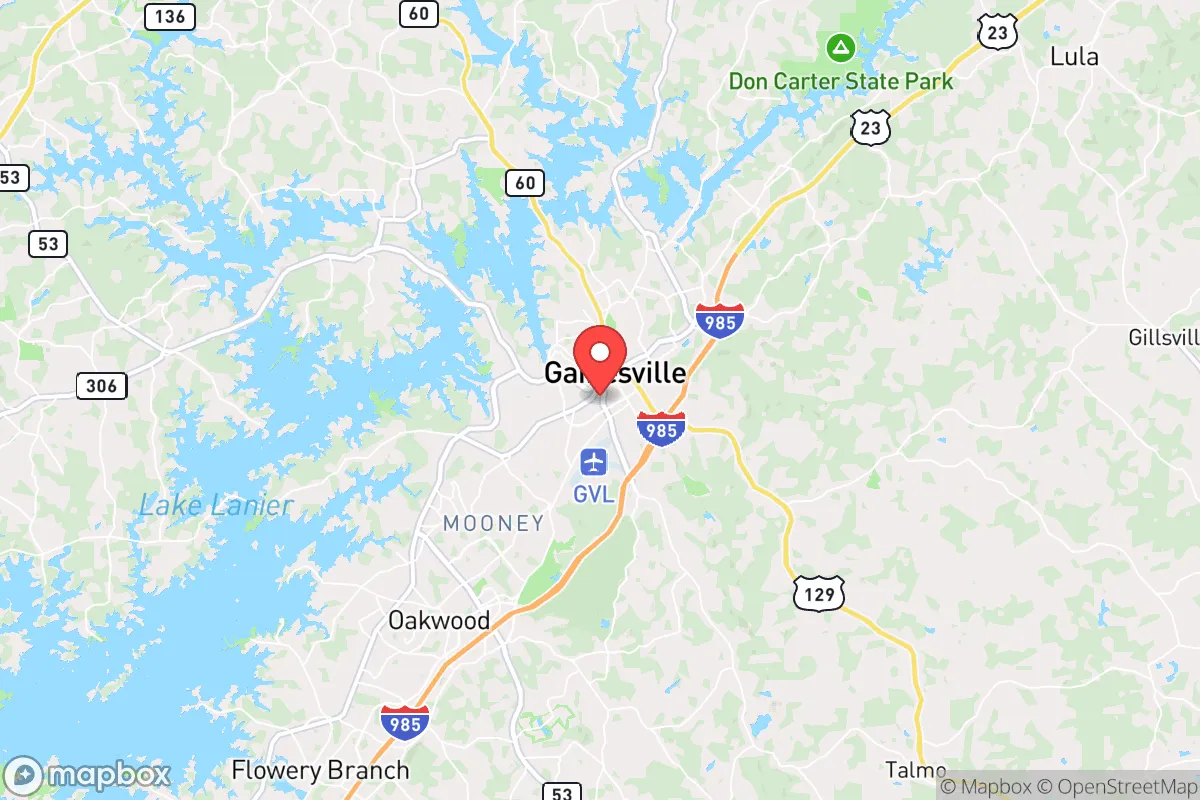
Photo: Wikipedia
Political ClimatePolitical Climate in Gainesville, GA
District shown is the primary district for this city’s centroid. Cities may span multiple districts.
Local Political AnalysisPolitical Analysis of Gainesville, GA
Gainesville, Georgia, has long been a reliably conservative stronghold, and the numbers back that up with a Cook PVI of R+17, meaning the area votes about 17 points more Republican than the national average. But if you’ve lived here as long as I have, you know the political climate isn’t just about party labels—it’s about a deep-seated belief in limited government, personal responsibility, and keeping Washington and Atlanta out of our local business. While the core of Hall County remains solidly red, you can feel the winds shifting in certain pockets, especially as new folks move in from places like California or New York, bringing with them a more progressive mindset that clashes with our traditional values.
How it compares
Compared to the rest of Georgia, Gainesville stands out as a conservative anchor. Drive 30 minutes south to Gwinnett County, and you’ll see a stark contrast—places like Duluth and Lawrenceville have swung hard left in recent years, with local governments pushing higher taxes and more regulations. Even closer to home, the city of Atlanta, just an hour south, is a whole different world, where government overreach into everything from zoning to business mandates is the norm. In Gainesville, we’ve largely held the line. Our county commission and school board elections still lean heavily Republican, and you won’t find the same push for radical social policies that you see in the metro area. That said, the influx of new residents from blue states is a real concern—some of them try to bring their big-government ideas with them, and it’s something we have to watch closely at the ballot box.
What this means for residents
For those of us who value personal freedoms, the political climate here means we can still live without constant government intrusion. You won’t see mask mandates or business shutdowns like you did in other parts of the state during the pandemic—our local leaders respected individual choice. Property taxes are relatively low compared to the Atlanta suburbs, and there’s no push for the kind of zoning overhauls that would let developers run wild without community input. But the long-term trajectory is what keeps me up at night. As Gainesville grows—and it’s growing fast, with new housing and commercial development popping up everywhere—the political balance could tip. If we’re not careful, we could end up with the same kind of progressive policies that have ruined other once-great towns: higher taxes, more red tape, and a loss of the local character that makes this place special.
Culturally, Gainesville still feels like a place where common sense rules. You’ll see American flags flying on Main Street, and the local churches are still a big part of community life. But there are warning signs. The push for “equity” initiatives in some local institutions and the slow creep of DEI training in schools are red flags that government overreach is trying to sneak in the back door. For now, we’re holding strong, but the next few elections will be critical. If you’re thinking about moving here, know that you’ll find a community that values freedom and self-reliance—but also one that’s fighting to keep it that way. Keep your eyes on local races, because that’s where the real battle for our way of life is happening.

State Political ClimatePolitical Climate in Georgia
State Political AnalysisPolitical Environment in the State
Georgia has shifted from a reliably red state to a true battleground over the past two decades, but it still leans right-of-center on most cultural and economic issues. The state voted for Joe Biden in 2020 by a razor-thin 0.2% margin, then re-elected Republican Governor Brian Kemp in 2022 by 7.5 points, while also sending two Democratic senators to Washington. This split-ticket reality reflects a deeply polarized electorate: the Atlanta metro has become a Democratic stronghold, while the rest of the state—especially the exurbs, small towns, and rural counties—remains solidly Republican. For a conservative considering relocation, Georgia offers low taxes and business-friendly policies, but the political trajectory is increasingly competitive, with demographic shifts and suburban migration steadily nudging the state toward purple status.
Urban vs. rural divide
The political map of Georgia is a tale of two Georgias. The Atlanta metropolitan area—encompassing Fulton, DeKalb, Cobb, Gwinnett, and Clayton counties—drives the state’s Democratic vote. Fulton County alone delivered nearly 400,000 votes for Biden in 2020, more than the entire population of some rural counties. Meanwhile, the rest of the state is overwhelmingly Republican. The rural southwest, including counties like Dougherty (Albany) and Colquitt (Moultrie), votes red, but with shrinking populations. The real conservative engine is the exurban ring: counties like Forsyth (Cumming), Cherokee (Canton), and Paulding (Dallas) have exploded in population and vote Republican by 30-40 point margins. The coastal city of Savannah (Chatham County) leans Democratic, while Augusta (Richmond County) is a blue island in a red sea. The key battlegrounds are the fast-growing suburban counties of Gwinnett and Cobb, which flipped from red to blue between 2016 and 2020, driven by an influx of diverse, college-educated professionals. If you’re moving to Georgia for a conservative environment, the exurbs north of Atlanta—places like Woodstock, Buford, and Suwanee—offer the most reliable Republican voting patterns, while the city itself and its inner suburbs are increasingly progressive.
Policy environment
Georgia’s policy environment is broadly conservative, with a few notable exceptions. The state has a flat income tax rate of 5.49%, which is scheduled to drop to 4.99% by 2029 under legislation signed by Governor Kemp. Property taxes are relatively low, with a median effective rate of 0.83% of home value, though they vary by county. The state is a right-to-work state, and its regulatory climate is business-friendly, with no state-level minimum wage (federal $7.25 applies) and limited occupational licensing burdens. On education, Georgia has a robust school choice program: the Georgia Promise Scholarship Act, passed in 2024, provides $6,500 per student for private school tuition or homeschooling expenses for families in low-performing school zones. The state also has a constitutional amendment protecting the right to keep and bear arms, and permitless carry was signed into law in 2022. However, healthcare policy is a mixed bag: Georgia did not expand Medicaid under the Affordable Care Act, but it did implement a limited “Georgia Pathways” work requirement program, which has seen low enrollment. Election laws have been a flashpoint: the 2021 Election Integrity Act (SB 202) added voter ID requirements for absentee ballots, limited drop boxes, and restricted third-party ballot collection—measures conservatives argue protect election security, while critics call them voter suppression. For a conservative, Georgia’s policy environment is largely favorable, but the constant political battles over election laws and voting access signal a state that is still sorting out its identity.
Trajectory & freedom
Georgia’s trajectory on personal freedom is a mixed picture, with clear gains in some areas and concerning trends in others. On the positive side, the state has expanded gun rights significantly: the 2022 permitless carry law (HB 218) allows any legal gun owner to carry a concealed firearm without a license, and the state preempts local gun ordinances, preventing cities like Atlanta from enacting their own restrictions. Parental rights were strengthened with the 2022 “Parents’ Bill of Rights” (SB 449), which requires schools to notify parents of any medical or counseling services provided to their children and prohibits classroom instruction on sexual orientation or gender identity in grades K-3. Property rights are generally strong, with no state income tax on Social Security benefits and a homestead exemption that shields a portion of home value from school taxes. However, there are warning signs. The state’s medical autonomy was compromised during COVID-19, when Governor Kemp issued a series of executive orders that included mask mandates and business closures, though he was relatively restrained compared to other states. More recently, the state has seen a push for “sanctuary city” policies in Atlanta, which the state legislature has countered with a 2024 law (SB 180) that requires local law enforcement to cooperate with federal immigration authorities. The biggest freedom concern for conservatives is the demographic shift: as more people move from blue states into the Atlanta suburbs, the political balance is tipping, and with it, the policy environment could shift leftward over time. If you value low taxes and gun rights, Georgia is still a good bet, but the trend line is toward more competition and less certainty.
Civil unrest & political movements
Georgia has seen its share of political flashpoints in recent years. The 2020 election aftermath was particularly intense, with widespread allegations of irregularities in Fulton County, leading to a controversial hand recount and the eventual certification of Biden’s win. This sparked a wave of election integrity activism, with groups like the Georgia Republican Assembly pushing for stricter voting laws, which culminated in SB 202. The state has also been a focal point for the “Stop the Steal” movement, with rallies at the state capitol and ongoing legal challenges. On the left, the 2020 murder of George Floyd sparked large protests in Atlanta, including the burning of the Wendy’s restaurant where Rayshard Brooks was killed by police. The city has since seen a rise in organized progressive activism, with groups like the Georgia Alliance for Social Justice pushing for criminal justice reform and defunding the police. Immigration politics are a growing issue: the influx of migrants through the southern border has led to increased tensions in rural counties like Whitfield (Dalton), where the poultry industry relies heavily on immigrant labor. The state has no sanctuary cities, but Atlanta’s “Welcoming City” ordinance limits cooperation with ICE, which has led to legislative pushback. For a new resident, the most visible political movement is the ongoing battle over election integrity, which remains a live issue ahead of the 2026 and 2028 cycles. If you’re moving to Georgia, expect to encounter a politically engaged population on both sides, with frequent rallies, town halls, and campaign events, especially in the Atlanta suburbs.
Projection
Over the next 5-10 years, Georgia is likely to become more competitive, but it will not flip blue overnight. The key demographic driver is the continued growth of the Atlanta suburbs, which are attracting young, college-educated, and diverse residents from other states. Gwinnett and Cobb counties are now reliably Democratic, and Forsyth County—once a Republican stronghold—is trending purple, with its Republican margin shrinking from 40 points in 2016 to 25 points in 2024. Meanwhile, rural counties are losing population, which reduces their electoral weight. However, the exurban and rural vote is still large enough to keep the state competitive. The 2026 gubernatorial election will be a bellwether: if a Republican can hold the governor’s mansion by a comfortable margin, the state will remain a lean-red battleground. If the Democrat wins, Georgia will be considered a true swing state. The state’s policy environment is likely to remain conservative for the next few years, but if Democrats gain control of the legislature—which is a long shot given current gerrymandering—expect to see pushes for Medicaid expansion, gun control, and higher taxes. For a conservative moving to Georgia, the safest bet is to settle in the exurban counties north of Atlanta, where the political culture is still reliably red and the schools are strong. The state’s trajectory is toward more political competition, but its low taxes and business-friendly climate are likely to endure for at least another decade.
For a conservative considering relocation, Georgia offers a solid mix of low taxes, gun rights, and school choice, but it is not a safe haven. The political climate is competitive and becoming more so, with the Atlanta metro driving a leftward shift that will only accelerate as the city grows. If you want a state where your vote will reliably count for conservative policies, the exurbs of Atlanta—places like Cumming, Canton, and Dallas—are your best bet. If you move into the city or its inner suburbs, expect to live in a blue enclave with progressive policies on everything from zoning to policing. The bottom line: Georgia is a good state for a conservative who is willing to stay engaged and vote, but it is not a place to take political stability for granted. The next decade will determine whether it remains a red-leaning battleground or becomes a blue state in the making.
* Values derived from national, state, county, city and local statistics and may differ in a specific area. Last updated: 2026-04-30T03:02:14.000Z
Narrative content on this page is AI-generated and may contain mistakes. Verify any details that matter before acting on them.
ReloMaps may earn a commission from affiliate links at no extra cost to you.

