
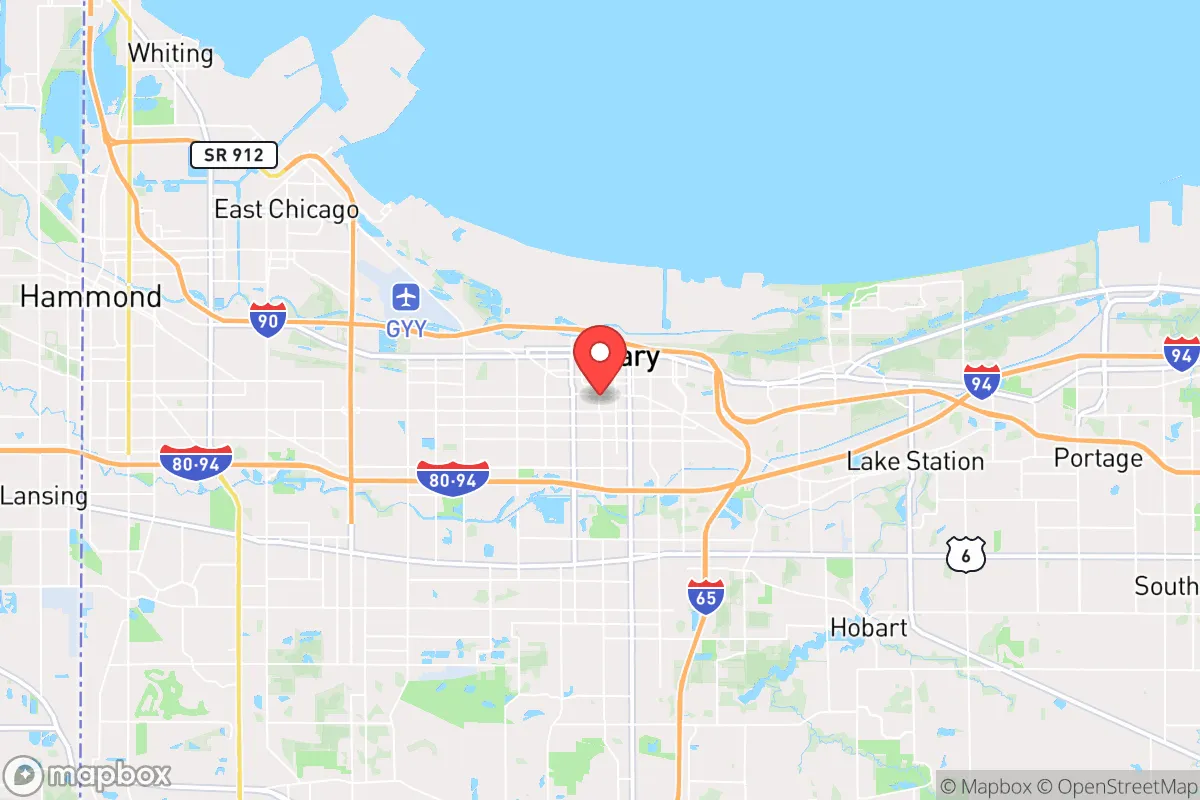
Photo: Wikipedia
Personal Sovereignty in Gary, IN
Viable for self-reliance. Generally workable, though some barriers may limit total independence.
What does Personal Sovereignty tell us?
Personal Sovereignty measures your capacity for self-reliance and independence with minimal government friction. Higher scores mean fewer barriers between you and the way you want to live... but it assumes you have the space you need and good neighbors.
What does this tell us?
Personal Sovereignty measures your capacity for self-reliance and independence with minimal government friction. Higher scores mean fewer barriers between you and the way you want to live... but it assumes you have the space you need and good neighbors.
State Policy
Energy independence: Importer (35% of energy produced in-state)
Personal Liberty
Homesteading

Personal Liberty Analysis
Gary, Indiana presents a deeply contradictory environment for personal sovereignty. While the state of Indiana generally offers a legal framework that respects gun rights and limits certain government overreach, the city of Gary itself is a high-tax, high-crime urban zone where de facto autonomy is severely constrained by public safety failures and a struggling local economy. For a survivalist or prepper, the calculus is stark: the state-level legal protections are solid, but the day-to-day reality of living in a city with a population decline of over 60% since 1960 and a violent crime rate roughly 4x the national average means that personal sovereignty is less about legal freedom and more about navigating a hostile environment where the state's monopoly on safety has effectively collapsed.
Tax burden and regulatory posture: how much of your income stays yours
Indiana is a relatively low-tax state overall, with a flat income tax rate of 3.05% (as of 2025, with scheduled reductions to 2.9% by 2027) and no inheritance or estate tax. However, Gary's local tax burden is punishing. The combined state and local sales tax is 7%, and property taxes in Lake County are among the highest in the state due to the city's shrinking tax base and legacy of industrial decay. A typical homeowner in Gary can expect an effective property tax rate around 2.0-2.5% of assessed value, compared to the state average of 0.85%. This means you're paying significantly more for fewer services—police response times are notoriously slow, and city infrastructure is crumbling. From a regulatory standpoint, Indiana is business-friendly with right-to-work laws and minimal occupational licensing burdens compared to coastal states. But Gary's local bureaucracy is inefficient; obtaining permits for home improvements or small-scale agriculture can be a headache. For a prepper focused on financial self-reliance, the high property tax is a direct drain on resources that could otherwise go toward supplies, land, or equipment.
Self-defense and gun law specifics: what you can carry and where
Indiana is a constitutional carry state as of July 2022, meaning no permit is required to carry a handgun openly or concealed for anyone legally allowed to possess a firearm. This is a major plus for personal sovereignty. There is no state-level red flag law, no magazine capacity restrictions, and no universal background checks for private sales. However, Gary is not a place where you want to test the limits of self-defense law in practice. The city has a homicide rate that consistently ranks among the highest in the Midwest, and the local police department has been under federal consent decree for years due to patterns of misconduct and understaffing. In a self-defense scenario, you may face a hostile legal environment from the local prosecutor's office, which has a reputation for being less gun-friendly than the rest of the state. Stand-your-ground laws apply statewide, but the practical reality is that a defensive shooting in Gary could lead to significant legal costs and scrutiny. For the survivalist, the legal right to carry is solid, but the social and legal risks of actually using a firearm in self-defense are higher here than in more rural parts of Indiana.
Self-reliance and homesteading viability: lot sizes, zoning, and off-grid feasibility
Gary's urban landscape is dominated by small lots, abandoned properties, and industrial brownfields. The median lot size for a single-family home is around 5,000 to 7,000 square feet, which is too small for meaningful homesteading. Zoning laws are typical of an older industrial city: residential areas restrict livestock, large gardens, and accessory structures like workshops or greenhouses without permits. Off-grid living is effectively illegal within city limits—Indiana building codes require connection to municipal water and sewer where available, and solar panels must comply with utility interconnection rules. However, the city's massive population loss has created a unique opportunity: vacant lots can be purchased for as little as $500 to $2,000 through the city's land bank program. If you're willing to navigate the bureaucracy, you could theoretically assemble multiple adjacent lots to create a larger parcel. But the soil in many areas is contaminated from decades of industrial activity (steel mills, refineries), making food gardening risky without raised beds and soil testing. For serious self-reliance, you're better off looking at unincorporated Lake County or nearby rural areas like Porter County, where you can find 1-5 acre parcels for $10,000-$30,000 with fewer zoning restrictions.
Personal liberties: parental rights, medical autonomy, speech, and property
Indiana has strong protections for parental rights in education, including a law requiring schools to notify parents of any changes to a student's health or well-being. The state also has a robust school choice program, including vouchers and charter schools, giving parents more control over their children's education. Medical autonomy is mixed: Indiana has some of the most restrictive abortion laws in the country (near-total ban with limited exceptions), which aligns with a conservative worldview, but it also has a vaccine mandate for schoolchildren that some libertarians view as overreach. Free speech is protected under the state constitution, and there are no notable local ordinances in Gary that suppress political expression. Property rights are where Gary falls short. The city has an aggressive demolition program for abandoned homes, and if you own a vacant lot or structure, you face constant pressure to maintain it to code or risk fines and liens. The property tax delinquency rate in Gary is around 20%, meaning the county tax sale system is a constant threat to landowners who fall behind. For the prepper, this means that holding property in Gary requires active vigilance and financial discipline—you cannot simply buy land and walk away.
Overall, personal sovereignty in Gary, Indiana is a study in contrasts. The state provides a solid legal foundation for gun rights, low income taxes, and parental control over education. But the city's fiscal collapse, high property taxes, and dangerous streets create an environment where true autonomy is constantly under siege from crime and bureaucratic decay. For a single individual or family with a survivalist mindset, Gary offers cheap real estate and legal gun freedom, but at the cost of living in a high-risk area where the social contract has frayed. Compared to a place like rural Montana or Texas, where you can buy 20 acres with no zoning and low taxes, Gary is a compromise that only makes sense if you have a specific reason to be in the Chicago metro area and are willing to treat the city as a base of operations rather than a long-term homestead. The sovereignty is there on paper, but in practice, you'll spend more time defending your property and navigating local government than actually building self-reliance.

* Values derived from national, state, county, city and local statistics and may differ in a specific area. Last updated: 2026-04-22T09:25:23.000Z
Narrative content on this page is AI-generated and may contain mistakes. Verify any details that matter before acting on them.
ReloMaps may earn a commission from affiliate links at no extra cost to you.

