Photo: Wikipedia
Demographics of Georgetown, KY
Affluence Level in Georgetown, KY
A middle-class area roughly in line with national averages across income, home values, education, and employment.
People of Georgetown, KY
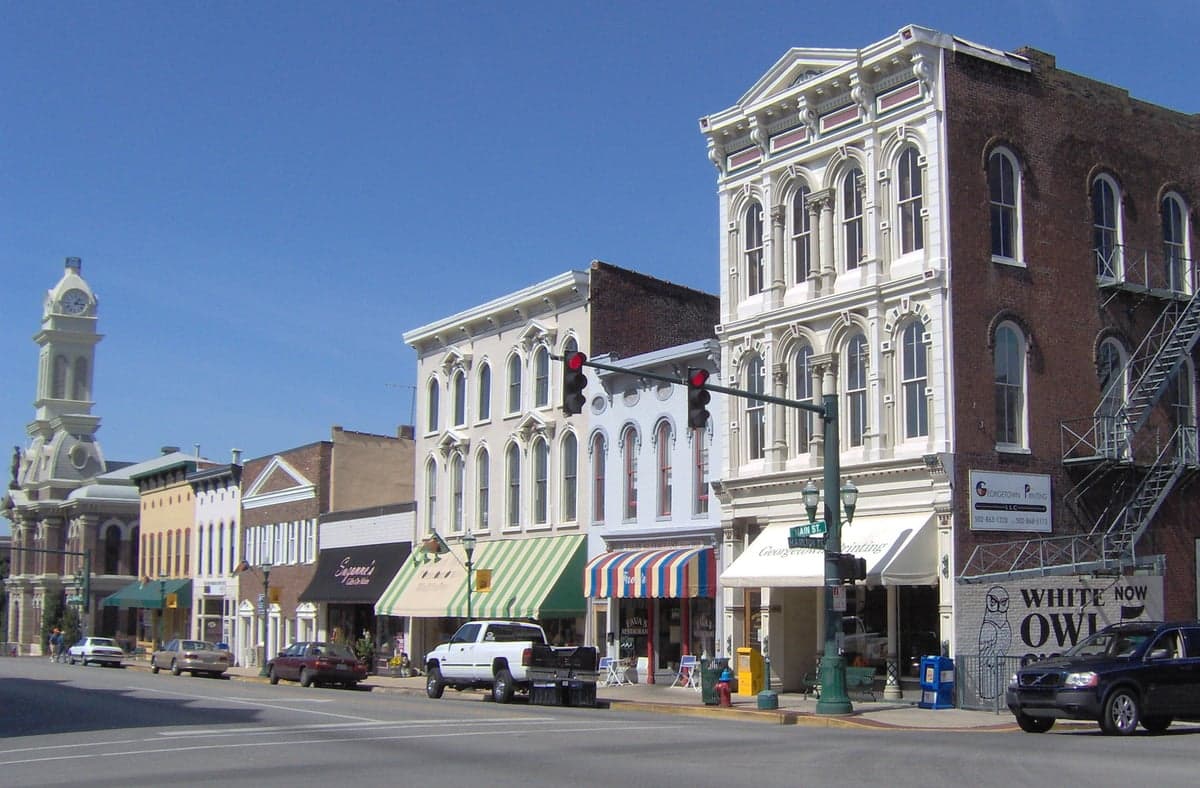
The people of Georgetown, Kentucky today form a predominantly white, family-oriented community of 38,206 residents, with a notably low foreign-born share of just 1.7% and a growing Hispanic population of 6.6%. The city’s character is shaped by its role as a Toyota manufacturing hub and a bedroom community for Lexington, producing a population that is 82.2% white, 5.7% Black, and 0.8% East/Southeast Asian, with 32.5% holding a college degree. Distinctive markers include a strong sense of local tradition, a visible military and veteran presence tied to the nearby National Guard base, and a civic identity centered on Georgetown College and the historic downtown square.
How the city was settled and grew
Georgetown was founded in 1784 as a frontier outpost on land granted to veterans of the Revolutionary War. The original white settlers were primarily of English, Scots-Irish, and German stock, migrating from Virginia, Maryland, and Pennsylvania via the Cumberland Gap. They built a compact grid of streets around the Scott County Courthouse, creating what is now the Historic Downtown District, where many original 19th-century homes and commercial buildings still stand. Enslaved Black laborers were brought to work the hemp and tobacco fields, and after the Civil War, a small free Black community coalesced in the South Broadway area, near the railroad tracks. Through the early 1900s, Georgetown remained a slow-growing agricultural market town, with population hovering around 5,000. The first major growth wave came in the 1950s and 1960s, when the construction of Interstate 75 and the expansion of Georgetown College drew middle-class families from rural Scott County into new subdivisions like Elm Tree Estates and Northside, which remain predominantly white, owner-occupied neighborhoods today.
Modern era (post-1965)
The single most transformative event in Georgetown’s modern history was Toyota’s 1985 announcement that it would build its first North American assembly plant just outside the city limits. This triggered a sustained in-migration of engineers, managers, and skilled tradespeople, many from Japan and the U.S. Midwest. The Japanese expatriate community, though small (0.8% East/Southeast Asian today), established a concentrated presence in the Cherry Blossom subdivision near the plant, where a Japanese Saturday school and cultural association operate. The plant also drew white-collar workers from across the U.S., who settled in newer subdivisions like Royal Spring and Meadow Creek, both of which are overwhelmingly white and above-average in income. The Hispanic population grew from near zero in 1990 to 6.6% today, driven by construction and service jobs tied to Toyota’s supply chain. These families initially clustered in older, more affordable housing stock in the West Main Street corridor and along US 25 South, where several Mexican grocery stores and a Catholic mission church now serve the community. The Black population, at 5.7%, has remained relatively stable, with most families living in the historic South Broadway area and newer subdivisions like Lakeview. The Indian-subcontinent population is negligible at 0.1%, reflecting the absence of a tech or medical hub that typically draws that group.
The future
Georgetown’s population is projected to continue growing at a moderate pace, driven by Toyota’s ongoing expansion into electric vehicle production and the spillover of Lexington’s suburban sprawl. The city is not homogenizing into a single identity; rather, it is tribalizing into distinct enclaves. The white majority remains dominant in the newer, higher-income subdivisions (Royal Spring, Meadow Creek, Cherry Blossom), while the Hispanic community is consolidating in the West Main and US 25 South corridors, where Spanish-language services and ethnic businesses are multiplying. The Black population is not growing significantly, and the East/Southeast Asian community is plateauing as the original Japanese expatriate families age and their children leave for larger cities. The foreign-born share, at 1.7%, is unlikely to rise sharply given the lack of refugee resettlement programs or a large university attracting international students. Over the next 10-20 years, Georgetown will likely become slightly more Hispanic and remain overwhelmingly white, with a stable but aging Black population and a tiny, assimilating Asian enclave.
For someone moving in now, Georgetown is becoming a more stratified but still safe, family-oriented suburb where neighborhood choice strongly correlates with income and ethnicity. The city offers a low-crime, high-amenity lifestyle for those who can afford the newer subdivisions, while older neighborhoods provide more affordable entry points for Hispanic and working-class families. The overall trajectory is toward a whiter, more Hispanic, and more economically segregated community, with little of the rapid diversification seen in larger Kentucky cities.

* Values derived from national, state, county, city and local statistics and may differ in a specific area. Last updated: 2026-04-21T09:46:36.000Z
Narrative content on this page is AI-generated and may contain mistakes. Verify any details that matter before acting on them.
ReloMaps may earn a commission from affiliate links at no extra cost to you.

