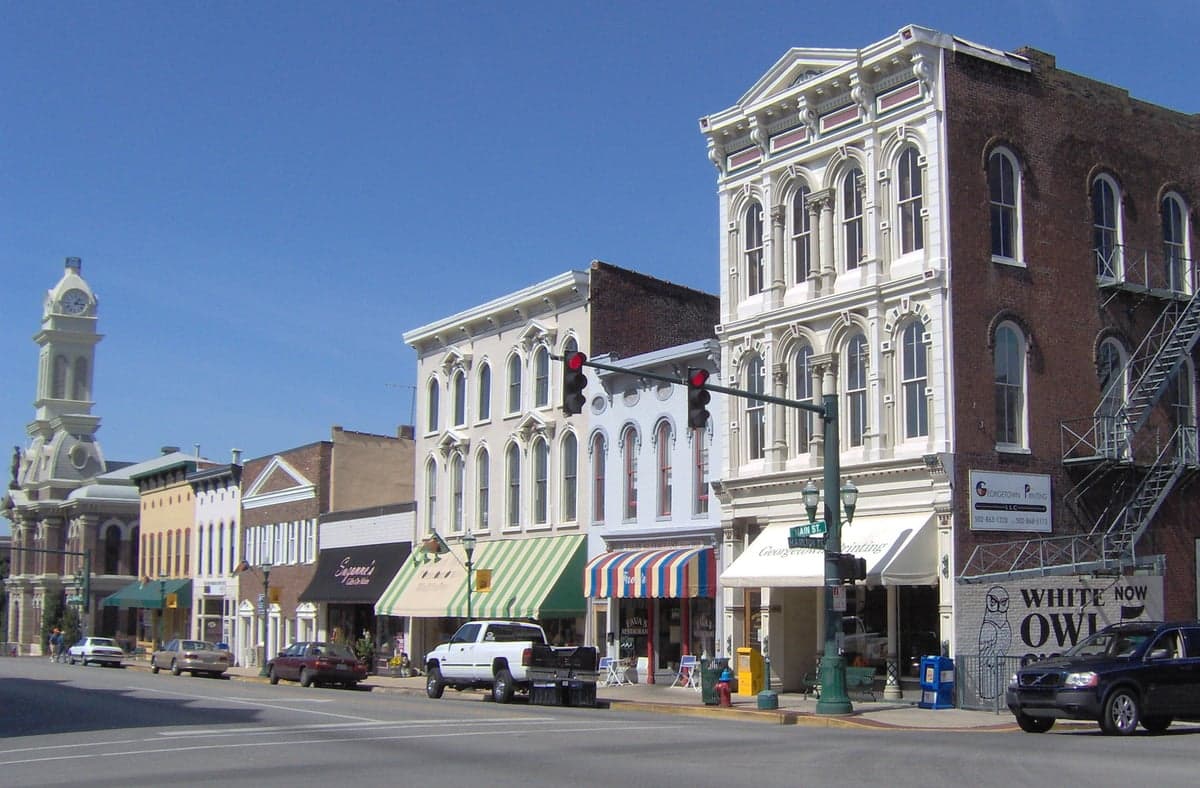

Photo: Wikipedia
Political ClimatePolitical Climate in Georgetown, KY
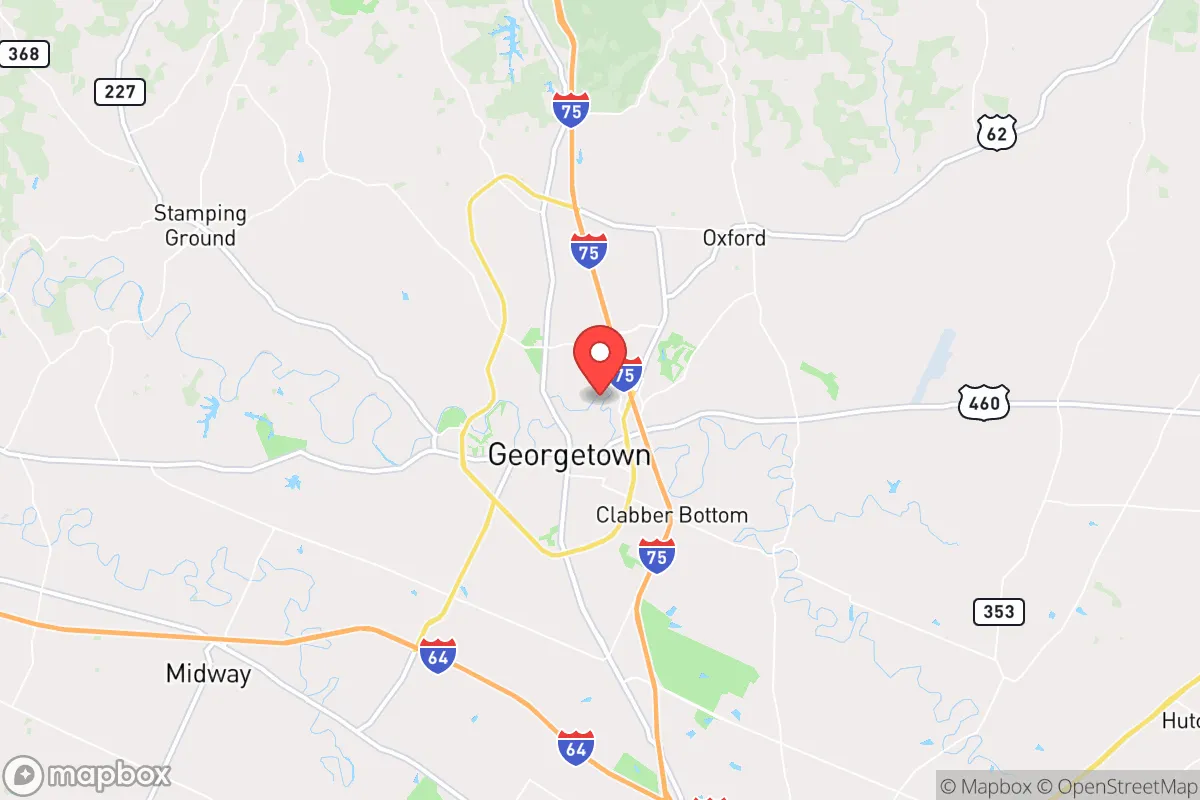
District shown is the primary district for this city’s centroid. Cities may span multiple districts.
Local Political AnalysisPolitical Analysis of Georgetown, KY
Georgetown, Kentucky, has long been a reliably conservative community, and that hasn't changed much despite the area's rapid growth. The Cook Partisan Voting Index (PVI) of R+7 tells the story: this is a solidly Republican district where you can expect most local and federal elections to lean right by a comfortable margin. But if you've lived here for a while, you'll notice the character of that conservatism is shifting. It used to be a quiet, "live and let live" kind of place, but now there's a growing unease about how much the government—both local and federal—is sticking its nose into our personal business.
How it compares
Drive ten miles north to Lexington, and you might as well be in a different country. That city has swung hard to the left in recent years, with a PVI of D+9, and you can feel the difference in everything from local ordinances to the general attitude toward personal freedoms. Georgetown, by contrast, has held the line. We're not as deep red as some of the rural counties to the south and east—places like Mount Vernon or London, where the PVI can hit R+30 or more—but we're a solid, sensible middle ground. The real contrast is with the state capital, Frankfort, which is a bit more purple but still leans left. When you see the kind of progressive policies they try to push down from there, it makes you appreciate Georgetown's stubbornness even more. We've managed to keep our local government focused on core services—roads, schools, public safety—without getting sidetracked by the kind of social engineering experiments you see in bigger cities.
What this means for residents
For the most part, it means you can go about your life without the government breathing down your neck. Property taxes are reasonable, zoning is straightforward, and there's a general understanding that you're responsible for your own success. But there are warning signs. The biggest one is the creeping influence of federal and state mandates that try to override local common sense. You see it in school board meetings, where parents are increasingly having to fight for their right to know what their kids are being taught. You see it in the push for "equity" initiatives that sound nice on paper but often lead to government overreach into private hiring and housing decisions. The good news is that the community pushes back. When Lexington tried to impose a plastic bag ban a few years ago, Georgetown's leaders wisely stayed out of it, recognizing that it's not the government's job to micromanage your shopping habits. That's the kind of common-sense conservatism that still holds here, but it takes constant vigilance to keep it that way.
Looking ahead, the biggest concern is the long-term cultural shift. As Toyota and other employers bring in new people from all over the country, we're seeing a slow but steady influx of folks who don't share the same values about limited government and personal responsibility. The next five to ten years will be critical. If we can keep our local elections focused on protecting individual rights—the right to keep what you earn, the right to speak your mind, the right to raise your family without government interference—then Georgetown will stay the kind of place where you can breathe easy. But if we let the progressive tide from Lexington and Frankfort wash over us, we'll lose what makes this town special. For now, it's still a good place to be, but keep your eyes open and your voice loud at those city council meetings. That's how we keep it ours.

State Political ClimatePolitical Climate in Kentucky
State Political AnalysisPolitical Environment in the State
Kentucky has been a reliably red state for decades, but it’s not the deep South stereotype you might imagine. The state leans Republican by about 15-20 points in presidential elections, with Donald Trump winning it by 26 points in 2020 and 30 points in 2024. But the real story is the shift: as recently as 2008, Kentucky voted for Barack Obama in the primary and only narrowly went for John McCain. The last 15 years have seen a dramatic realignment, with working-class white voters in rural areas and small towns abandoning the Democratic Party over cultural and economic issues, while the state’s few urban centers have become reliably blue. If you’re considering a move here, you’ll find a state that’s broadly conservative but with sharp local divides—and a political culture that values personal liberty, gun rights, and local control, even as national trends push in the opposite direction.
Urban vs. rural divide
The political map of Kentucky is a textbook case of the urban-rural split. Louisville (Jefferson County) and Lexington (Fayette County) are the state’s blue islands, with Louisville voting for Biden by 20 points in 2020 and Lexington by 15. These cities are home to the University of Kentucky, large hospital systems, and a growing professional class that leans left on social issues. But drive 20 minutes outside either city, and you’re in deep red territory. Northern Kentucky’s suburbs—like Covington, Florence, and Independence—have been trending redder as Cincinnati spillover brings in families fleeing Ohio’s tax hikes and COVID mandates. The state’s rural heartland—places like Bowling Green, Owensboro, Paducah, and the coal counties of eastern Kentucky (Harlan, Pike, Perry)—votes Republican by 40-60 points. The western part of the state, around the Jackson Purchase region, is also solidly red, with Murray and Mayfield being conservative strongholds. The only real exception is Frankfort, the state capital, which leans slightly blue due to state government workers. If you’re looking for a conservative community, you’ll find it almost everywhere outside the two major cities.
Policy environment
Kentucky’s policy environment is broadly conservative, but with some notable wrinkles. The state has a flat income tax that’s been cut from 5% to 4% as of 2025, with a path to elimination by 2028 under the Tax Cuts and Jobs Act-style reforms pushed by the Republican supermajority. Property taxes are low, and there’s no estate tax. The regulatory posture is business-friendly, with right-to-work laws and a tort reform cap on non-economic damages that’s kept lawsuit costs down. On education, Kentucky has a robust school choice movement: the state passed a charter school law in 2017 (though implementation has been slow) and created education opportunity accounts in 2021 that let parents use state funds for private school tuition. However, the state’s public school system is heavily unionized, and teacher strikes in 2018 and 2019 over pension reform showed the limits of conservative governance. On healthcare, Kentucky expanded Medicaid under the Affordable Care Act in 2014, and the state has a popular state-based exchange—but the Republican legislature has added work requirements and premiums for able-bodied adults. Election laws are solid: voter ID is required, no-excuse absentee voting was ended after 2020, and the state has a clean voter roll maintenance program. There’s no sanctuary city policy anywhere in Kentucky—local law enforcement cooperates with ICE.
Trajectory & freedom
Kentucky is moving in a decidedly more freedom-oriented direction, especially on gun rights and parental rights. In 2019, the state passed constitutional carry (permitless concealed carry), and in 2021 it passed a Second Amendment Preservation Act that prohibits state enforcement of any future federal gun bans. On parental rights, the 2022 “Parents’ Bill of Rights” (HB 563) requires schools to notify parents of any medical or mental health services offered to their children and prohibits instruction on sexual orientation or gender identity in K-5. In 2023, the legislature passed a ban on gender transition procedures for minors (SB 150), overriding the governor’s veto. Medical freedom got a boost with the 2021 COVID-19 vaccine mandate ban for state employees and contractors, and a 2023 law prohibiting vaccine passports. Property rights are strong: Kentucky is a “Dillon’s Rule” state but has preempted local gun and rental ordinances. The biggest concern for liberty-minded folks is the state’s high incarceration rate and a criminal justice system that’s tough on drugs—Kentucky still has mandatory minimums for some offenses. But overall, the trajectory is toward more personal autonomy, not less.
Civil unrest & political movements
Kentucky has seen its share of political flashpoints, but they’re mostly localized. The Breonna Taylor protests in Louisville in 2020 were the most intense, with months of nightly demonstrations, property damage, and a state of emergency. That event galvanized a progressive activist movement in Louisville, but it also hardened conservative sentiment in the rest of the state. The “Justice for Breonna” movement led to a police reform bill (banning no-knock warrants) that passed with bipartisan support, but it didn’t shift the state’s overall political balance. On the right, the Kentucky Freedom Coalition and local Tea Party groups are active, especially in rural counties. Immigration politics are relatively quiet—Kentucky has a small foreign-born population (about 4%), and there’s no sanctuary movement. Election integrity concerns flared after 2020, leading to the 2021 law tightening absentee voting and requiring signature verification. There’s been some nullification rhetoric around federal gun laws, but no serious secession talk. The most visible political movement you’ll notice is the “Let Them Grow” parental rights groups that show up at school board meetings, especially in suburbs like Boone County and Oldham County.
Projection
Over the next 5-10 years, Kentucky will likely get more conservative, not less. The in-migration pattern is key: people moving to Kentucky are coming from blue states like Illinois, California, and Ohio, and they’re choosing places like Bowling Green, Richmond, and the Lake Cumberland region for lower taxes and more freedom. These newcomers tend to be conservative-leaning, especially on economic and Second Amendment issues. The urban centers—Louisville and Lexington—will continue to drift left, but they’re losing population share to the suburbs and exurbs. The coal counties in eastern Kentucky will keep losing people, but the state’s overall political weight is shifting to the growing I-65 corridor (Louisville to Bowling Green) and the northern Kentucky suburbs. Expect the flat income tax to be fully eliminated by 2028, more school choice expansion, and further preemption of local ordinances on guns and housing. The biggest wildcard is the state’s pension crisis—Kentucky has one of the worst-funded public pension systems in the country, and a future fiscal crunch could force tax hikes or service cuts that might shift the political mood. But for now, the trajectory is clear: Kentucky is becoming a freer, more conservative state.
Bottom line for a new resident: If you’re moving to Kentucky for freedom, you’re making a smart bet. You’ll find low taxes, strong gun rights, parental control over education, and a political culture that values local control. Just know that Louisville and Lexington are blue bubbles, and the state’s pension debt is a ticking time bomb. Pick a county like Warren, Boone, or Oldham for the most freedom-friendly environment, and you’ll be set for the next decade.
* Values derived from national, state, county, city and local statistics and may differ in a specific area. Last updated: 2026-04-21T09:46:36.000Z
Narrative content on this page is AI-generated and may contain mistakes. Verify any details that matter before acting on them.
ReloMaps may earn a commission from affiliate links at no extra cost to you.

