
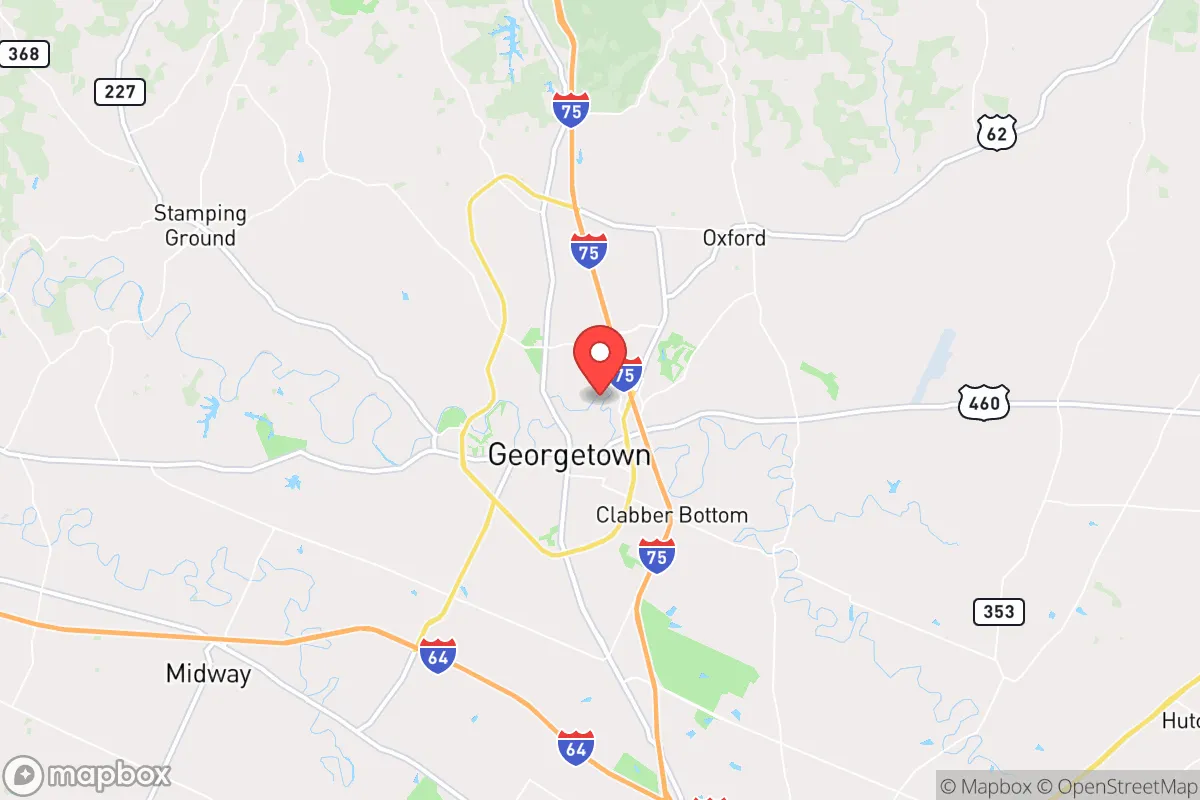
Photo: Wikipedia
Personal Sovereignty in Georgetown, KY
Viable for self-reliance. Generally workable, though some barriers may limit total independence.
What does Personal Sovereignty tell us?
Personal Sovereignty measures your capacity for self-reliance and independence with minimal government friction. Higher scores mean fewer barriers between you and the way you want to live... but it assumes you have the space you need and good neighbors.
What does this tell us?
Personal Sovereignty measures your capacity for self-reliance and independence with minimal government friction. Higher scores mean fewer barriers between you and the way you want to live... but it assumes you have the space you need and good neighbors.
State Policy
Energy independence: Importer (60% of energy produced in-state)
Personal Liberty
Homesteading

Personal Liberty Analysis
Georgetown, Kentucky, offers a notably high degree of personal sovereignty relative to much of the United States, particularly for those who prioritize minimal government interference in daily life. The city sits within a state that has consistently pushed back against federal overreach, maintaining a legal and cultural environment where individual autonomy—from gun rights to medical choice—is broadly protected. For the survivalist or prepper, this translates into a lower baseline of regulatory friction, though it is not a libertarian utopia; local zoning and state-level licensing still impose real constraints. The key question for a relocation-minded individual is whether Georgetown’s blend of state-level protections and local governance creates enough buffer against the national trend toward centralized control.
Tax burden and regulatory posture: how much the state leaves in your pocket
Kentucky’s tax structure is a mixed bag for the sovereignty-minded, but the trend is favorable. The state has a flat individual income tax rate of 4.5% as of 2025, with a scheduled reduction to 4.0% by 2026—a deliberate move to remain competitive with low-tax neighbors like Tennessee. Property taxes are low, with the effective rate in Scott County hovering around 0.85% of assessed value, well below the national average. There is no state-level tax on Social Security benefits, and military pensions are fully exempt, which matters for retirees or those planning a long-term independent lifestyle. Sales tax is 6%, but groceries and prescription drugs are exempt. The regulatory posture at the state level is generally permissive: Kentucky is a right-to-work state, has no state-level OSHA plan (federal OSHA covers it), and imposes minimal business licensing requirements for sole proprietors. However, Georgetown itself enforces standard building codes and zoning ordinances that can frustrate off-grid ambitions—more on that below. For a prepper, the key takeaway is that the state leaves a relatively large share of your income and property value in your hands, but local compliance costs (permits, inspections) still apply.
Self-defense and gun law specifics: what you can carry and where
Kentucky is a constitutional carry state, meaning no permit is required to carry a concealed firearm for anyone legally allowed to possess one. This went into effect in 2019, and Georgetown has not enacted any local ordinances that restrict it—city police do not enforce a separate permitting scheme. Open carry is also legal without a permit. The state preempts local gun laws, so Scott County cannot pass its own bans or magazine limits. Stand-your-ground laws are in effect, with no duty to retreat in any place you are lawfully present. For the survivalist, this is a strong foundation: you can carry a sidearm daily without bureaucratic hurdles, and self-defense claims are judged under a relatively broad standard. The only notable restriction is that Kentucky does not recognize out-of-state concealed carry permits from all states (though it honors many), so if you move from a non-reciprocal state, you may need to apply for a Kentucky concealed carry license (which is still shall-issue and inexpensive) to maintain reciprocity when traveling. There are no state-level restrictions on magazine capacity, and NFA items (suppressors, short-barreled rifles) are legal with federal compliance. Georgetown’s local law enforcement is generally supportive of gun rights; the police department does not maintain a voluntary firearm registry or conduct proactive confiscation programs.
Self-reliance and homesteading viability: lot sizes, zoning, and off-grid feasibility
This is where Georgetown’s sovereignty picture gets more complicated. The city itself is a growing suburb of Lexington, and its zoning code is typical of a mid-sized Kentucky town: residential lots in the city limits are often 0.25 to 0.5 acres, with strict setbacks and prohibitions on keeping livestock or poultry. If you want to raise chickens, have a large garden, or install solar panels with battery backup, you will need to be in the unincorporated areas of Scott County, where zoning is far more relaxed. Outside the city, minimum lot sizes for rural residential zoning are typically 1 to 5 acres, and many parcels allow for small-scale agriculture, beekeeping, and even limited livestock. Off-grid living—meaning no connection to municipal water, sewer, or electric—is technically possible on rural land, but you must comply with state health department requirements for septic systems and well water. Kentucky has no state-level ban on rainwater collection, and solar panels are permitted without special permits in most rural areas. However, the county does enforce building codes for any permanent structure, so a tiny house on wheels or a shipping container home may require a variance. For the prepper seeking true self-reliance, the strategy is clear: buy land outside the city limits, ideally 5+ acres, and build with code compliance in mind. The soil in Scott County is good for gardening (limestone-based, well-drained), and the growing season runs about 180 days, enough for most vegetables and some grains.
Personal liberties: parental rights, medical autonomy, speech, and property
Kentucky has been a battleground for parental rights, and the current legal environment is favorable to family sovereignty. The state passed a Parents’ Bill of Rights in 2022, requiring schools to notify parents of any medical or mental health services offered to minors and to obtain consent before administering surveys on sensitive topics. Homeschooling is straightforward: you must notify the local school board annually, but there is no curriculum approval, no standardized testing requirement, and no home visits. Medical autonomy is more mixed. Kentucky has not expanded Medicaid under the Affordable Care Act in a way that forces participation, but it does have a state-run health insurance exchange. Vaccine mandates are not enforced at the state level for private employers, and there is no state-level vaccine passport system. For the prepper concerned about medical freedom, the key is that Kentucky does not have a prescription drug monitoring program that is aggressively used to deny pain medication, though federal DEA restrictions still apply. Speech and assembly rights are robust; Georgetown has not enacted any local ordinances restricting public protest or leafleting, and the city’s public spaces (like the historic courthouse square) are open for expressive activity. Property rights are protected by Kentucky’s strong eminent domain laws, which require a public purpose and just compensation, and the state has no statewide rent control or landlord licensing schemes. For the survivalist, the property rights environment is a net positive: you can build a fence, store supplies, and keep your land without fear of government seizure for non-payment of taxes (though property taxes must be paid, of course).
Overall, Georgetown, Kentucky, ranks as a strong-to-moderate sovereignty location for the conservative prepper. It is not a free county in the libertarian sense—local zoning, building codes, and state health regulations impose real limits on off-grid living and self-reliance. But compared to the West Coast, the Northeast, or even much of the Midwest, the baseline of personal autonomy is significantly higher. The state’s constitutional carry law, low tax burden, parental rights protections, and permissive homeschooling environment create a buffer against federal overreach that many other areas lack. For a single individual or family willing to navigate local zoning and buy land outside the city limits, Georgetown offers a viable base for a self-sufficient lifestyle with minimal government interference in daily decisions about self-defense, education, and property use. The primary risk is that Scott County’s growth—driven by Toyota’s massive plant and Lexington’s sprawl—may eventually bring more restrictive local ordinances, so early relocation and careful land selection are advisable for those who value long-term sovereignty.

* Values derived from national, state, county, city and local statistics and may differ in a specific area. Last updated: 2026-04-21T09:46:36.000Z
Narrative content on this page is AI-generated and may contain mistakes. Verify any details that matter before acting on them.
ReloMaps may earn a commission from affiliate links at no extra cost to you.

