
Photo: Wikipedia
Demographics of Bibb County
Affluence Level in Bibb County
A below-average socioeconomic profile. Incomes, home values, and educational attainment trail the U.S., with higher poverty and unemployment.
People of Bibb County
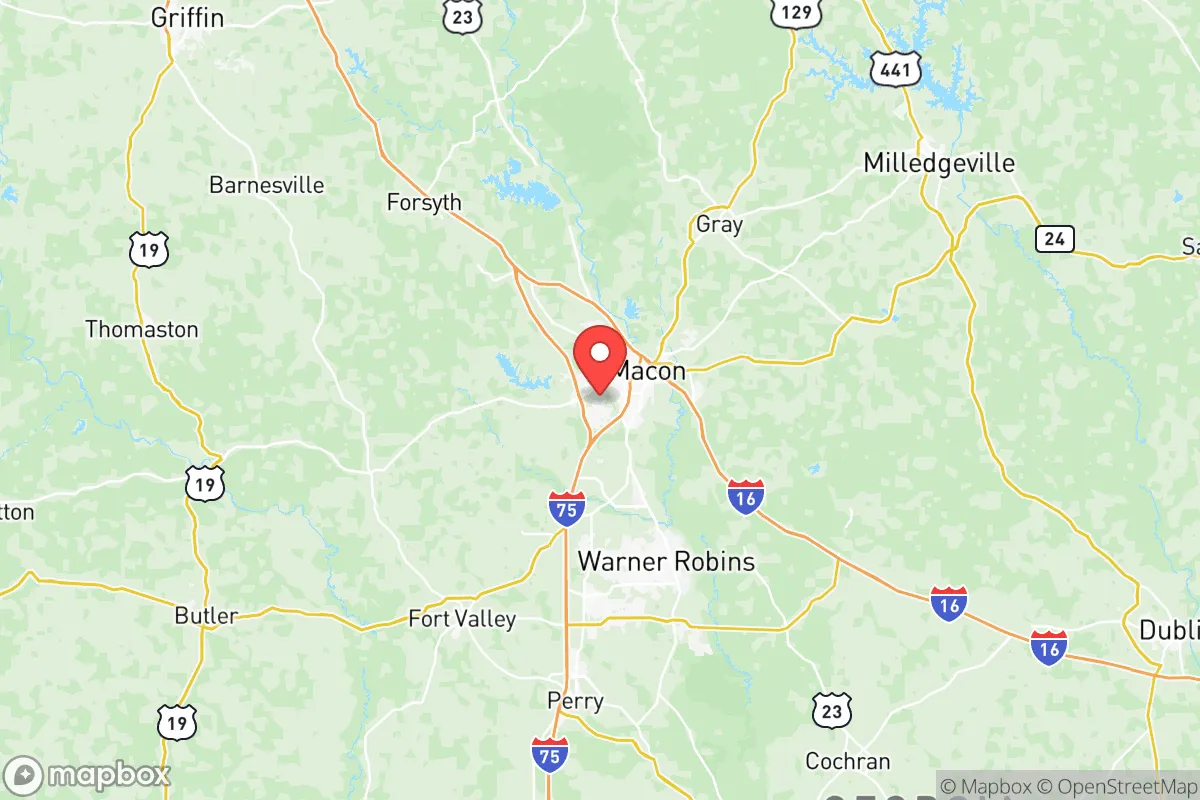
Bibb County, Georgia, anchored by the city of Macon, is home to 156,543 residents and stands as a historically Black-majority county in central Georgia, with a population that is 54.3% Black or African American and 34.9% White. The county’s identity is deeply shaped by its role as a regional hub for healthcare, education, and logistics, yet it retains a distinctly Southern, small-city character. With a foreign-born population of just 2.0% and a modest 4.5% Hispanic share, Bibb County remains less diverse than many other Georgia metros, but its demographic story is one of deep-rooted African American heritage, a shrinking White population, and slow, emerging growth among Hispanic and Asian communities.
Settlement & growth (pre-1960)
Long before European settlement, the area now known as Bibb County was part of the ancestral homeland of the Creek (Muscogee) Nation, who lived in scattered villages along the Ocmulgee River. The Ocmulgee Mounds, located just east of downtown Macon, preserve evidence of continuous Indigenous habitation dating back thousands of years, including the Mississippian culture that built the site’s iconic earthworks. By the early 1800s, the Creek people were forcibly removed through land cessions and the subsequent Trail of Tears, opening the region to White settlers.
Bibb County was created in 1822 from portions of Jones, Monroe, Houston, and Twiggs counties, with Macon established as the county seat the same year. The first wave of White settlers were primarily of English and Scots-Irish descent, migrating from the Upper South and coastal Georgia to farm the fertile Piedmont soil. The arrival of the railroad in the 1840s transformed Macon into a major transportation and commercial hub, and the city became a key manufacturing center for the Confederacy during the Civil War. After the war, the county’s economy shifted toward cotton, and the Black population swelled as newly freed African Americans settled in Macon and surrounding rural areas like Lizella and Payne City, seeking work as sharecroppers and laborers.
The early 20th century brought a second major demographic shift: the Great Migration. Between roughly 1910 and 1960, tens of thousands of Black residents left Bibb County for industrial jobs in the North, but the county’s Black population remained substantial due to natural increase and the presence of a stable Black middle class centered around Macon’s Pleasant Hill and Unionville neighborhoods. Meanwhile, White population growth slowed as suburbanization began pulling families toward newer developments in north Macon and unincorporated areas like Rocky Creek. By 1960, Bibb County was already a majority-Black county, a distinction it has held ever since.
Modern era (post-1965)
The 1965 Hart-Cellar Act had a limited direct impact on Bibb County compared to coastal Georgia or metro Atlanta. The county’s foreign-born population remains low at just 2.0%, and the immigrant communities that have arrived since the 1970s are small but notable. The largest group is Hispanic, now 4.5% of the population, with many families settling in south Macon and along the Eisenhower Parkway corridor. A smaller but growing East/Southeast Asian community, primarily of Vietnamese and Filipino origin, has concentrated in north Macon near the Mercer University area, drawn by educational and healthcare employment. The Indian-subcontinent population, at 0.9%, is also present but dispersed, with no single ethnic enclave.
Domestic migration has been more consequential. Since the 1970s, Bibb County has experienced a steady outflow of White residents to surrounding counties, particularly Monroe County to the north and Houston County to the south, a pattern of suburbanization and exurban flight common across the South. This has deepened the county’s Black majority, as the White population has fallen from over 40% in 1980 to 34.9% today. At the same time, the county has attracted some Black return migrants from the North, part of a broader reverse Great Migration that has brought African Americans back to the South since the 1990s. These returnees often settle in established Black neighborhoods like Bloomfield and East Macon, drawn by lower costs of living and family ties.
The county’s economy has shifted from manufacturing to healthcare and education, with major employers like Atrium Health Navicent, Mercer University, and Robins Air Force Base (just south in Houston County) anchoring the labor market. This has attracted a modest inflow of college-educated professionals, though Bibb County’s college attainment rate of 26.0% remains below the national average. The county’s population has been essentially flat since 2010, hovering around 155,000, as outmigration of White families has been offset by natural increase and small-scale immigration.
The future
Bibb County’s population is projected to remain stable or decline slightly over the next decade, as the county continues to lose White residents to surrounding suburbs while retaining a large, aging Black population. The Hispanic and Asian shares are expected to grow slowly, but from a very small base, meaning the county will likely remain a Black-majority, low-immigration area for the foreseeable future. The biggest demographic wildcard is whether Macon can attract more young professionals and families — particularly Black millennials and Gen Z returnees — through investments in downtown revitalization, the revitalization of the Ocmulgee River corridor, and the expansion of Mercer University. If successful, the county could see a modest reversal of population decline, but it is unlikely to experience the explosive growth seen in metro Atlanta’s northern suburbs.
For someone moving to Bibb County now, the area offers a deeply rooted African American cultural identity, a lower cost of living than most of Georgia, and a slower pace of life. The county is not becoming more diverse in the way that Atlanta or Savannah are, but it is becoming more stable, with a growing emphasis on healthcare, education, and historic preservation. New residents will find a community that is proud of its Black heritage, cautious about change, and increasingly focused on building a future around Macon’s historic downtown and riverfront rather than sprawling outward.

* Values derived from national, state, county, city and local statistics and may differ in a specific area. Last updated: 2026-08-08T19:25:03.000Z
Narrative content on this page is AI-generated and may contain mistakes. Verify any details that matter before acting on them.
ReloMaps may earn a commission from affiliate links at no extra cost to you.

