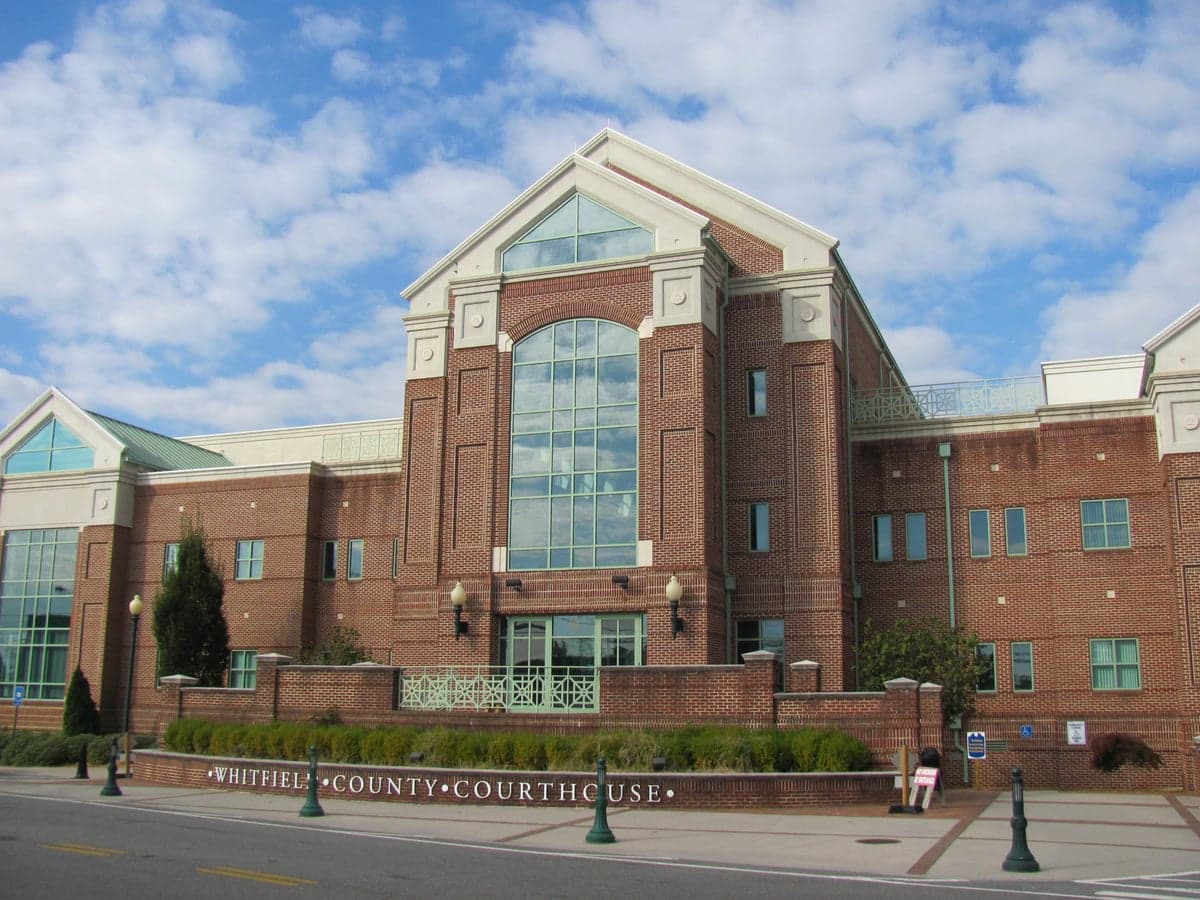
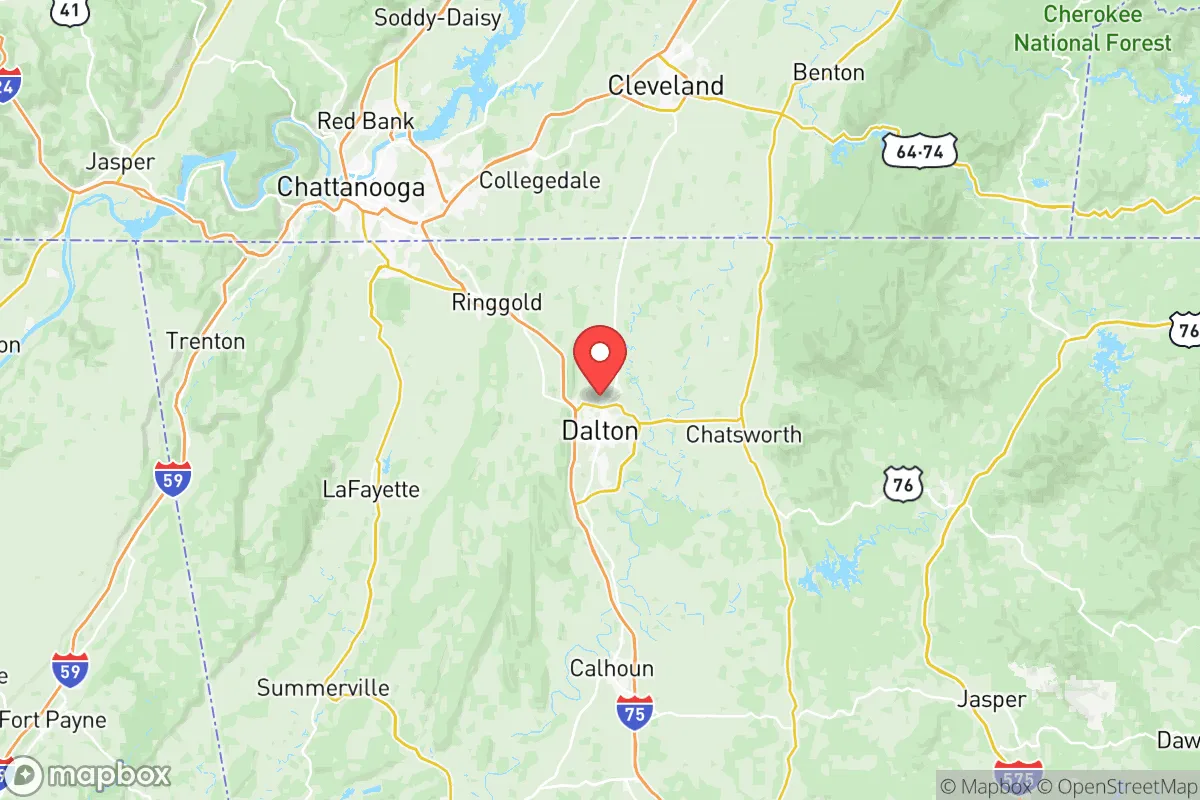
Photo: Wikipedia
Demographics of Whitfield County
Affluence Level in Whitfield County
A middle-class area roughly in line with national averages across income, home values, education, and employment.
People of Whitfield County
Today, Whitfield County, Georgia, is home to roughly 103,000 residents, a population defined by its deep Southern roots and a rapidly growing Hispanic community that now makes up over a third of the county. The county seat of Dalton serves as the historic and economic heart, famously known as the "Carpet Capital of the World," an industry that has shaped the area's character and attracted waves of immigrants for decades. The population is notably less college-educated than the national average, with just 19.3% holding a bachelor's degree, reflecting a strong blue-collar, manufacturing-based economy. This is a community where a traditional Southern identity coexists with a vibrant, Spanish-speaking culture, creating a distinctive blend found in few other parts of Georgia.
Settlement & growth (pre-1960)
Before European settlement, the land that is now Whitfield County was part of the ancestral territory of the Cherokee Nation. The Cherokee had established towns and farms throughout the region, including along the Conasauga River, until they were forcibly removed on the Trail of Tears in the late 1830s. The area was then opened to white settlement, and the Georgia General Assembly created Whitfield County in 1851 from part of Murray County, naming it after a state legislator.
The first major wave of American settlers were primarily of Scots-Irish and English descent, moving south from Virginia, North Carolina, and Tennessee. They were drawn by the promise of fertile land for small-scale farming, particularly in the valleys around what would become Dalton, Tunnel Hill, and Cohutta. The arrival of the Western & Atlantic Railroad in the 1840s was the transformative event, turning Dalton into a critical transportation and supply hub. The railroad's completion through the nearby Chetoogeta Mountain Tunnel cemented the area's role in regional commerce.
The post-Civil War era saw the birth of the carpet industry, which would define the county for the next century. In the early 1900s, local families like the Crowns and the Whitfields began experimenting with tufted bedspreads, a cottage industry that exploded into a full-scale manufacturing sector. By the 1950s, Dalton was the undisputed center of the U.S. carpet industry. This economic boom created a massive demand for labor, pulling in white workers from the surrounding rural South, including from neighboring counties like Murray and Gordon, as well as a smaller number of Black families who moved to the area during the early stages of the Great Migration. The county's population grew steadily, but remained overwhelmingly white and native-born through the 1960 census.
Modern era (post-1965)
The passage of the Hart-Cellar Act in 1965, combined with the carpet industry's insatiable need for labor, fundamentally reshaped Whitfield County's demographics. The first major wave of new immigrants came from Mexico in the 1970s and 1980s, recruited directly by carpet mills to fill entry-level positions. These workers settled primarily in Dalton, establishing a small but growing barrio near the mill districts. As the industry expanded through the 1990s, the Hispanic population exploded, drawing not only from Mexico but also from Central American nations like Guatemala and El Salvador.
Today, this community is deeply rooted. The Hispanic population now stands at 36.6% of the county's total, a dramatic shift from just 1.5% in 1980. The foreign-born population is 11.1%, a figure that significantly exceeds the Georgia state average. The Hispanic community is concentrated in Dalton, where they make up a majority of the population in several census tracts, and has also spread to Varnell and Cohutta. This is not a transient population; many families have been in the county for two or three generations, and Spanish is heard as commonly as English in many local businesses and schools.
Domestic migration patterns have also shifted. While the county has not seen the explosive Sun Belt growth of metro Atlanta, it has attracted a steady stream of residents from the Rust Belt, particularly from Ohio, Indiana, and Michigan, who are drawn by the lower cost of living and the still-strong manufacturing base. The white population, now 56.5% of the total, is aging and declining in relative share, while the Black population remains a small but stable 3.3%. The East/Southeast Asian community (0.9%) and the Indian subcontinent community (0.5%) are small but present, often associated with professional roles in the carpet industry's management and logistics sectors.
The future
Demographic projections indicate that Whitfield County will continue to become more diverse, with the Hispanic share of the population expected to approach or exceed 45% by 2040. This growth is driven by a younger median age among Hispanic residents and higher birth rates, while the white population is projected to decline in absolute numbers. The county is not likely to see a major influx of new immigrant groups from Asia or Africa, as the economic draw remains tied to the carpet and flooring industry, which primarily recruits from Latin America.
The cultural identity of the county is evolving in real time. Dalton and the surrounding communities are becoming a bilingual, bicultural region, a transition that has at times created social friction but is increasingly accepted as the new normal. Newer residential developments are emerging on the outskirts of Dalton and in Tunnel Hill, catering to families seeking newer housing stock. The county's political leanings remain conservative, but the growing Hispanic electorate is beginning to exert influence on local elections and school board decisions.
For someone moving to Whitfield County now, they are entering a community in the midst of a profound demographic transition. It remains a blue-collar, family-oriented place with a strong manufacturing economy, but its character is shifting from a predominantly white Southern town to a majority-minority community with a rich Latino cultural layer. The cost of living is low, the job market is stable for those in manufacturing and logistics, and the sense of community is strong, but newcomers should expect a region where the future looks markedly different from its past.

* Values derived from national, state, county, city and local statistics and may differ in a specific area. Last updated: 2026-08-08T12:28:50.000Z
Narrative content on this page is AI-generated and may contain mistakes. Verify any details that matter before acting on them.
ReloMaps may earn a commission from affiliate links at no extra cost to you.

