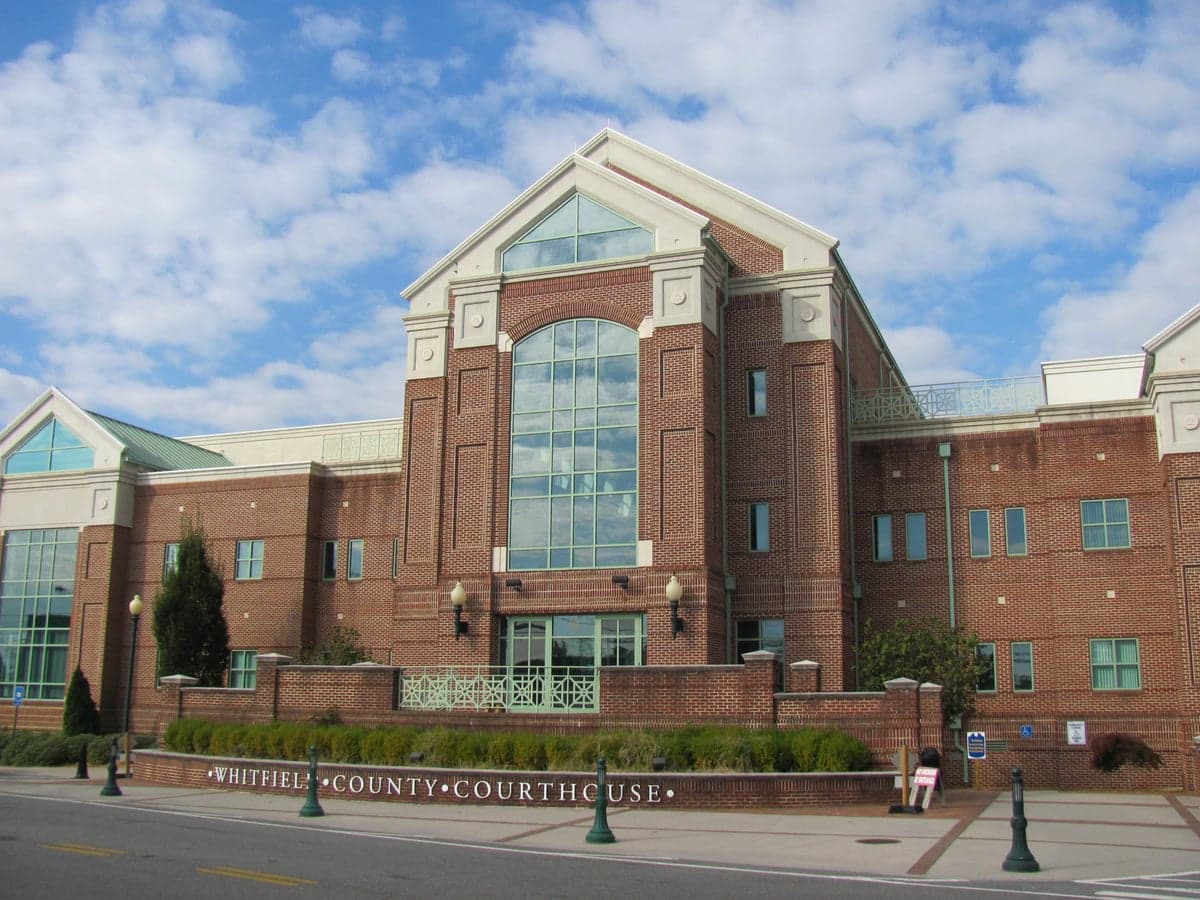
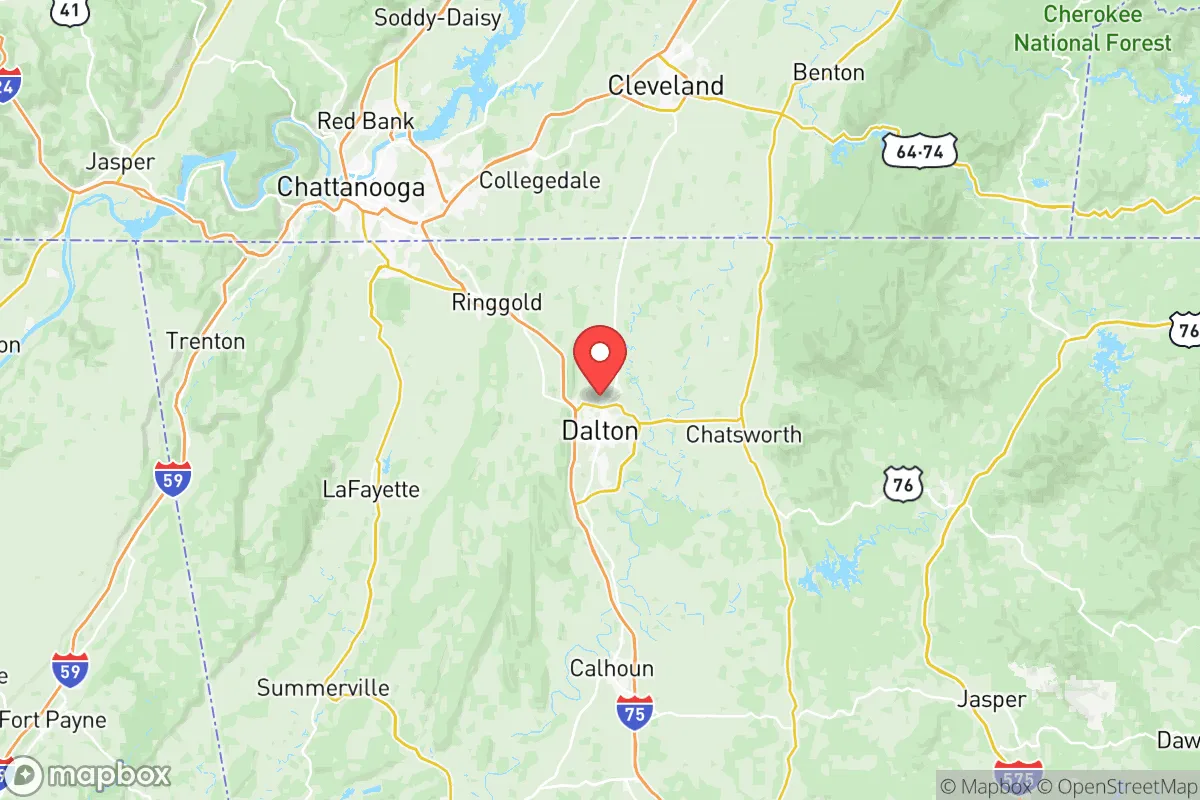
Photo: Wikipedia
Political ClimatePolitical Climate in Whitfield County
Showing district-level results — no local-only data available.
Local Political AnalysisPolitical Analysis of Whitfield County
Whitfield County, Georgia, is a solidly conservative area with a Cook Partisan Voting Index of R+19, meaning it votes about 19 points more Republican than the national average. The county has been reliably red for decades, but the real story is how the political landscape is shifting beneath the surface. While the county as a whole hasn't flipped, the margins have tightened in some precincts, especially around the city of Dalton, which is the county seat and the economic hub. The surrounding unincorporated areas and smaller towns like Tunnel Hill and Varnell remain deeply red, but Dalton itself has become a fascinating microcosm of changing demographics and political attitudes.
How it compares
Compared to the state of Georgia as a whole, Whitfield County is significantly more conservative. Georgia has become a competitive swing state in recent cycles, with a Cook PVI that is effectively even (R+3 as of 2024, but widely considered a toss-up). Whitfield County, by contrast, is one of the most reliably Republican counties in the state. In the 2020 presidential election, Donald Trump won Whitfield County with 72% of the vote, compared to his 49% statewide. The difference is stark: while Georgia's urban and suburban counties like Fulton, Cobb, and Gwinnett have shifted blue, Whitfield has held firm. However, the county's political geography is not monolithic. Dalton's precincts, particularly those near the downtown area and around the Dalton State College campus, have shown a slight but noticeable shift toward Democrats in recent local and national elections. These precincts are still red, but they're trending purple. Meanwhile, the rural precincts in the northern and western parts of the county, around Cohutta and Rocky Face, remain deeply conservative, often voting 80% or more Republican.
What this means for residents
For conservative residents, Whitfield County offers a political environment where their views are the clear majority. Local elections are dominated by Republicans, and the county commission, school board, and city councils are overwhelmingly conservative. This means policies on taxes, development, and education tend to align with conservative priorities. For liberal residents, the reality is more nuanced. While they are a clear minority, they are not invisible. The shift in Dalton's precincts has given them a foothold in local politics, and there are active Democratic Party organizations in the county. However, they face an uphill battle in countywide elections, and their influence is largely limited to the city limits of Dalton. The cultural divide is also palpable: rural areas tend to be more traditional and church-oriented, while Dalton's urban core is more diverse and cosmopolitan, thanks in part to a growing Hispanic population that now makes up nearly 40% of the city's residents. This demographic change is slowly reshaping the political conversation, particularly around issues like immigration, education, and economic development.
One of the most distinctive cultural and policy distinctions in Whitfield County is the role of the carpet and flooring industry. Dalton is known as the "Carpet Capital of the World," and the industry's influence extends into local politics. Many local officials have ties to the industry, and economic policy often revolves around supporting manufacturing and trade. This creates a unique political dynamic where conservative fiscal policies are paired with a pragmatic approach to international trade, given the industry's reliance on global supply chains. For residents, this means that local politics can sometimes feel more focused on business interests than on the culture war issues that dominate national headlines. It's a place where a conservative can find common ground with a liberal on the importance of keeping the mills running, even if they disagree on almost everything else. The trajectory is clear: Whitfield County will remain red for the foreseeable future, but the shade of red is getting lighter in Dalton, and that slow shift will continue to shape the county's political identity for years to come.

State Political ClimatePolitical Climate in Georgia
State Political AnalysisPolitical Environment in the State
Georgia has transformed from a reliably Republican stronghold into the nation’s premier swing state over the past two decades, a shift driven by explosive growth in the Atlanta metro and a diversifying electorate. The state voted for Joe Biden in 2020 and narrowly for Donald Trump in 2024, a razor-thin margin that underscores its 50/50 status. This realignment means that for a relocator, Georgia offers a genuinely competitive political environment where both conservative and liberal coalitions hold real power, but the practical experience of living here varies dramatically depending on whether you are in a booming suburb, a rural county, or the urban core.
Urban vs. rural divide
The political map of Georgia is a story of two Georgias. The Atlanta metropolitan area, encompassing Fulton, DeKalb, Cobb, and Gwinnett counties, is the engine of the Democratic coalition. Fulton County, home to Atlanta proper, routinely delivers margins of 70-80% for Democratic candidates, while Gwinnett and Cobb—once Republican bastions—have flipped decisively blue over the last decade, driven by an influx of diverse, college-educated professionals. Outside the metro, the state is deeply red. Rural counties like Murray in the northwest and Bacon in the southeast vote Republican by margins of 70-80%. The key battlegrounds are the exurban and suburban "collar" counties—places like Forsyth County, north of Atlanta, which remains heavily Republican but is growing more diverse, and Columbia County near Augusta, a fast-growing conservative stronghold. Savannah and Augusta are blue-leaning cities surrounded by red rural areas, while Columbus and Macon are more politically mixed. For a new resident, your daily political reality will be almost entirely determined by which of these zones you choose to live in.
Policy environment
Georgia’s state-level policy environment is solidly conservative, even as the statewide vote has tightened. The state has a flat income tax rate of 5.49%, which is scheduled to drop to 4.99% by 2029 under legislation passed in 2022. There is no state-level property tax, but local property taxes vary widely; average effective rates are around 0.87% of home value, slightly below the national average. The state is a "right-to-work" state, meaning union membership is low and labor laws favor employers. On education, Georgia has a robust school choice program, including the Georgia Promise Scholarship Act, which provides state funds for private school tuition or homeschooling expenses in certain districts. The state also has a constitutional carry law, allowing permitless carry of firearms for legal residents 21 and older, passed in 2022. Election laws have been a flashpoint: the Election Integrity Act of 2021 (SB 202) added a voter ID requirement for absentee ballots, limited drop box locations, and reduced the runoff election window, changes that Republicans argue increase security and Democrats argue suppress turnout. Healthcare policy remains a major point of contention; Georgia did not expand Medicaid under the Affordable Care Act, leaving a coverage gap for low-income adults.
Recent policy direction
The trajectory of Georgia policy under Governor Brian Kemp and the Republican-controlled legislature has been a steady push toward conservative governance, tempered by the reality of a closely divided state. On gun rights, the 2022 permitless carry law was a landmark, removing the requirement for a license to carry a concealed firearm. On parental rights and education, the state passed the "Parents' Bill of Rights" in 2022, which codifies a parent's right to review instructional materials and opt their child out of certain lessons. On abortion, Georgia passed the "Living Infants Fairness and Equality" (LIFE) Act in 2019, which bans abortion after a fetal heartbeat is detected (around six weeks), with exceptions for rape, incest, and medical emergencies; this law took effect in 2022 after the Dobbs decision. On voting, SB 202 remains the most consequential recent law, and its effects are still being litigated and debated. On property rights, Georgia has strong eminent domain protections, and the state generally favors low regulatory burdens for development. On privacy and surveillance, Georgia has no comprehensive state data privacy law, though there have been recent legislative efforts. For a relocator, the practical takeaway is that Georgia is a state where conservative policy wins at the state level, but local governance in Atlanta and its suburbs can feel very different, with blue cities enacting their own progressive ordinances on housing, policing, and public health.
Civil unrest & political movements
Georgia has been a focal point for national political movements on both sides. The 2020 election and the subsequent 2021 Senate runoff elections drew massive grassroots organizing from both parties, with Stacey Abrams' Fair Fight Action on the left and the Trump-aligned "Stop the Steal" movement on the right. The state saw significant protests in 2020 following the murder of George Floyd, particularly in Atlanta, where the "Cop City" training facility became a flashpoint for years of protests and legal battles. On the right, the Georgia Republican Party has seen internal divisions between establishment figures like Governor Kemp and more Trump-aligned factions, though Kemp's decisive primary win in 2022 demonstrated the establishment's continued strength. Immigration politics are less visible in Georgia than in border states, but the state has passed laws requiring local law enforcement to cooperate with federal immigration authorities, and there is a growing Latino population in areas like Dalton and Gainesville that is beginning to shift local politics. For a new resident, you will see political yard signs and bumper stickers everywhere, but actual civil unrest is rare outside of organized protests in downtown Atlanta.
Projection
Over the next five to ten years, Georgia is likely to remain a competitive swing state, but the demographic trends favor a slow drift toward the Democratic column. The Atlanta metro continues to grow rapidly, attracting domestic migrants from other states and international immigrants, both groups that tend to lean Democratic. The state's rural areas are depopulating, which reduces the Republican base. However, the GOP is making inroads with Latino and Asian American voters in the suburbs, and the state's conservative policy environment may continue to attract conservative-leaning migrants from blue states. The wild card is the 2026 gubernatorial election and the 2028 presidential cycle; if Democrats can turn out their base in Atlanta and the suburbs while holding the line in places like Savannah and Macon, Georgia could become a reliably blue state. If Republicans continue to improve their margins with non-white voters and hold the exurbs, it could remain a toss-up. For someone moving in now, expect a decade of close elections, intense political advertising, and a state government that remains conservative but is constantly negotiating with a powerful urban and suburban Democratic opposition.
For a new resident, the bottom line is that Georgia offers a politically diverse experience where your day-to-day life will be shaped more by your local community than by state policy. If you are a conservative, you will find a state government that largely reflects your values on taxes, guns, and education, and you will find plenty of like-minded communities in the exurbs and rural areas. If you are a liberal, you will find a vibrant and powerful political coalition in Atlanta and its suburbs that can win statewide elections and that governs the state's largest city with progressive policies. The practical reality is that Georgia is a state where both sides have real power, and the political climate is one of constant, high-stakes competition. That makes it an exciting place to live for political junkies, but for the average family, it means you can find a community that fits your values, as long as you choose your county carefully.
* Values derived from national, state, county, city and local statistics and may differ in a specific area. Last updated: 2026-08-08T12:28:50.000Z
Narrative content on this page is AI-generated and may contain mistakes. Verify any details that matter before acting on them.
ReloMaps may earn a commission from affiliate links at no extra cost to you.

