Photo: Wikipedia
Demographics of Gillette, WY
Affluence Level in Gillette, WY
A middle-class area roughly in line with national averages across income, home values, education, and employment.
People of Gillette, WY
The people of Gillette, Wyoming, today number 33,278, forming a predominantly white (83.6%) and politically conservative workforce hub in the Powder River Basin. The city’s identity is defined by its energy-industry roots—coal, oil, and natural gas—which have drawn successive waves of domestic migrants seeking high-wage blue-collar and technical jobs. With a low foreign-born share of 1.8% and a Hispanic population of 10.6%, Gillette remains one of the least ethnically diverse cities in the Mountain West, though its character is shifting as younger families arrive from across the region.
How the city was settled and grew
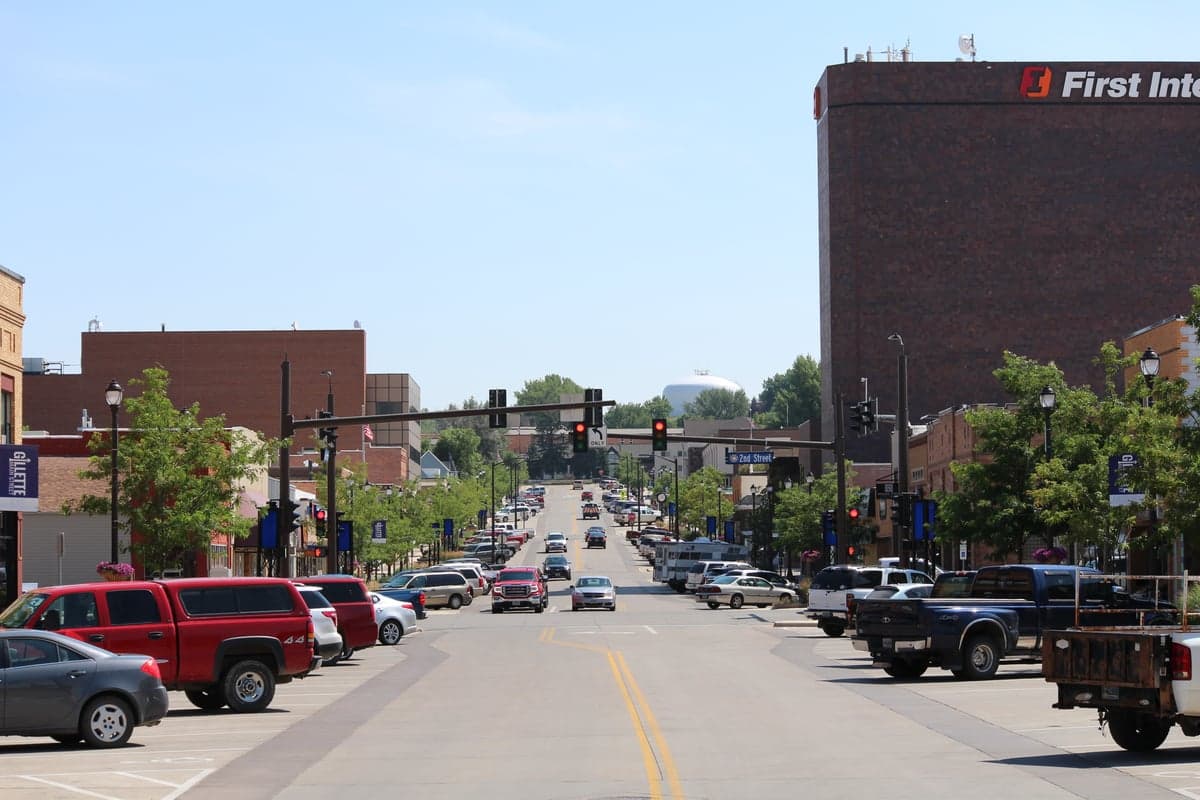
Gillette was founded in 1891 as a railroad town along the Chicago, Burlington and Quincy line, named after railroad surveyor Edward Gillette. The original settlers were predominantly white homesteaders and ranchers drawn by the federal Homestead Act and the promise of open range. The city’s first neighborhoods—Downtown Gillette and the adjacent Westside—were built by these early ranchers and merchants, with simple wood-frame houses and commercial blocks that still anchor the historic core. A second wave arrived during the 1920s oil boom, when wildcatters and roughnecks from Texas and Oklahoma poured in, settling in the South Gillette area near the rail yards. By mid-century, the population hovered around 3,000, and the city remained a quiet agricultural and energy service town until the energy crises of the 1970s triggered explosive growth.
Modern era (post-1965)
The post-1965 era in Gillette is defined by the Powder River Basin coal boom, which began in earnest in the 1970s and accelerated through the 2000s. Domestic in-migration—overwhelmingly white workers from the Rust Belt, Texas, and the Mountain West—flooded the city, pushing population from roughly 7,000 in 1970 to over 33,000 today. These new arrivals settled in master-planned subdivisions like Antelope Valley and Buffalo Ridge, which feature larger single-family homes on cul-de-sacs and are now the dominant residential landscape. The Hispanic population, which stands at 10.6%, grew primarily through domestic migration from the Southwest and Mexico, concentrated in the Lakeway and Westover neighborhoods, where rental housing and mobile home parks offer lower entry costs. The East/Southeast Asian community (0.2%) and the Black community (0.4%) remain very small, largely composed of professionals and their families tied to mining engineering and healthcare, scattered across newer subdivisions rather than forming distinct ethnic enclaves. The Indian subcontinent population is effectively zero (0.0%), reflecting the city’s lack of a tech or academic sector that typically draws that demographic.
The future
Gillette’s population is heading toward modest growth, projected at 1–2% annually through 2035, driven by continued energy demand and a lower cost of living relative to the Front Range. The city is not homogenizing into a single identity but is instead tribalizing into distinct zones: Antelope Valley and Buffalo Ridge are solidifying as white, middle-to-upper-income family enclaves, while Lakeway and Westover are becoming more Hispanic and working-class. The foreign-born share (1.8%) is likely to plateau, as Gillette lacks the service-economy jobs and immigrant networks that attract newcomers to larger cities. The white share (83.6%) may decline slowly as younger Hispanic families have higher birth rates, but the city will remain overwhelmingly white and conservative for the foreseeable future. The college-educated share (23.1%) is below the national average, limiting the city’s ability to attract knowledge-economy migrants, though the new Gillette College technical programs may slowly raise that figure.
For someone moving in now, Gillette is becoming a more stratified but stable energy town—safe, affordable, and politically conservative, with clear neighborhood divides by income and ethnicity. The city offers a straightforward trade-off: high wages in the energy sector and a low crime rate, but limited diversity and cultural amenities. New arrivals should expect to find their social footing in neighborhoods that match their income bracket, with the understanding that the city’s future depends on the volatile coal and oil markets that have always defined it.

* Values derived from national, state, county, city and local statistics and may differ in a specific area. Last updated: 2026-04-21T11:15:05.000Z
Narrative content on this page is AI-generated and may contain mistakes. Verify any details that matter before acting on them.
ReloMaps may earn a commission from affiliate links at no extra cost to you.

