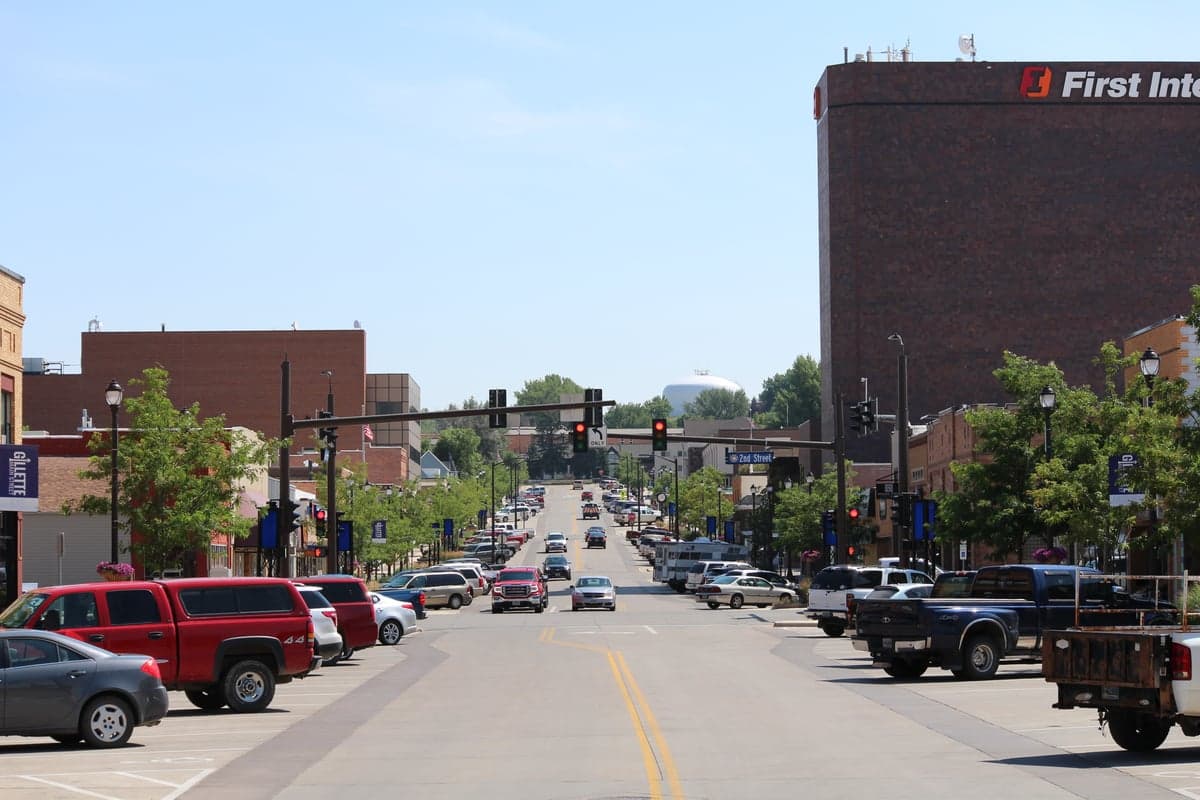
Photo: Wikipedia
Political ClimatePolitical Climate in Gillette, WY
District shown is the primary district for this city’s centroid. Cities may span multiple districts.
Inherited from parent state — no local data available.
Local Political AnalysisPolitical Analysis of Gillette, WY
Gillette, Wyoming, is about as solidly conservative as it gets, and that’s been the case for as long as anyone around here can remember. The Cook PVI of R+23 tells you the math, but the real story is in the culture—this is a place where folks take personal responsibility seriously and don’t cotton to outsiders telling them how to live. The political lean hasn’t shifted much in decades, though you can feel a subtle tension creeping in as more people move here for the energy jobs, bringing with them ideas that don’t always fit the local mold. For now, the trajectory is still firmly red, but it’s worth keeping an eye on how that changes as the county grows.
How it compares
Compared to the rest of the state, Gillette is actually a bit more conservative than the state average, which is already deep red. Places like Laramie, home to the university, or Jackson Hole, with its tourist-driven economy, lean more moderate or even left-leaning on certain issues—especially around land use and environmental regulations. But here in Campbell County, you’re surrounded by towns like Wright and Moorcroft that share the same no-nonsense, pro-energy, small-government mindset. The contrast is stark: while Laramie might debate bike lanes and carbon offsets, Gillette is focused on keeping the coal mines open and the tax burden low. That’s not just a political preference; it’s survival for a lot of families.
What this means for residents
For the people living here, the conservative tilt means a government that mostly stays out of your business. You won’t see the kind of overreach you hear about in blue states—no mask mandates that drag on for years, no heavy-handed zoning that tells you what you can do with your own land, and no property tax hikes disguised as “investments.” The downside is that if you’re hoping for a lot of public services or social programs, you’ll be disappointed. The local government prioritizes keeping things lean, which works fine if you’re self-reliant, but can feel harsh if you’re used to a safety net. For families, it means more freedom to raise kids without a lot of bureaucratic interference, but also a need to plan ahead for things like healthcare and education, since the state isn’t going to hold your hand.
One thing that sets Gillette apart is its no-nonsense approach to energy policy. While other parts of the country are pushing for a rapid green transition, this area still sees coal, oil, and gas as the backbone of the economy—and the culture. There’s a real wariness of federal overreach, especially from the EPA or BLM, that feels like a direct threat to livelihoods. You’ll hear folks talk about “keeping Washington out of our business” not as a slogan, but as a daily reality. That said, there’s also a growing recognition that the energy landscape is changing, and the community is starting to have quieter conversations about diversifying without losing its identity. For now, though, Gillette remains a place where personal freedom and local control aren’t just talking points—they’re how life is lived.

State Political ClimatePolitical Climate in Wyoming
State Political AnalysisPolitical Environment in the State
Wyoming is one of the most reliably conservative states in the Union, with a Republican Party registration advantage that has only grown over the past two decades. The state hasn’t voted for a Democratic presidential candidate since 1964, and in 2024, Donald Trump carried it by over 40 points. But don’t let the uniform red map fool you — there’s a real political divide between the small, growing energy hubs and the vast, shrinking rural counties, and the state’s trajectory is being shaped by an influx of remote workers and retirees who are choosing Wyoming specifically for its low-tax, high-freedom environment. The dominant coalition remains a mix of ranchers, oil and gas workers, and libertarian-leaning newcomers, but the old-guard establishment is increasingly challenged by a more populist, constitutionalist wing.
Urban vs. rural divide
The political map of Wyoming is less about urban vs. rural and more about energy corridor vs. everything else. The state’s only real population center, Cheyenne (Laramie County), leans Republican but is the most moderate part of the state — it’s home to state government workers and F.E. Warren Air Force Base, which brings in a transient, slightly more centrist population. Casper (Natrona County) is the oil and gas hub and votes reliably red, but its local politics can be more pragmatic than ideological. The real conservative firepower comes from the smaller counties: Campbell County (Gillette) is the coal and methane heartland and votes 80%+ Republican. Sublette County (Pinedale) and Sweetwater County (Rock Springs) are similarly deep red, driven by energy extraction. The one notable exception is Teton County (Jackson Hole), which is a wealthy, resort-driven enclave that votes Democratic — it’s the only county that went for Biden in 2020, and it’s a stark reminder that the state’s political identity is defined by its working landscapes, not its ski slopes. Laramie (Albany County), home to the University of Wyoming, also leans blue but is small enough that it doesn’t shift statewide results.
Policy environment
Wyoming’s policy environment is a dream for anyone fleeing high-tax, high-regulation states. There is no state income tax, and the sales tax is a low 4% (local options can push it to 6%). Property taxes are among the lowest in the nation, though they’ve been rising with home values — a concern for longtime residents. The regulatory posture is aggressively pro-business, especially for energy extraction, but the state has also become a haven for cryptocurrency mining and data centers due to cheap power and light oversight. Education policy is a mixed bag: the state funds schools well through mineral revenues, but there’s a growing school choice movement, and the legislature passed a school voucher-style program in 2023 (the Wyoming Freedom Scholarship Act) that lets families use state funds for private or homeschool expenses. Election laws are solid — voter ID is required, and the state has resisted mail-in ballot expansions. In 2024, Wyoming passed a law banning ranked-choice voting and requiring all ballots to be hand-counted in counties under 20,000 people, a move that drew national attention but was popular locally.
Trajectory & freedom
Wyoming is arguably becoming more free, not less, especially for those who value gun rights, medical autonomy, and property rights. In 2021, the legislature passed a constitutional carry law (no permit needed to carry a concealed firearm), and in 2023, it passed a Second Amendment Preservation Act that prohibits state enforcement of any future federal gun bans. On medical freedom, Wyoming enacted a COVID-19 vaccine mandate ban in 2022 that applies to both public and private employers, and it has resisted CDC overreach in public health emergencies. The state also passed a parental rights in education bill in 2023 that requires schools to notify parents of any curriculum involving sexuality or gender identity and allows them to opt their children out. Property rights are strong — there’s no statewide zoning, and counties have limited ability to impose land-use restrictions. The one area where freedom has contracted is in the energy sector: the Biden administration’s leasing moratoriums and EPA rules have effectively shut down new coal mining and slowed oil and gas permitting, which has hurt the state’s economy and forced a diversification push that some conservatives view as a federal overreach.
Civil unrest & political movements
Wyoming is not a hotbed of civil unrest, but there have been notable flashpoints. The Standing Rock pipeline protests in 2016-2017 drew some activists from the state, but the dominant political movement in recent years has been the “Freedom Caucus” wing of the state GOP, which has pushed for more aggressive nullification of federal laws and has clashed with the more moderate, establishment Republicans who control the state senate. In 2023, the legislature considered a bill to nullify federal gun laws entirely (it passed the House but died in the Senate). Immigration politics are relatively quiet — Wyoming has a very small foreign-born population (under 4%), and there are no sanctuary cities. The state did pass a law in 2024 requiring local law enforcement to cooperate with ICE and banning any local “sanctuary” policies. Election integrity has been a major topic: after the 2020 election, the legislature created a Select Committee on Election Integrity that recommended the hand-counting law and stricter voter roll maintenance. You won’t see street protests in Cheyenne or Casper, but you will see a lot of “Don’t Tread on Me” flags and a deep skepticism of federal authority that is baked into the culture.
Projection
Over the next 5-10 years, Wyoming is likely to become even more conservative and more libertarian, driven by two forces: the continued exodus of people from blue states (especially California, Colorado, and Washington) who are specifically seeking low taxes and freedom, and the ongoing decline of the coal industry, which is forcing the state to diversify its economy. The newcomers tend to be even more conservative than the native population on fiscal issues and gun rights, but they can be more moderate on social issues like marijuana legalization (which the state has resisted, though medical cannabis is being debated). The big wildcard is water rights — as the Colorado River basin dries up, Wyoming’s water is becoming more valuable, and the state is already seeing legal battles with downstream states. This could bring federal intervention that would be deeply unpopular. Demographically, the state is aging and shrinking in rural areas, but towns like Sheridan and Laramie are growing as remote workers and retirees move in. Expect the Freedom Caucus to gain more power, and expect the state to continue pushing back against federal overreach on energy, guns, and education. A move to a constitutional convention or Article V convention is a live topic in the legislature.
Bottom line for a new resident: If you’re moving to Wyoming for freedom, you’re making a smart bet — the state is on a trajectory to become even more protective of individual rights, especially on guns, medical choice, and property. But you need to be comfortable with a rural, isolated lifestyle and a economy that is still heavily dependent on energy. The political culture is serious, not performative — people here actually believe in limited government, and they’re willing to pass laws to prove it. Just don’t expect the amenities of a big city, and be prepared for long winters and long drives to the nearest grocery store. If that sounds good, you’ll fit right in.
* Values derived from national, state, county, city and local statistics and may differ in a specific area. Last updated: 2026-04-21T11:15:05.000Z
Narrative content on this page is AI-generated and may contain mistakes. Verify any details that matter before acting on them.
ReloMaps may earn a commission from affiliate links at no extra cost to you.

