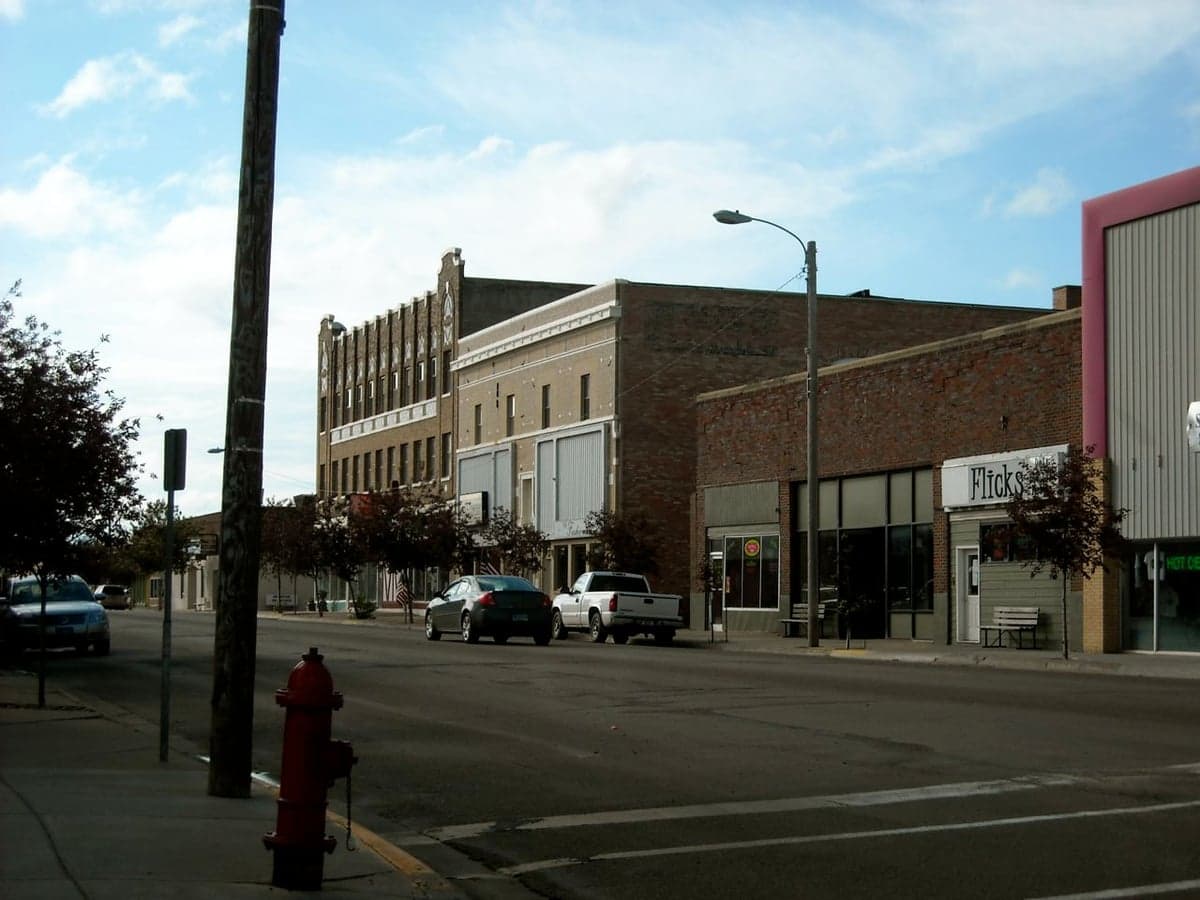
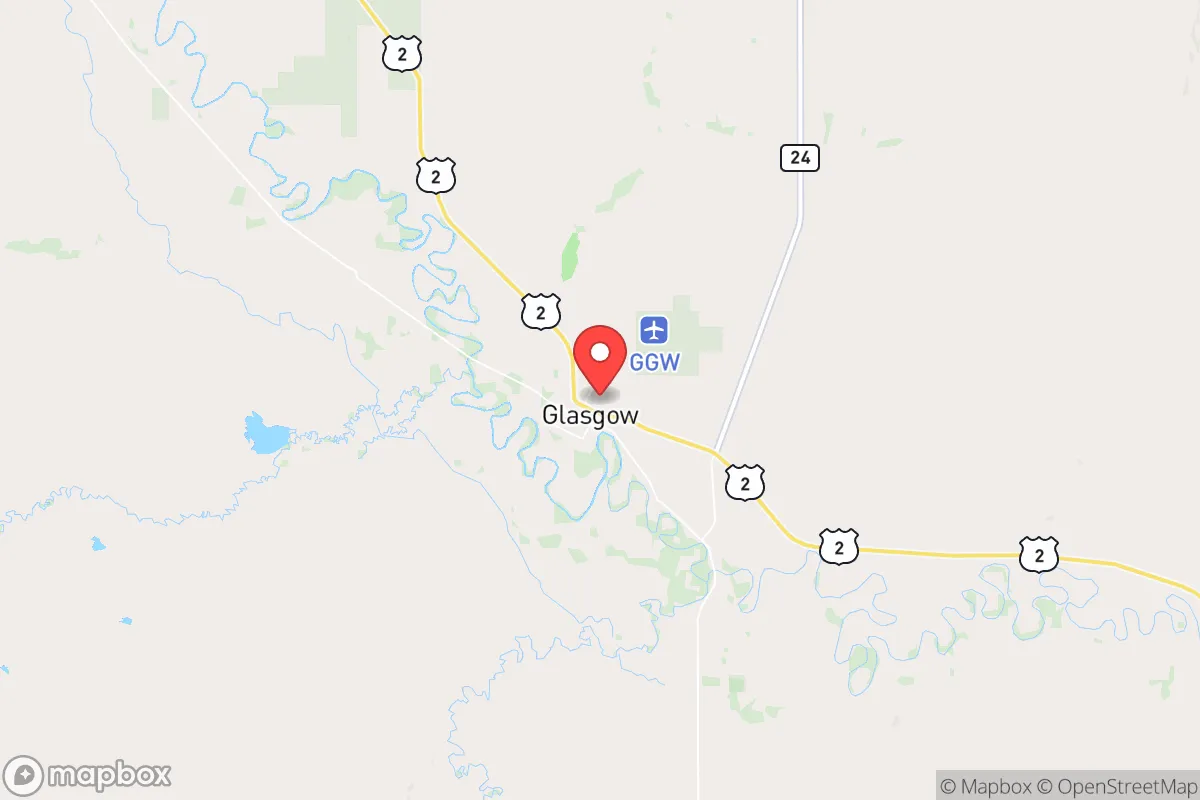
Photo: Wikipedia
Personal Sovereignty in Glasgow, MT
Viable for self-reliance. Generally workable, though some barriers may limit total independence.
What does Personal Sovereignty tell us?
Personal Sovereignty measures your capacity for self-reliance and independence with minimal government friction. Higher scores mean fewer barriers between you and the way you want to live... but it assumes you have the space you need and good neighbors.
What does this tell us?
Personal Sovereignty measures your capacity for self-reliance and independence with minimal government friction. Higher scores mean fewer barriers between you and the way you want to live... but it assumes you have the space you need and good neighbors.
State Policy
Energy independence: Net exporter (120% of energy produced in-state)
Personal Liberty
Homesteading

Personal Liberty Analysis
Glasgow, Montana, offers a level of personal sovereignty that is increasingly rare in the modern United States, functioning as a practical stronghold for those who prioritize self-reliance and minimal government interference. Located in the vast, sparsely populated plains of Valley County, this community of roughly 3,200 people operates under a distinctly hands-off regulatory environment, where the nearest state capital is a four-hour drive away and local officials are far more concerned with keeping the town functional than with enforcing progressive social experiments. For a conservative-leaning individual or family looking to escape the creeping overreach seen in coastal and urban centers, Glasgow represents a place where the state’s presence is light, the culture is rooted in frontier independence, and the practical ability to live life on your own terms is still the default expectation rather than a hard-won exception.
Tax burden and regulatory posture: How Montana’s fiscal landscape protects your autonomy
Montana’s tax structure is a major asset for anyone seeking to keep more of their own money and reduce dependency on government services. The state has no sales tax, which means every dollar you earn or spend stays in your pocket without a hidden consumption levy. Property taxes in Valley County are among the lowest in the state, with effective rates typically hovering around 0.7% of assessed value—far below the national average. Income tax is a flat 6.75% on all taxable income over a modest threshold, but for most residents, the lack of sales tax more than offsets this. The regulatory posture in Glasgow is equally favorable: there is no state-level income tax on Social Security benefits, no estate tax, and no inheritance tax. For a prepper or survivalist, this means less of your hard-earned resources are funneled into state coffers, leaving you with more capital to invest in land, supplies, and self-sufficiency infrastructure. The local county government is notoriously lean, with minimal zoning enforcement outside the town limits, and the state’s business climate ranks in the top ten nationally for regulatory freedom. This isn’t a place where you’ll face endless permits or bureaucratic hurdles to build a workshop, store fuel, or raise livestock on your own property.
Self-defense and gun law specifics: What the Second Amendment looks like on the ground in Glasgow
Montana is a constitutional carry state, meaning no permit is required to carry a concealed firearm for anyone legally allowed to possess one. Glasgow’s local culture treats firearms as everyday tools, not political symbols, and you’ll see rifles in pickup racks and sidearms on hips without anyone batting an eye. The state preempts all local gun ordinances, so Glasgow’s city council cannot impose its own restrictions—what’s legal in the state is legal in town. There is no waiting period for firearm purchases, no magazine capacity limits, and no registry of any kind. Stand-your-ground laws are fully in effect, with no duty to retreat in any place you are lawfully present. For a survivalist, this legal framework is critical: it means your ability to defend your home, your family, and your supplies is not subject to the whims of a distant legislature or a local anti-gun mayor. The nearest federal presence is minimal, and local law enforcement generally respects the principle that a well-armed populace is the first line of defense against both criminals and overreach. If you’re coming from a state with magazine bans or red-flag laws, Glasgow offers a complete reset—a place where the Second Amendment is treated as an individual right, not a privilege to be managed by bureaucrats.
Self-reliance and homesteading viability: Lot sizes, zoning, and off-grid feasibility in Valley County
The practical ability to live off-grid or semi-off-grid in Glasgow is exceptionally high, largely because the local government has little interest in telling you how to use your land. Within the town limits, standard residential lots range from a quarter-acre to half-acre, but the real opportunity lies in the surrounding county, where you can purchase parcels of 5, 10, or 40 acres for a fraction of what similar land costs in the West. Zoning is virtually nonexistent outside the city limits; Valley County has no county-wide zoning ordinance, meaning you can build a cabin, dig a well, install solar panels, or set up a rainwater catchment system without needing a permit from a planning department. Off-grid living is not only tolerated but common—many residents rely on propane, wood stoves, and private wells, and the county does not require connection to municipal water or sewer. The growing season is short (roughly 120 frost-free days), but the soil in the Milk River valley is fertile enough for a substantial garden, and the open range means you can keep chickens, goats, or even a few head of cattle without restrictive animal ordinances. For a prepper, this is the kind of place where you can quietly build a self-sufficient homestead without drawing attention or facing bureaucratic pushback. The biggest challenge is the harsh winter climate, but that’s a natural obstacle, not a government one—and for those willing to adapt, the trade-off is profound freedom.
Personal liberties: Parental rights, medical autonomy, speech, and property in Glasgow
Montana has some of the strongest parental rights protections in the nation, with state law explicitly affirming that parents have the fundamental right to direct the upbringing, education, and healthcare of their children. Glasgow’s public schools are small and community-oriented, but many families opt for homeschooling or private religious instruction, both of which face minimal state oversight. Medical autonomy is similarly robust: Montana does not have a state-level vaccine mandate for adults or children, and there are no forced medical treatment laws that would override a parent’s decision. During the COVID-19 era, Glasgow’s local government largely stayed out of the way, with no mask mandates or business closures enforced by the city council—a stark contrast to the lockdown-heavy approaches seen in blue states. Free speech is protected by a strong state constitution, and there is no hate speech law that could be weaponized against political dissent. Property rights are enshrined in Montana’s constitution, and the state has a strong tradition of defending landowners against eminent domain abuse. For a conservative concerned about government overreach, Glasgow offers a legal environment where your rights as a parent, a patient, a speaker, and a property owner are treated as inherent rather than conditional. The local culture reinforces this: people here expect to be left alone and extend the same courtesy to their neighbors, creating a social fabric that values personal responsibility over collective compliance.
In the broader landscape of American personal sovereignty, Glasgow, Montana, stands out as a place where the state’s footprint is light enough that a determined individual can live largely outside the system’s reach. Compared to the heavily regulated corridors of the Pacific Northwest or the Northeast, where zoning, gun control, and tax burdens can suffocate independence, Glasgow offers a genuine alternative—a community where the frontier ethos of self-reliance is not just a historical memory but a living, practical reality. The trade-offs are real: harsh winters, limited economic diversity, and a long drive to major medical facilities. But for those who view government overreach as a greater threat than a cold snap or a long drive, Glasgow provides a sanctuary where personal sovereignty is not something you have to fight for every day—it’s just the way things are. If your priority is to live free, raise your family without state interference, and prepare for uncertain times on your own terms, this corner of Montana deserves a serious look.

* Values derived from national, state, county, city and local statistics and may differ in a specific area. Last updated: 2026-04-30T01:05:10.000Z
Narrative content on this page is AI-generated and may contain mistakes. Verify any details that matter before acting on them.
ReloMaps may earn a commission from affiliate links at no extra cost to you.

