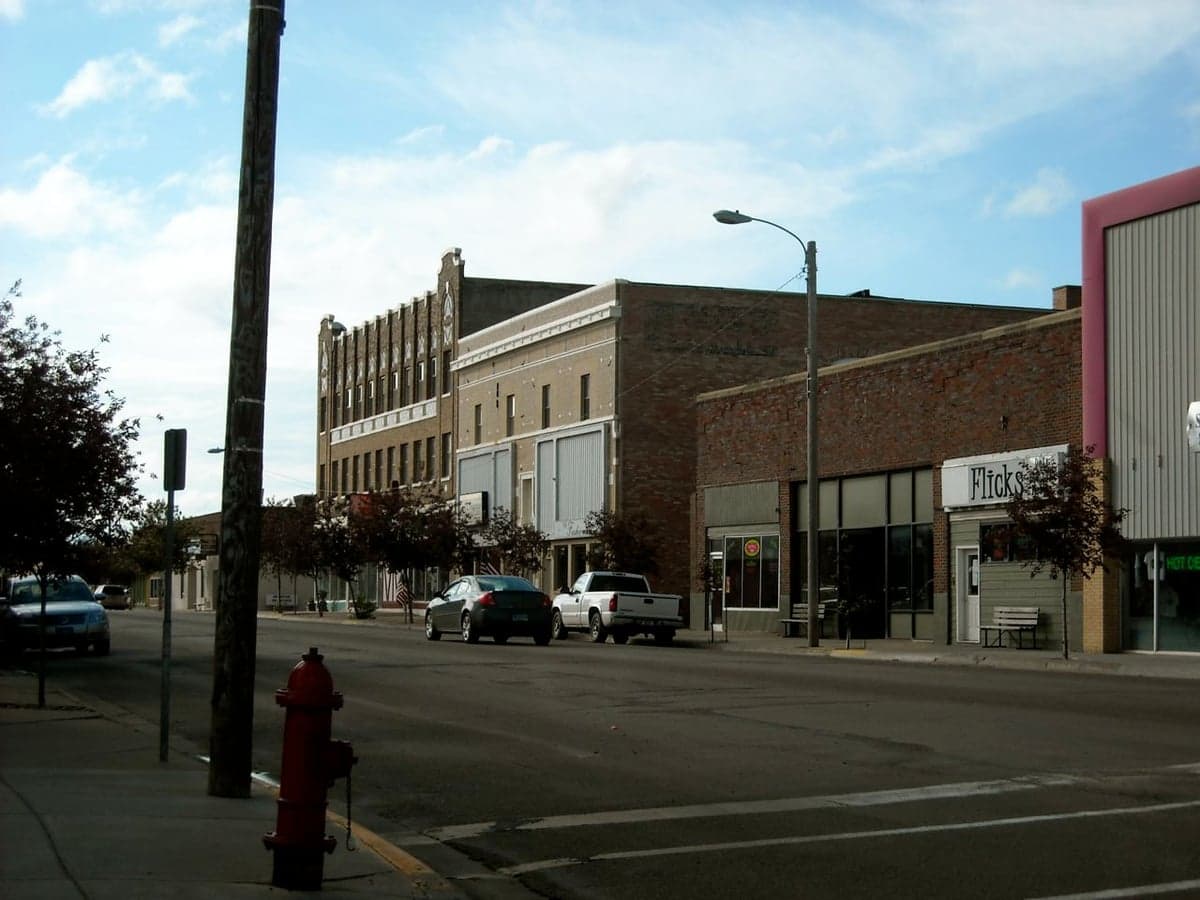
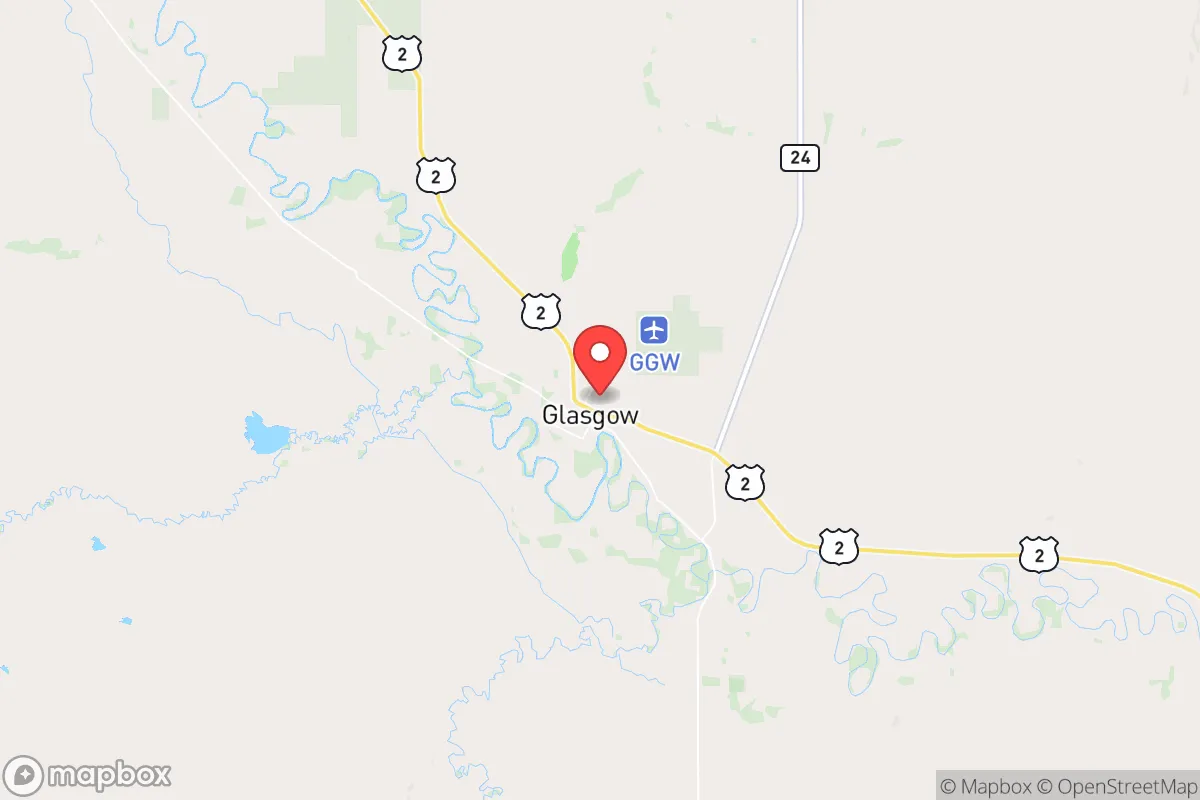
Photo: Wikipedia
Demographics of Glasgow, MT
Affluence Level in Glasgow, MT
A middle-class area roughly in line with national averages across income, home values, education, and employment.
People of Glasgow, MT
The people of Glasgow, Montana, today number just 3,194, forming a tight-knit, predominantly white community where 91.6% of residents identify as White alone. With a foreign-born population of 0.0% and a college-educated share of 19.6%, the city is characterized by its deep-rooted, working-class character and a demographic profile that has changed little in decades. Distinctive identity markers include a strong sense of local independence, a reliance on agriculture and the nearby Glasgow Air Force Base (now an industrial park), and a population that is notably older and more stable than the national average.
How the city was settled and grew
Glasgow was founded in 1887 as a division point on the Great Northern Railway, which drew the city's original population of railroad workers, merchants, and homesteaders. The first major wave of settlers were predominantly of Northern European descent—Irish, German, and Scandinavian immigrants—who built the initial homes and businesses in what is now the Original Townsite neighborhood, centered around the railroad depot. A second wave arrived during the homestead boom of the early 1900s, with families claiming land under the Enlarged Homestead Act of 1909, settling in the South Side district, which grew as a residential area for farmers and ranchers. The city's population peaked at around 5,000 in the 1950s, driven by the construction of the Glasgow Air Force Base in 1956, which brought a temporary influx of military personnel and their families, many of whom lived in the Air Base Housing area (now part of the Glasgow Industrial Park). No significant non-white or immigrant communities formed during this period, as the region's isolation and agricultural economy attracted almost exclusively white settlers.
Modern era (post-1965)
After the Hart-Cellar Act of 1965, Glasgow saw no measurable increase in foreign-born or non-white populations—the foreign-born share remains 0.0% today. The city's modern demographic story is one of domestic out-migration and aging. The closure of the Glasgow Air Force Base in 1968 triggered a population decline from 5,000 to roughly 3,200, with many departing families leaving behind a smaller, older, and more homogenous population. The Hillcrest neighborhood, developed in the 1970s as a middle-class subdivision, absorbed many of the remaining families, while the West Side district, originally built for railroad workers, saw gradual depopulation and an increase in vacant lots. The Hispanic share (0.6%) and Black share (1.4%) are negligible and concentrated in scattered single-family homes, not in any distinct enclave. The city's Asian and Indian-subcontinent populations are both 0.0%, reflecting no post-1965 immigration from those regions. The college-educated share (19.6%) is well below the national average, indicating a population that values practical, trade-oriented skills over academic credentials.
The future
Glasgow's population is projected to continue a slow decline, with the 2020 census showing 3,194 residents—down from 3,253 in 2010. The city is homogenizing further, not tribalizing into distinct enclaves, as the small non-white populations are too small to form any meaningful community clusters. The immigrant population is not growing, plateauing, or assimilating—it is effectively non-existentched. The next 10-20 years will likely see a continued aging of the white population, with younger residents leaving for larger Montana cities like Billings or Bozeman for education and employment. The Air Base Housing area, now redeveloped as the Glasgow Industrial Park, may attract some light manufacturing jobs, but it is unlikely to reverse the demographic trend. The city's future is one of a stable, shrinking, and increasingly elderly white community, with no significant in-migration from any racial or ethnic group.
For someone moving in now, Glasgow offers a quiet, safe, and deeply traditional environment where neighbors know each other and the pace of life is slow. The city is becoming a retirement and agricultural service hub, not a growing or diversifying one. New residents should expect a community that values self-reliance, low crime, and a strong sense of place, but also one with limited economic opportunity and a population that is not changing in any meaningful demographic way.

* Values derived from national, state, county, city and local statistics and may differ in a specific area. Last updated: 2026-04-30T01:05:10.000Z
Narrative content on this page is AI-generated and may contain mistakes. Verify any details that matter before acting on them.
ReloMaps may earn a commission from affiliate links at no extra cost to you.

