Photo: Wikipedia
Demographics of Glen Rose, TX
Affluence Level in Glen Rose, TX
A middle-class area roughly in line with national averages across income, home values, education, and employment.
People of Glen Rose, TX
Glen Rose, Texas, is a small, predominantly white community of 2,770 residents where a strong sense of local heritage and conservative values shape daily life. The population is notably homogenous, with 81.2% identifying as white and 14.8% as Hispanic, while Black (0.6%), Asian (0.0%), and Indian (0.0%) populations are nearly absent. With only 23.9% holding a college degree, the workforce leans toward trades, tourism, and service industries tied to Dinosaur Valley State Park and the Paluxy River. The city’s identity is rooted in its rural Texas character, where family ties run deep and newcomers are often drawn by the promise of a slower, safer pace of life.
How the city was settled and grew
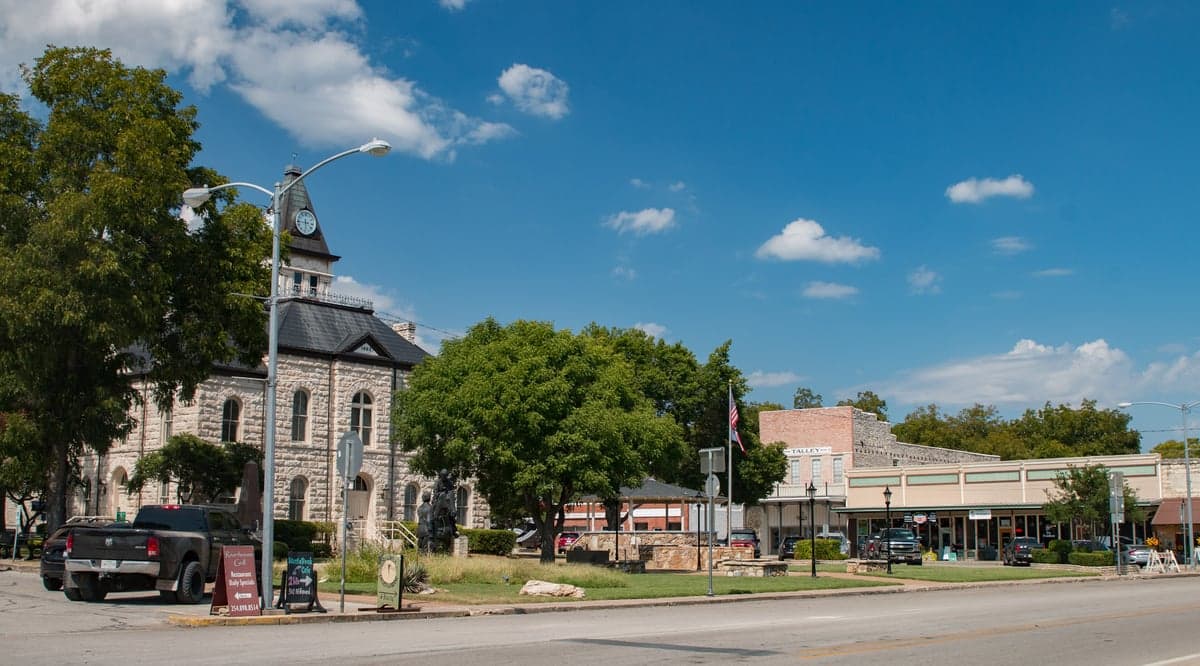
Glen Rose was officially founded in the 1870s as a trading post along the Paluxy River, attracting Anglo-American settlers from the South and Midwest who were drawn by cheap land and the promise of farming and ranching. The arrival of the Texas Central Railroad in 1887 spurred growth, turning the area into a shipping hub for cotton and livestock. The original settlers clustered around what is now the Downtown Historic District, building wood-frame homes and storefronts along Barnard Street. By the early 1900s, a small but stable community of German and Czech farmers had established homesteads in the Paluxy Valley area, drawn by the fertile river bottomland. The discovery of mineral springs in the 1920s briefly boosted tourism, but the Great Depression slowed growth, and the population remained under 1,000 through the 1940s. No significant waves of non-white immigration occurred during this period; the city’s population was almost entirely white, with a handful of Hispanic families working as ranch hands and settling in the South Glen Rose area near the railroad tracks.
Modern era (post-1965)
After the 1965 Immigration and Nationality Act, Glen Rose saw no meaningful influx of foreign-born residents—the current foreign-born share is just 5.2%, well below the national average. Instead, the city’s growth since the 1970s has come from domestic in-migration: white retirees and families from the Dallas-Fort Worth metroplex seeking a rural escape. The Oakdale Park neighborhood, developed in the 1980s around the Paluxy River, became a magnet for second-home buyers and vacation rental investors. Meanwhile, the Heritage Hills subdivision, built in the 1990s on the city’s western edge, attracted younger families priced out of suburban Fort Worth. The Hispanic population grew modestly from about 5% in 1990 to 14.8% today, concentrated in the East Glen Rose area near Highway 67, where many work in construction, landscaping, and the local tourism industry. Black and Asian populations remain negligible, reflecting the city’s limited economic diversity and lack of large employers that would attract a broader workforce. The college-educated share, at 23.9%, is lower than the Texas average of roughly 32%, indicating that many residents hold blue-collar or service-sector jobs rather than professional or tech roles.
The future
Glen Rose’s population is projected to grow slowly, likely reaching 3,200–3,500 by 2040, driven by continued domestic migration from the DFW metroplex. The city is not homogenizing further—it is already highly homogenous—but it is becoming slightly more Hispanic, with the share projected to rise to 18–20% as younger Hispanic families move in for affordable housing and service jobs. The white population will remain the overwhelming majority, though its share may decline to around 75% as the Hispanic cohort grows. The Asian and Black populations are unlikely to increase significantly unless a major employer—such as a large manufacturing plant or regional hospital—relocates to the area, which is not currently planned. The Paluxy River Ranch development, a new master-planned community approved in 2024, will add roughly 400 homes over the next decade, likely attracting more white retirees and remote workers from Dallas. The city is not tribalizing into distinct ethnic enclaves; instead, new subdivisions will remain predominantly white, while the Hispanic community will continue to concentrate in the older, more affordable East Glen Rose area. No significant immigrant community is emerging, and the foreign-born share will likely plateau at 5–6%.
For someone moving to Glen Rose now, the city offers a stable, safe, and culturally conservative environment where the population is slowly diversifying along ethnic lines but remains overwhelmingly white and native-born. The community is becoming more suburban in character, with new subdivisions catering to commuters and retirees, while the historic downtown retains its small-town feel. The lack of racial or ethnic tension is a selling point for many, but the limited diversity also means fewer cultural amenities and a narrower range of perspectives. This is a place where newcomers are expected to integrate into existing social networks—church, school, and local events—rather than form separate enclaves. For those seeking a quiet, family-oriented life in a politically red area, Glen Rose is a solid choice; for those looking for a diverse, fast-growing city with a dynamic economy, it is not.

* Values derived from national, state, county, city and local statistics and may differ in a specific area. Last updated: 2026-05-11T20:08:28.000Z
Narrative content on this page is AI-generated and may contain mistakes. Verify any details that matter before acting on them.
ReloMaps may earn a commission from affiliate links at no extra cost to you.

