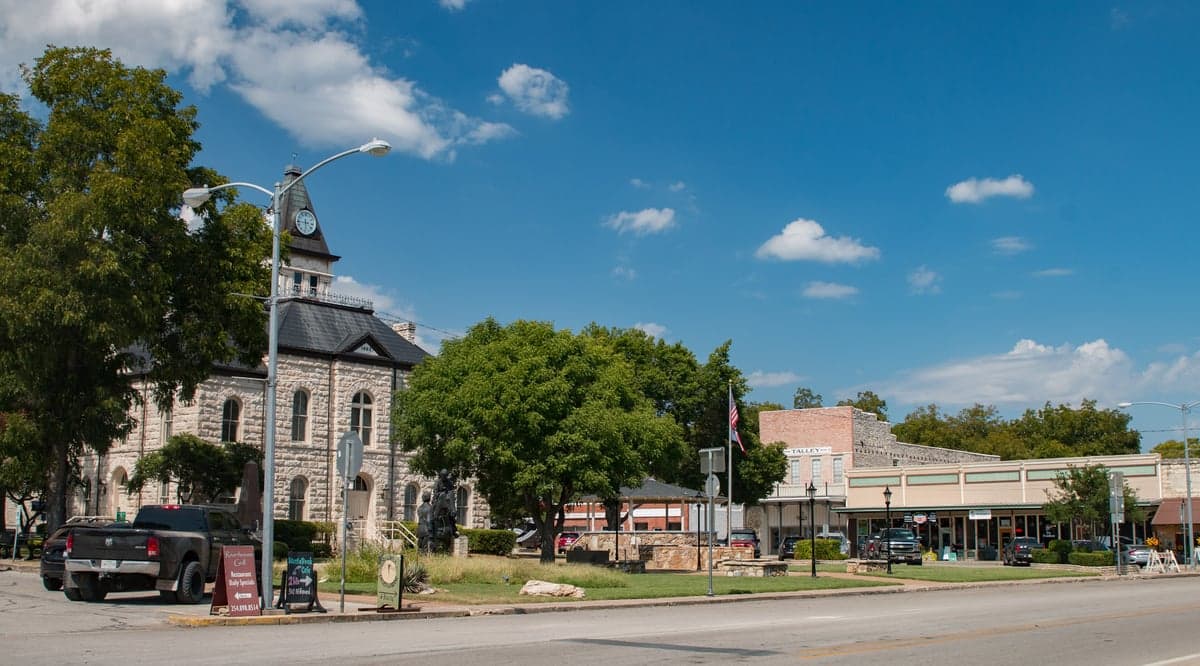

Photo: Wikipedia
Political ClimatePolitical Climate in Glen Rose, TX
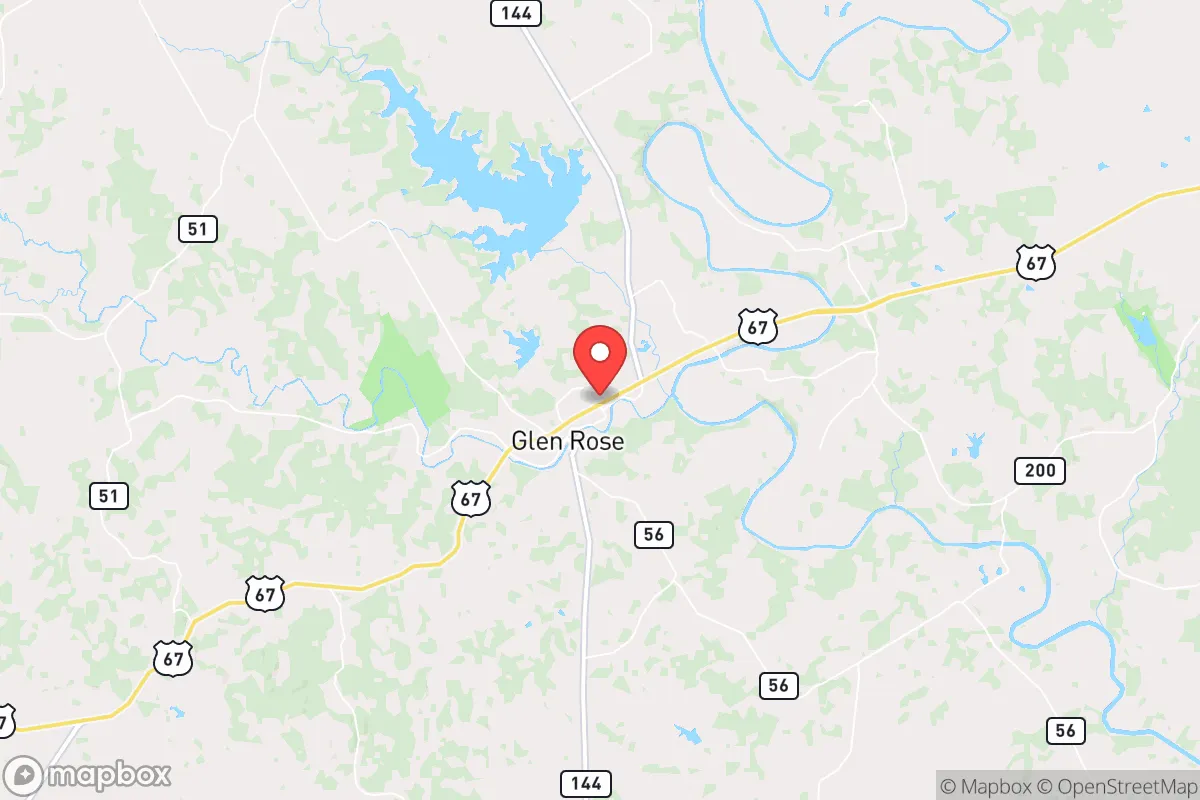
District shown is the primary district for this city’s centroid. Cities may span multiple districts.
Local Political AnalysisPolitical Analysis of Glen Rose, TX
Glen Rose is about as solidly conservative as small-town Texas gets, and it’s been that way for as long as anyone can remember. The Cook PVI here sits at R+18, which is a full 14 points more Republican than the state of Texas as a whole (R+4). That’s not just a number—it means in a county like Somervell, you can pretty much bank on Republican candidates winning by double digits every cycle. The political trajectory here hasn’t shifted much, and honestly, that’s a relief to most folks. While you see places like nearby Granbury or Stephenville starting to feel the pressure of growth and the politics that come with it, Glen Rose has held the line. There’s a quiet, stubborn resistance to the kind of progressive drift that’s creeping into other parts of the state, and that’s something locals are proud of.
How it compares
When you stack Glen Rose up against the rest of Texas, the difference is stark. The state as a whole is R+4, which means it’s still red, but it’s a lot more purple than it used to be. You see that in places like Dallas-Fort Worth, where the suburbs are flipping blue or becoming competitive. Even in smaller towns like Cleburne or Weatherford, you’ll start to hear more talk about “progressive values” and “equity initiatives” creeping into local school boards and city councils. Not here. Glen Rose is still the kind of place where the county commissioners are all conservative, the sheriff’s office is well-supported, and the local school board isn’t trying to push critical race theory or gender ideology on kids. The contrast with the state’s overall lean is a reminder that while Texas is still red, the rural, traditional parts are holding onto what made the state great in the first place—personal responsibility, limited government, and a deep respect for individual freedoms.
What this means for residents
For someone living here, the political climate means you don’t have to worry about government overreach in your daily life the way you might in Austin or even some of the bigger suburbs. Property taxes are still a pain—that’s a Texas-wide issue—but you’re not dealing with city councils trying to ban gas stoves or impose mask mandates that last for years. The local government here is small, and they tend to stay out of your business. That’s a big deal for folks who value their Second Amendment rights, their ability to send their kids to school without political indoctrination, and their freedom to run a small business without a mountain of red tape. The downside? If you’re hoping for a lot of diversity in political thought, you won’t find it. But for most residents, that’s a feature, not a bug. The community is tight-knit, and the shared values make it easy to trust your neighbors.
One thing that sets Glen Rose apart culturally is how the local churches and civic groups still drive a lot of the community’s identity. You won’t see the kind of secular, progressive activism you’d find in a place like Denton or San Marcos. The policy distinctions are subtle but real—things like a strong local police presence, a school board that actually listens to parents, and a county government that isn’t trying to fast-track renewable energy projects that disrupt the landscape. Looking ahead, the concern is that as more people move out from the cities, they’ll bring their politics with them. But so far, Glen Rose has managed to absorb growth without losing its soul. If that changes, it’ll be a slow erosion, not a sudden flip. For now, it’s still a place where you can live free, raise a family, and not have to look over your shoulder for the government telling you how to live.

State Political ClimatePolitical Climate in Texas
State Political AnalysisPolitical Environment in the State
Texas remains a solidly Republican state at the statewide level, with a Cook PVI of R+4, but that number masks a dramatic 20-year shift. From 2004 to 2024, the GOP’s dominance in the suburbs has eroded, while rural and exurban areas have become even more conservative. The dominant coalition is still a mix of rural conservatives, suburban families, and business-oriented moderates, but the Democratic surge in fast-growing metros like Houston, Dallas, Austin, and San Antonio has turned what was once a 15-point GOP lock into a competitive 5-6 point lean. The trajectory is clear: Texas is becoming a true battleground, with the 2024 presidential margin under 6 points for the first time since 1996.
Urban vs. rural divide
The political map of Texas is a tale of two landscapes. The state’s five largest metros—Houston, Dallas-Fort Worth, San Antonio, Austin, and El Paso—now cast over 60% of the vote, and they are trending blue. Austin is the bluest major city in the South, with Travis County delivering a 40-point margin for Democrats in 2024. El Paso County is similarly deep blue, driven by a heavily Hispanic population that has shifted left on immigration and social issues. Meanwhile, the rural and exurban counties that ring these metros—places like Collin County (north of Dallas), Comal County (north of San Antonio), and Montgomery County (north of Houston)—have become GOP strongholds. Collin County, once a swing area, voted +18 for Trump in 2024, up from +12 in 2020. The divide is stark: in the 2022 governor’s race, Greg Abbott won rural counties by an average of 45 points, while losing urban counties by 20. The suburbs are the real battleground—places like Fort Bend County (southwest of Houston) flipped from red to blue in 2018 and have stayed there, while Tarrant County (Fort Worth) is now a true toss-up.
Policy environment
Texas’s policy environment is defined by a low-tax, low-regulation posture that has attracted millions of new residents. There is no state income tax, and property taxes are high but capped by a 2023 law (Proposition 4) that raised the homestead exemption to $100,000 and cut school tax rates. The regulatory climate is business-friendly: no state-level minimum wage above the federal $7.25, no state-level paid leave mandate, and a right-to-work law that keeps unions weak. On education, the state has expanded school choice via the 2023 Texas Education Savings Account program, which allows parents to use public funds for private school tuition. Healthcare is a mixed bag: Texas has the highest uninsured rate in the nation (over 17%), and the state has refused Medicaid expansion under the ACA. Election laws tightened after 2020: Senate Bill 1 (2021) banned 24-hour and drive-through voting, added ID requirements for mail ballots, and gave poll watchers more access. The state also passed a 2023 law banning DEI offices at public universities. For a conservative, the policy environment is largely aligned with limited government, but the lack of Medicaid expansion and high property taxes are persistent pain points.
Trajectory & freedom
On personal liberty, Texas has moved in two directions. Gun rights expanded significantly with the 2021 permitless carry law (HB 1927), allowing any law-abiding adult to carry a handgun without a license. Parental rights were strengthened by the 2023 "Parental Bill of Rights" (HB 900), which requires schools to get parental consent before changing a student’s gender marker or pronoun. On medical autonomy, the state banned nearly all abortions in 2021 (SB 8) and passed a 2023 law restricting gender-affirming care for minors. Property rights got a boost with the 2023 "Texas Property Rights Act," which limits eminent domain for private development. However, freedom has contracted in areas like speech and medical privacy. The 2023 "Drag Ban" law (SB 12) restricts public drag performances, and the state has aggressively prosecuted doctors who provide abortion care across state lines. The 2024 "Digital Fairness Act" (HB 20) requires age verification for adult websites, which critics say chills free speech. For a conservative, the trajectory is mixed: gun rights and parental rights are stronger, but the state’s willingness to regulate private behavior (drag shows, online speech) raises questions about overreach. The net effect is that Texas is freer than California or New York, but less free than it was a decade ago on some cultural issues.
Civil unrest & political movements
Texas has seen its share of political flashpoints. The 2020 protests in Austin and Dallas over George Floyd’s death were among the largest in the nation, with property damage in downtown Austin exceeding $10 million. The "Defund the Police" movement gained traction in Austin’s city council, leading to a 2020 budget cut of $150 million, but that was reversed after a 2021 ballot measure (Prop A) restored funding. On the right, the "Texas Nationalist Movement" (Texit) has gained visibility, with a 2024 poll showing 20% of Texans supporting secession. Immigration politics are a constant flashpoint: Governor Abbott’s "Operation Lone Star" has bused over 100,000 migrants to sanctuary cities since 2021, and the state passed SB 4 in 2023, allowing local police to arrest suspected illegal immigrants. The law is currently blocked by federal courts. Election integrity remains a hot-button issue: the 2020 election saw a lawsuit from the Texas Attorney General to overturn results in four other states, and the 2022 primary saw a purge of over 1 million inactive voters from the rolls. A new resident would notice the heavy police presence at the border, the "Don’t Mess with Texas" bumper stickers, and the occasional protest at the state capitol. The political temperature is high, but it rarely boils over into sustained violence.
Projection
Over the next 5-10 years, Texas will likely become a true swing state. Demographic trends favor Democrats: the state adds over 400,000 new residents annually, mostly from California and other blue states, and the Hispanic population (now 40% of the state) is trending left. The 2024 election saw Democrats win the state’s 10 fastest-growing counties. However, the GOP is not standing still: the 2023 redistricting gave Republicans a 25-13 advantage in the U.S. House delegation, and the state’s voter ID laws and polling place closures in Democratic areas will continue to suppress turnout. The wild card is the rural vote: if rural turnout continues to surge (it was up 15% in 2024), the GOP can hold on. For a conservative moving in now, expect a decade of close elections, with the state likely flipping blue in a presidential race by 2032 if current trends hold. The policy environment will remain conservative at the state level, but local control will become more important—choose your county wisely. Collin, Comal, and Montgomery counties will remain red bastions, while Travis, Harris, and Dallas counties will become even bluer.
Bottom line for a new resident: Texas is still a conservative state, but it’s changing fast. If you’re moving for freedom from government overreach, you’ll find it in the suburbs and rural areas, but you’ll also see the progressive wave coming. The key is to pick a county that matches your values—places like Frisco (Collin County) or New Braunfels (Comal County) offer a conservative lifestyle with good schools and low crime. Just be prepared for higher property taxes and a political climate that will only get more heated. Texas is still worth it for the lack of income tax and the gun-friendly laws, but don’t expect it to stay the same for long.
* Values derived from national, state, county, city and local statistics and may differ in a specific area. Last updated: 2026-05-11T20:08:28.000Z
Narrative content on this page is AI-generated and may contain mistakes. Verify any details that matter before acting on them.
ReloMaps may earn a commission from affiliate links at no extra cost to you.

