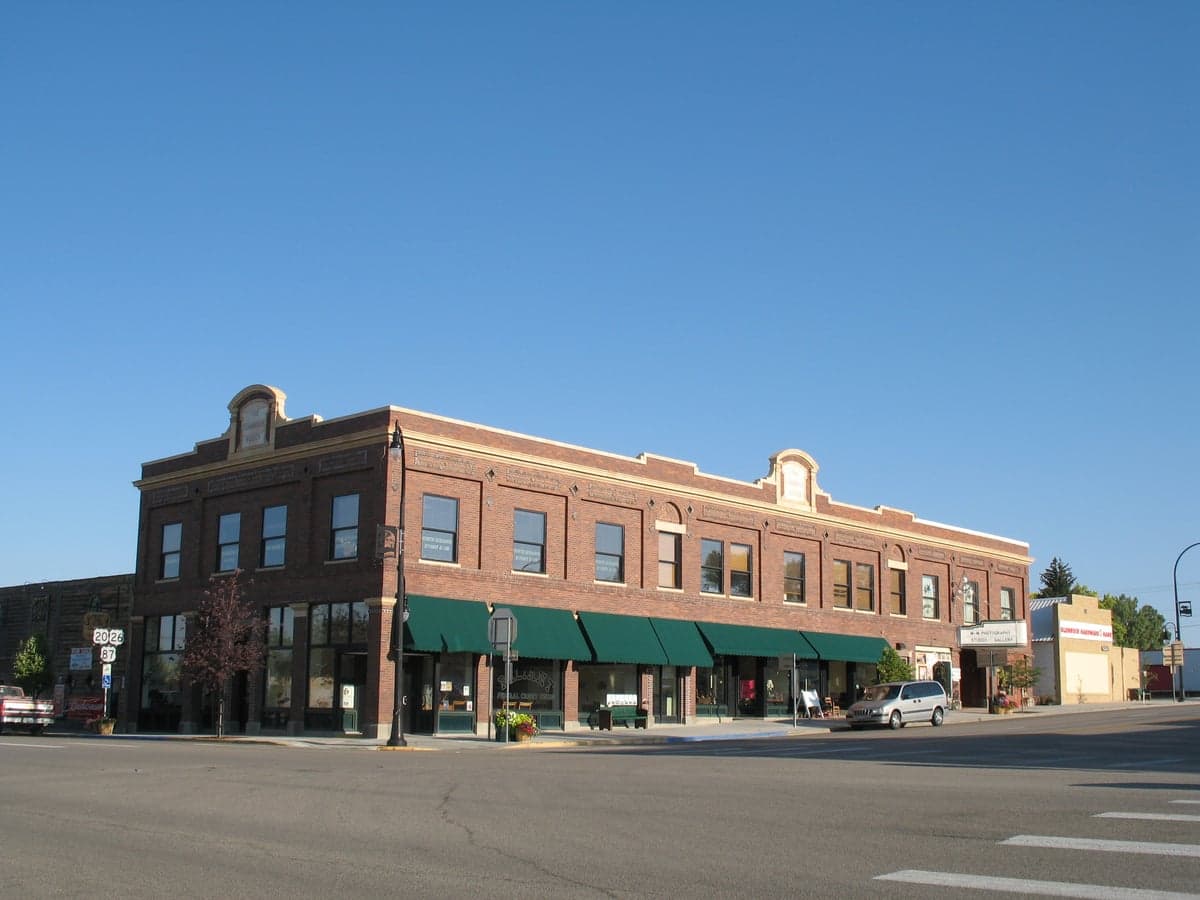
Photo: Wikipedia
Demographics of Glenrock, WY
Affluence Level in Glenrock, WY
A below-average socioeconomic profile. Incomes, home values, and educational attainment trail the U.S., with higher poverty and unemployment.
People of Glenrock, WY
The people of Glenrock, Wyoming, today number roughly 2,806, forming a tight-knit, predominantly white community with a strong blue-collar and outdoor-recreation identity. With 91.7% of residents identifying as white and a foreign-born population of just 2.2%, the city remains one of the least ethnically diverse in Converse County. Glenrock’s character is defined by its ranching heritage, energy-sector employment, and a population density of about 1,100 people per square mile—sparse enough to offer quiet, but concentrated enough to sustain local schools and a historic downtown.
How the city was settled and grew
Glenrock’s human history begins not with colonial settlement but with the railroad. Founded in 1886 as a station stop on the Fremont, Elkhorn & Missouri Valley Railroad, the town was originally named "Glen Rock" for the steep rock canyon nearby. The first wave of settlers were railroad workers and their families, many of Irish and German descent, who built modest homes along what is now Birch Street and Center Avenue—the original core of the town. By 1900, the population had reached just over 200, drawn by the promise of work on the line and the surrounding cattle ranches. A second wave arrived in the 1910s and 1920s, when coal mining opened in the nearby Deer Creek area. Miners, many from Eastern European backgrounds (Polish, Czech, and Slovak), settled in the Deer Creek Addition, a neighborhood of small frame houses just north of the tracks. The 1930s brought a third wave: homesteaders and Dust Bowl refugees from the Great Plains, who took up dryland farming and ranching in the outlying areas, but few settled inside town limits. By 1950, Glenrock’s population had grown to roughly 1,200, with the West Glenrock district—west of the railroad—developing as a working-class enclave of ranch hands and miners.
Modern era (post-1965)
The 1965 Hart-Cellar Act had minimal impact on Glenrock; the city saw no significant influx of immigrants from Asia, Latin America, or the Indian subcontinent. Instead, the post-1965 era was defined by domestic in-migration tied to energy booms. The 1970s oil crisis spurred uranium and coal mining in the Powder River Basin, drawing workers from Texas, Oklahoma, and the Gulf Coast. These new arrivals—overwhelmingly white and Protestant—settled in the Glenrock Hills subdivision, a planned development of ranch-style homes on the town’s eastern edge, built between 1975 and 1985. A smaller wave of retirees and telecommuters arrived in the 1990s and 2000s, drawn by low property taxes and proximity to outdoor recreation on the North Platte River; they concentrated in Riverbend Estates, a newer subdivision of custom homes along the river corridor. Today, the city’s Hispanic population stands at 4.0%, up from near zero in 1990, with most families living in the South Side neighborhood near the old railroad depot, working in construction and service jobs. There are no recorded Black, East/Southeast Asian, or Indian-subcontinent residents in the 2020 census data, reflecting the city’s continued homogeneity.
The future
Glenrock’s population is projected to remain stable or decline slightly over the next decade, mirroring rural Wyoming trends. The city’s age structure is older than the state average—median age 42.3 versus Wyoming’s 38.5—and outmigration of young adults to larger cities like Casper (25 miles west) is a persistent drain. The Hispanic share may grow modestly, perhaps to 6-8% by 2035, driven by labor demand in the energy and agriculture sectors, but the city shows no signs of significant diversification beyond that. The Glenrock Hills and Riverbend Estates neighborhoods are likely to remain the most desirable for incoming families, while the Deer Creek Addition and South Side may see gradual disinvestment as older residents age out. No new subdivisions are planned, and the city’s zoning favors low-density single-family homes, reinforcing its current demographic profile.
For someone moving in now, Glenrock offers a stable, culturally homogeneous community with a strong sense of local identity rooted in energy and ranching. The population is not diversifying rapidly, nor is it shrinking fast—it is holding steady, aging slowly, and remaining overwhelmingly white. New residents will find a place where neighbors know each other, schools are small, and the pace of life is dictated by the seasons and the commodity markets, not by demographic change.

* Values derived from national, state, county, city and local statistics and may differ in a specific area. Last updated: 2026-04-21T11:37:05.000Z
Narrative content on this page is AI-generated and may contain mistakes. Verify any details that matter before acting on them.
ReloMaps may earn a commission from affiliate links at no extra cost to you.

