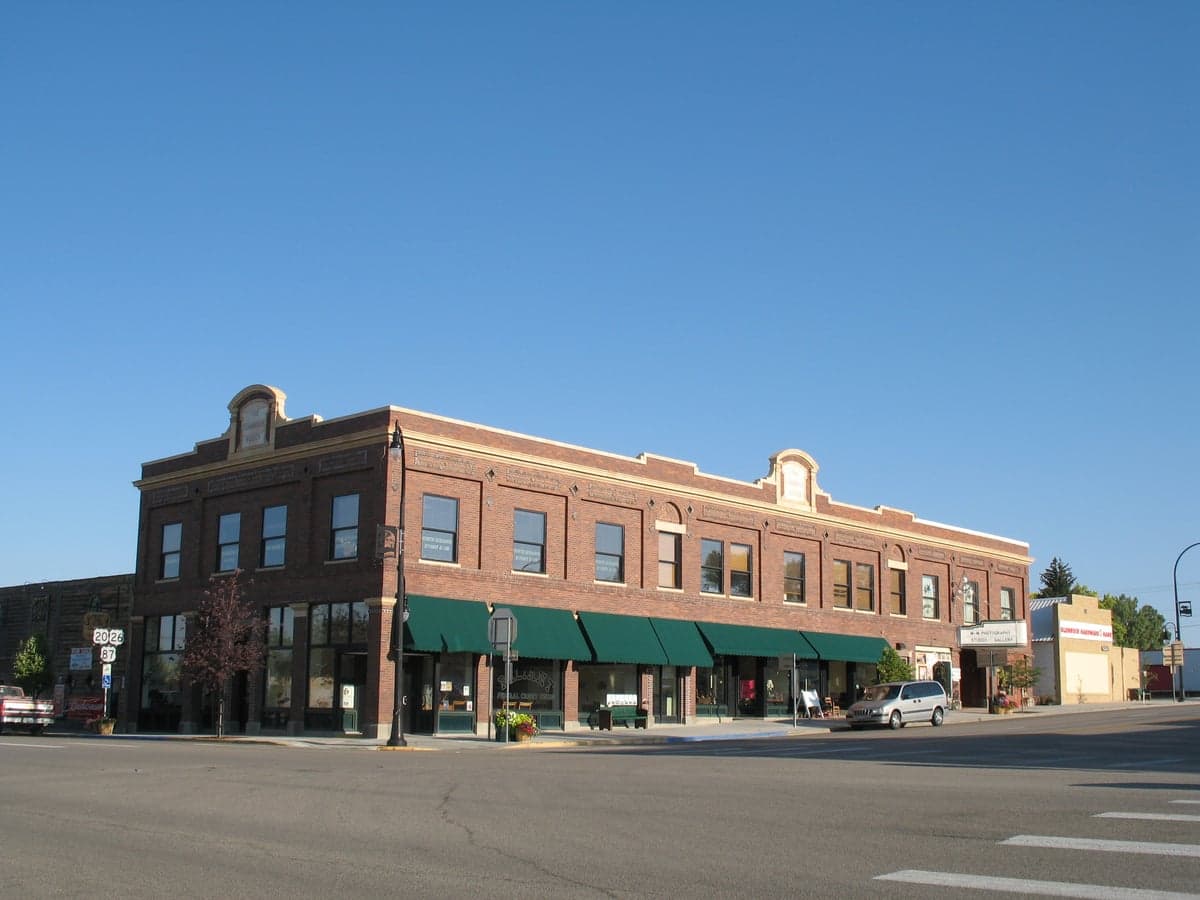
Photo: Wikipedia
Personal Sovereignty in Glenrock, WY
Viable for self-reliance. Generally workable, though some barriers may limit total independence.
What does Personal Sovereignty tell us?
Personal Sovereignty measures your capacity for self-reliance and independence with minimal government friction. Higher scores mean fewer barriers between you and the way you want to live... but it assumes you have the space you need and good neighbors.
What does this tell us?
Personal Sovereignty measures your capacity for self-reliance and independence with minimal government friction. Higher scores mean fewer barriers between you and the way you want to live... but it assumes you have the space you need and good neighbors.
State Policy
Energy independence: Net exporter (800% of energy produced in-state)
Personal Liberty
Homesteading

Personal Liberty Analysis
Glenrock, Wyoming, offers a level of personal sovereignty that is increasingly rare in the modern United States, making it a serious consideration for those prioritizing autonomy over convenience. Nestled in Converse County, this small town of roughly 2,600 people operates under Wyoming’s state constitution, which explicitly affirms the right to self-defense and places strong limits on government intrusion. For a conservative-leaning individual or parent who views federal overreach, regulatory creep, and cultural decay as existential threats, Glenrock represents a strategic outpost where the state’s legal framework still respects the individual as the primary unit of society.
Tax burden and regulatory posture: how Wyoming law protects your income and property
Wyoming’s tax structure is among the most favorable in the nation for those seeking to keep more of what they earn. There is no state income tax, no corporate income tax, and no tax on retirement income, which means every dollar you earn or save stays in your pocket. Property taxes in Converse County are low by national standards, with effective rates typically under 0.6% of assessed value, and the state caps annual increases to prevent the kind of assessment creep seen in blue states. The regulatory environment mirrors this philosophy: Wyoming has no state-level building code for most rural areas, no mandatory vehicle emissions testing, and a right-to-farm law that protects agricultural operations from nuisance lawsuits. For a prepper or survivalist, this means you can build a workshop, store supplies, or raise livestock without navigating a maze of permits or worrying about a neighbor’s complaint shutting you down. The state’s overall regulatory burden ranks among the lowest in the country, and Converse County’s local government tends to follow suit, with minimal zoning enforcement outside the town limits.
Self-defense and gun law specifics: constitutional carry and castle doctrine in practice
Wyoming is a constitutional carry state, meaning no permit is required to carry a concealed firearm for anyone legally allowed to possess one. Glenrock residents enjoy this right without the need for government permission slips, background checks beyond the federal level, or waiting periods. The state’s castle doctrine is unambiguous: there is no duty to retreat in any place where you are lawfully present, and deadly force is presumed justified if an intruder has unlawfully entered your home, vehicle, or workplace. Stand-your-ground protections extend to public spaces as well. For parents, this legal clarity is critical—if a threat arises at home or in the community, the law is on your side, not the aggressor’s. Wyoming also preempts local gun ordinances, so Glenrock’s town council cannot pass its own restrictions. The state has no magazine capacity limits, no assault weapon bans, and no red flag laws, making it one of the most firearm-friendly jurisdictions in the country. For those stockpiling ammunition or training for worst-case scenarios, the legal environment is as permissive as it gets.
Self-reliance and homesteading viability: lot sizes, zoning, and off-grid feasibility
Glenrock sits in a semi-arid basin with access to the North Platte River, and the surrounding Converse County land is largely unincorporated, meaning county zoning is minimal. Inside town limits, residential lots typically range from a quarter-acre to half-acre, but just outside town, you can find parcels of 5, 10, or 40 acres with no subdivision restrictions. Off-grid living is entirely feasible: Wyoming has no state law requiring connection to municipal water or power, and many rural properties rely on wells, septic systems, and solar arrays. The county’s building department does not enforce the International Residential Code on most rural structures, so you can erect a pole barn, a shipping container home, or a traditional cabin without expensive engineered plans. Rainwater collection is legal and unregulated, and the state’s water rights system, while complex, allows for domestic wells without a permit if you’re drawing less than 25 gallons per minute for household use. For a family looking to grow food, raise chickens or goats, and store years of supplies, Glenrock’s rural fringe offers the space and legal latitude to do so without government interference. The biggest practical constraint is the climate—short growing seasons and low rainfall mean you’ll need to invest in greenhouses or irrigation—but the regulatory freedom more than compensates.
Personal liberties: parental rights, medical autonomy, speech, and property
Wyoming has a strong track record on parental rights, with state law affirming that parents have the fundamental right to direct the upbringing, education, and healthcare of their children. There are no state-level vaccine mandates for school attendance, and parents can opt out of any required immunizations with a simple philosophical or religious exemption. The state does not have a medical marijuana program, but it also does not criminalize the possession of raw hemp or CBD products, and there is no state-level prescription drug monitoring program that could be used to track your medical choices. On speech, Wyoming has no hate speech laws that could chill political or religious expression, and the state’s open meeting and public records laws are relatively weak, meaning local government can operate with less transparency—which cuts both ways, but for those wary of surveillance, it means less data collection. Property rights are protected by a strong eminent domain statute that requires just compensation and a public use test, and the state has a right-to-farm law that shields agricultural operations from nuisance claims, even if your neighbor moves in later and complains about noise or smell. For a prepper concerned about government overreach, these protections mean you can homeschool, refuse medical treatments you disagree with, speak your mind without fear of retaliation, and use your land as you see fit—within the bounds of common law nuisance.
Compared to states like Colorado, Oregon, or New York, Glenrock offers a sovereignty profile that is genuinely distinct. The absence of income tax, the constitutional carry framework, the minimal zoning, and the strong parental rights protections create an environment where the individual—not the state—is the default authority. For a single person or family looking to opt out of the federal regulatory state and build a self-sufficient life, Glenrock is not just a good option; it is one of the few remaining places where the legal architecture still aligns with the principles of limited government and personal responsibility. The trade-offs are real—limited healthcare access, harsh winters, and a long drive to major amenities—but for those who prioritize freedom over convenience, those are acceptable costs.

* Values derived from national, state, county, city and local statistics and may differ in a specific area. Last updated: 2026-04-21T11:37:05.000Z
Narrative content on this page is AI-generated and may contain mistakes. Verify any details that matter before acting on them.
ReloMaps may earn a commission from affiliate links at no extra cost to you.

