
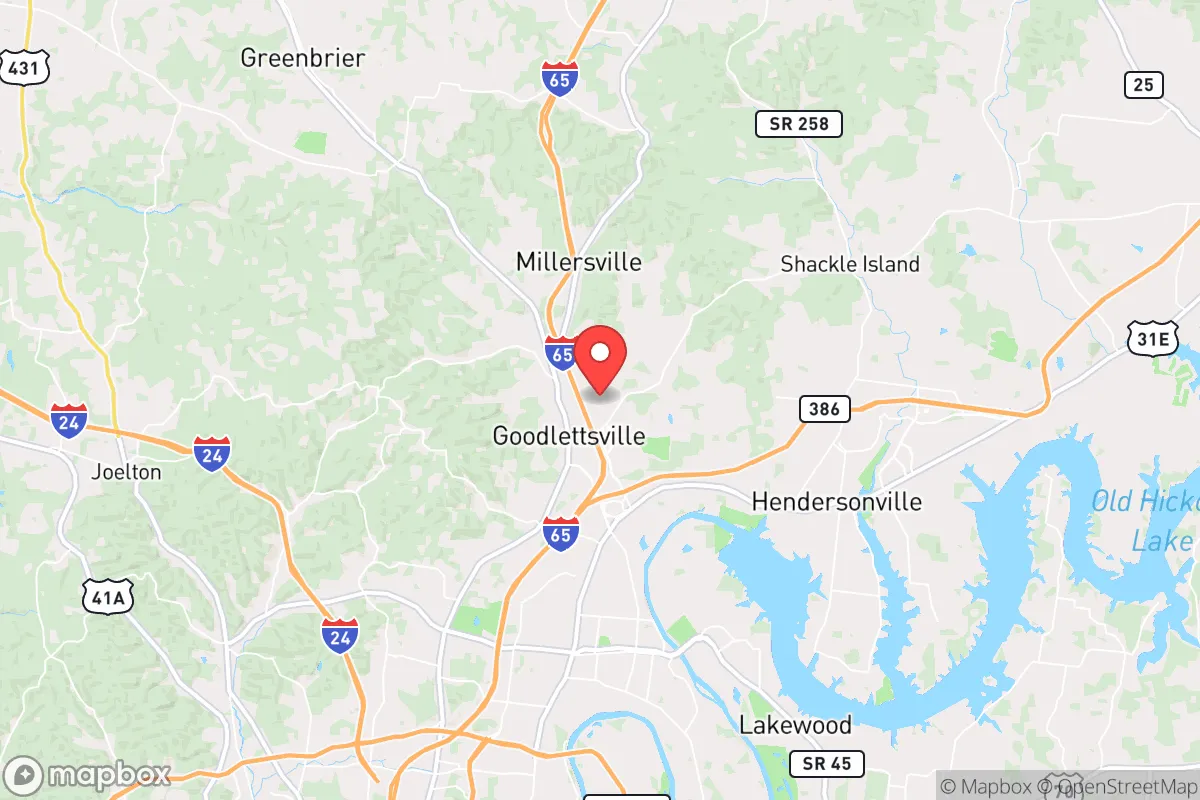
Photo: Wikipedia
Strategic Assessment of Goodlettsville, TN
Multiple tactical vulnerabilities. Population density, target proximity, or disaster risk are likely compounding. A retreat property and exit planning is required.
What does the Strategic Assessment tell us?
Our Strategic Assessment grades tactical survivability of an area. Major population centers, military targets, fallout zones, natural disasters, and border exposure all drive risk — lower exposure means a more defensible position in a crisis.
This is heavily inspired by Joel Skousen's Strategic Relocation book. Highly recommended you checkout the book ($)What does this tell us?
Our Strategic Assessment grades tactical survivability of an area. Major population centers, military targets, fallout zones, natural disasters, and border exposure all drive risk — lower exposure means a more defensible position in a crisis.
This is heavily inspired by Joel Skousen's Strategic Relocation book. Highly recommended you checkout the book ($)Strategic Pillars

Key Distances
Regional Safe Places
Below is our recommended "safe zones" in Tennessee and the surrounding area based on our strategic heuristics. For most people, it's unrealistic to live in a “safe zone” full-time due to work, family or other personal reasons. They tend to be more rural. However, many of these areas are perfect for second homes and retreat properties that double as a vacation home or even a short-term rental.
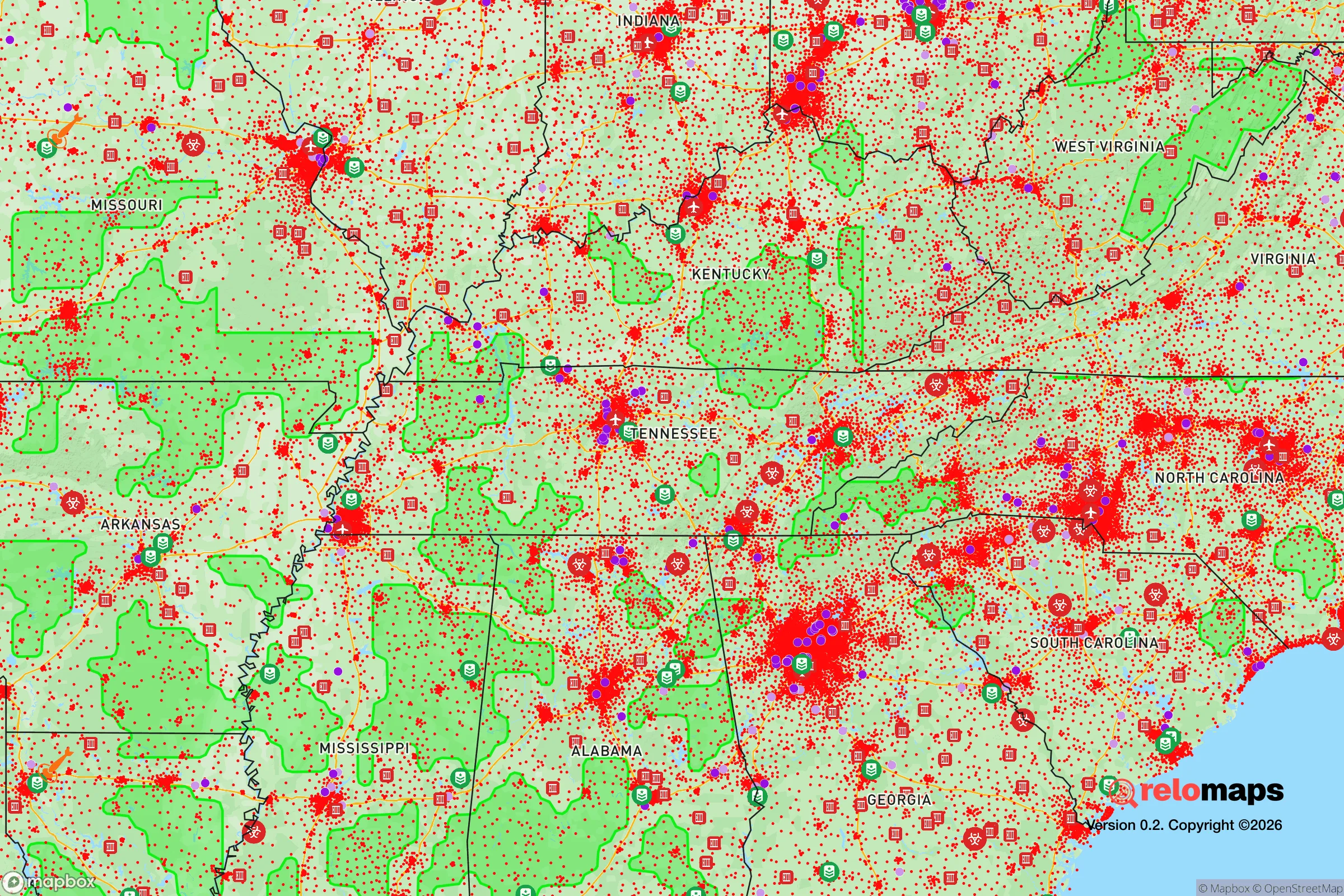
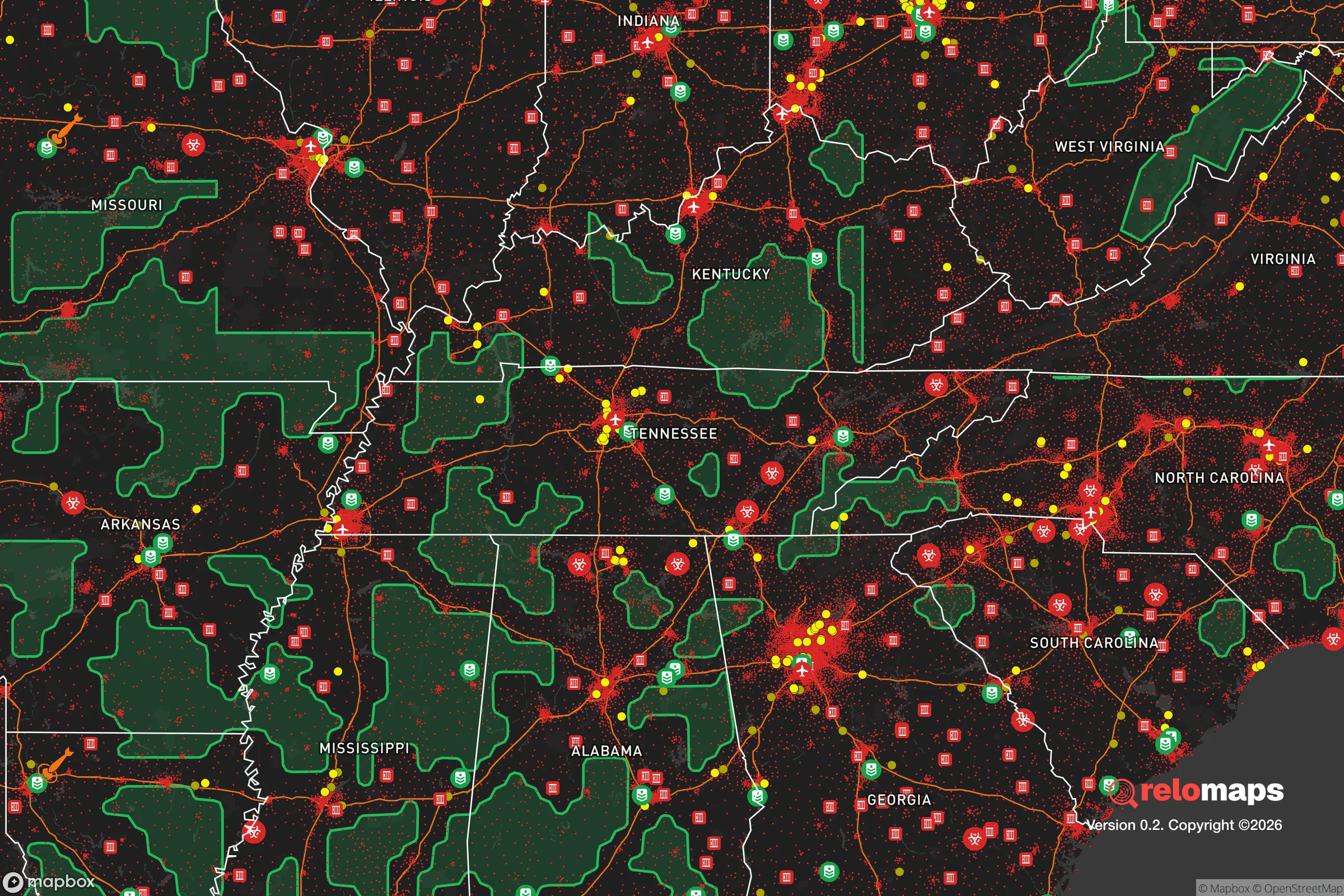


Important Note: For informational purposes only. This does not mean nothing bad ever happens in the green zones. Please use common sense. This is based on public data and modeled with AI. We tried to take a conservative approach but mistakes happen. We update this regularly as new information becomes available.
Solar Generator Recommendations
Backup power matters more here than in safer locations. We've picked three solar generators across budgets and capacity tiers — start with the budget unit if you only need a few essentials, or step up if you want to run a fridge and HVAC for days at a time.

Jackery Portable Power Station Explorer 300
Budget OptionPower on the Go: Weighing only 11 lbs, it's convenient to set up and store with book-sized foldable solar panels

BLUETTI Portable Power Station AC180
Designed for both indoor and outdoor scenarios, AC180 is highly capable as it has a robost capacity and continuous output power.

EF ECOFLOW DELTA Pro Ultra Power Station
Upgraded PickEcoFlow DELTA Pro Ultra is a whole-home energy system designed to grow with your family. Integrated with the Smart Home Panel 2, it scales to meet your evolving energy needs — keeping your home powered, intelligent, and secure through every stage of life.
We earn a commission, at no additional cost to you.
Strategic Assessment Analysis
Goodlettsville, Tennessee, sits in a precarious but potentially strategic pocket for those prioritizing resilience and self-sufficiency. Its location—roughly 12 miles north of downtown Nashville—offers a deceptive mix of proximity to urban resources and access to rural escape routes, but the calculus for a prepper or survivalist is far from simple. The area’s real advantage lies not in isolation, but in its position as a buffer zone: close enough to monitor regional instability, yet with enough geographic friction to slow down the worst of a cascading crisis. For a conservative-leaning relocator concerned with civic unrest, mass casualty events, or systemic collapse, Goodlettsville demands a clear-eyed assessment of its strengths and glaring vulnerabilities.
Geographic position and natural advantages for strategic relocation
Goodlettsville’s geography is defined by the Cumberland River and the rolling hills of Middle Tennessee, which provide modest natural barriers and water access. The area sits at the junction of Interstates 65 and 24, a double-edged sword: these highways offer rapid evacuation north toward Kentucky or south toward the Gulf, but they also serve as arterial routes for any crisis spilling out of Nashville. The surrounding terrain—forested ridges, limestone bluffs, and the Old Hickory Lake reservoir—offers decent cover and a reliable freshwater source. The lake, created by a TVA dam, is a strategic asset for long-term water security, though it also makes the area a target for anyone seeking the same resource. The climate is temperate, with four distinct seasons, reducing the risk of extreme weather events that plague coastal or plains regions. Tornadoes are a real but manageable threat, with warning systems and storm shelters common in rural pockets. For a relocator, the key natural advantage is the ability to retreat deeper into the countryside—toward Gallatin, Portland, or the Highland Rim—within 30 minutes, creating a layered defense against urban spillover.
Risks, exposures, and proximity to fallout-relevant landmarks
The most glaring risk for Goodlettsville is its proximity to Nashville, a major metropolitan hub with a population over 1.9 million in the metro area. In a scenario of civil unrest, mass casualty events, or a breakdown of supply chains, Nashville becomes a magnet for chaos—riots, resource hoarding, and refugee flows. Goodlettsville’s location on the northern edge means it would likely be the first suburb to absorb the shockwave of any urban exodus. The city itself has a population of about 18,000, but it’s surrounded by dense suburban development that blurs the line between town and city. Interstate 65, which runs through the heart of Goodlettsville, is a primary evacuation route for Nashville, meaning it could become a parking lot or a chokepoint in a crisis. Additionally, the area is within 20 miles of the Tennessee Valley Authority’s Cumberland Fossil Plant and the Gallatin Steam Plant, both industrial targets that could pose secondary hazards if attacked or compromised. The Nashville International Airport (BNA) is 20 miles south, a likely focal point for any mass casualty event involving air travel or a coordinated attack. For a survivalist, these are not abstract risks—they are concrete vulnerabilities that require a plan for rapid egress or hardened in-place defense.
Practical resilience for a relocator: food, water, energy, and defensibility
Goodlettsville’s practical resilience is a mixed bag. On the positive side, the area has access to multiple freshwater sources: the Cumberland River, Old Hickory Lake, and numerous creeks and springs in the surrounding hills. A well-equipped property with a drilled well or a lake-access easement is a must, as municipal water systems are vulnerable to contamination or disruption. The soil in the region is a mix of clay and loam, suitable for gardening but requiring amendment for serious food production. The growing season runs from April to October, allowing for a decent harvest of staples like tomatoes, beans, squash, and root vegetables. Local farmers’ markets and co-ops exist but are not robust enough to rely on in a collapse—better to establish a home garden and seed bank immediately. For energy, the grid is typical of the Southeast: prone to outages during storms but generally reliable. Solar panels are a viable investment, given the region’s average of 207 sunny days per year, but tree cover in the hills can limit exposure. Propane tanks and wood stoves are common in rural homes, offering backup heat and cooking. Defensibility is the weak link. Goodlettsville’s suburban layout—with cul-de-sacs, strip malls, and interconnected neighborhoods—makes it difficult to secure a perimeter. A property on the outskirts, with a long driveway, natural tree cover, and a clear line of sight to approach routes, is far preferable to a house in a subdivision. The local law enforcement presence is adequate for day-to-day crime but would be overwhelmed in a mass event. The nearest National Guard armory is in Smyrna, 30 miles south, meaning response times could be hours or days in a crisis. For a relocator, the strategy should be to buy land with a well, septic, and a defensible structure, then treat Goodlettsville as a resupply and intel hub rather than a permanent redoubt.
The overall strategic picture for Goodlettsville is one of calculated risk. It offers a foothold in a region with decent water, moderate climate, and access to rural escape routes, but it is not a standalone survival location. The area’s proximity to Nashville and major infrastructure makes it a high-risk zone for any event that triggers urban collapse or mass migration. For a conservative-minded relocator who values community, church networks, and a slower pace of life, Goodlettsville can work—but only if paired with a hardened retreat property further north or east, and a mindset that treats the town as a forward operating base rather than a final destination. The smart play is to buy land with a well and a garden, keep a low profile, and maintain a vehicle capable of navigating back roads when the interstates clog. Goodlettsville is not a bug-out location; it’s a place to build a life with one eye on the horizon, ready to move when the signs turn bad. For those willing to do the work, it’s a viable option. For anyone expecting safety in numbers or suburban convenience, it’s a trap waiting to spring.

* Values derived from national, state, county, city and local statistics and may differ in a specific area. Last updated: 2026-05-01T00:56:34.000Z
Narrative content on this page is AI-generated and may contain mistakes. Verify any details that matter before acting on them.
ReloMaps may earn a commission from affiliate links at no extra cost to you.

