Photo: Wikipedia
Demographics of Grafton, ND
Affluence Level in Grafton, ND
A middle-class area roughly in line with national averages across income, home values, education, and employment.
People of Grafton, ND
Grafton, North Dakota, is a small, tight-knit community of 4,128 residents, characterized by a strong agricultural heritage and a notably high Hispanic population of 23.4%—a demographic marker that sets it apart from many other rural Plains towns. The city’s identity is rooted in its role as a regional service hub for Walsh County, with a population that is 70.2% White and a foreign-born share of just 2.4%, reflecting a largely domestic, multi-generational settlement pattern. Today, Grafton feels like a place where the rhythms of farming and food processing still set the pace, and where distinct neighborhoods tell the story of successive waves of settlers.
How the city was settled and grew
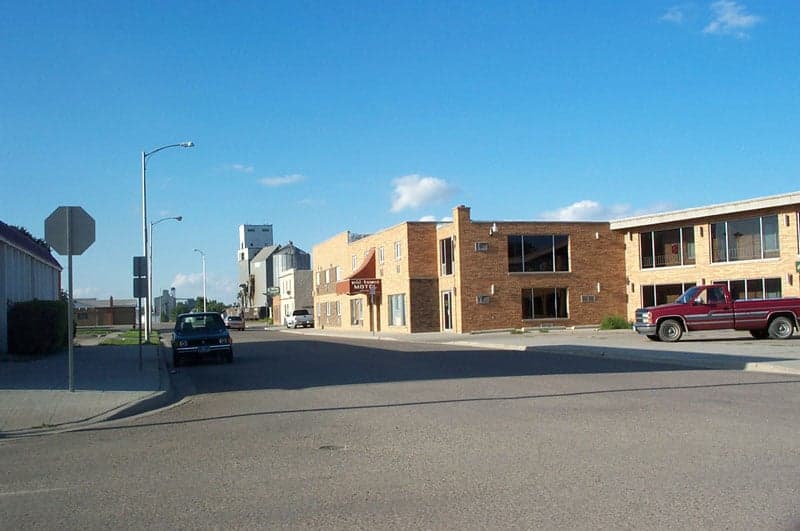
Grafton was founded in 1881 as a railroad town on the Great Northern Railway line, drawing its first settlers primarily from Scandinavian and German immigrant stock. The original plat centered on the railroad depot, with early homes and businesses clustering around what is now the Downtown Historic District, where brick storefronts and the old opera house still stand. The first major wave of settlers—Norwegian and German farmers—arrived to take advantage of the fertile Red River Valley soil, establishing the town as a grain and livestock shipping point. By the early 1900s, a second wave of Polish and Czech immigrants arrived to work in the expanding sugar beet fields, settling in the South End neighborhood near the rail yards and the beet dump. These groups built St. John the Evangelist Catholic Church (1905) and the Grafton Lutheran Church, which remain anchors of their respective communities. The North Side, developed later in the 1910s and 1920s, became home to the town’s merchants and professionals, with larger single-family homes along what is now Hill Avenue.
Modern era (post-1965)
After the 1965 Immigration and Nationality Act, Grafton’s demographic story shifted dramatically with the arrival of Hispanic workers, primarily of Mexican and Central American descent, drawn by year-round jobs at the American Crystal Sugar Company processing plant. This facility, which opened in 1963 and expanded through the 1970s, became the largest employer in the region and a magnet for labor. The Hispanic population concentrated initially in the West Grafton area, near the plant and along 12th Street, where affordable housing and proximity to work created a distinct enclave. Over the decades, this community grew from a small seasonal workforce to a settled, multi-generational population that now makes up nearly a quarter of the city. The East Side, by contrast, remained predominantly White and older, with established families in homes near the golf course and the Grafton State School campus. The Asian population (1.5%) and Indian subcontinent population (0.2%) are very small, with most Asian residents being Filipino or Vietnamese families who arrived in the 1990s and 2000s for healthcare and manufacturing jobs, settling without forming a distinct neighborhood. The Black population (0.8%) is similarly dispersed. The college-educated share (18.0%) is below the national average, reflecting the town’s blue-collar economic base in food processing and agriculture.
The future
Grafton’s population is aging and slowly declining, down from a peak of roughly 4,500 in the 1980s, as younger residents leave for larger cities like Grand Forks or Fargo. The Hispanic community, however, is younger and growing through natural increase, with higher birth rates and a stable economic anchor at the sugar plant. This group is gradually assimilating—second- and third-generation Hispanic residents are bilingual, attend local schools, and are buying homes in previously White-dominated neighborhoods like the North Side and East Side, reducing the historical concentration in West Grafton. The White population is shrinking and aging, with many retirees staying in place while their children move away. Over the next 10–20 years, Grafton is likely to become more Hispanic as a share of the total, but the overall population will probably plateau or decline slightly. The city is not tribalizing into distinct enclaves; rather, it is slowly homogenizing as younger Hispanic families integrate into all neighborhoods, while the older White population contracts. New in-migration is minimal, limited to a trickle of workers for the sugar plant and the local hospital.
For someone moving in now, Grafton offers a stable, affordable, and safe community with a strong work ethic rooted in agriculture and food processing. The demographic trajectory points toward a more Hispanic-influenced culture over the next generation, but the pace of change is gradual, and the town remains overwhelmingly American-born and English-speaking. It is a place for those who value quiet, low-cost living and a job at the plant or in a supporting service role, rather than for those seeking diversity or rapid growth.

* Values derived from national, state, county, city and local statistics and may differ in a specific area. Last updated: 2026-04-19T06:43:43.000Z
Narrative content on this page is AI-generated and may contain mistakes. Verify any details that matter before acting on them.
ReloMaps may earn a commission from affiliate links at no extra cost to you.

