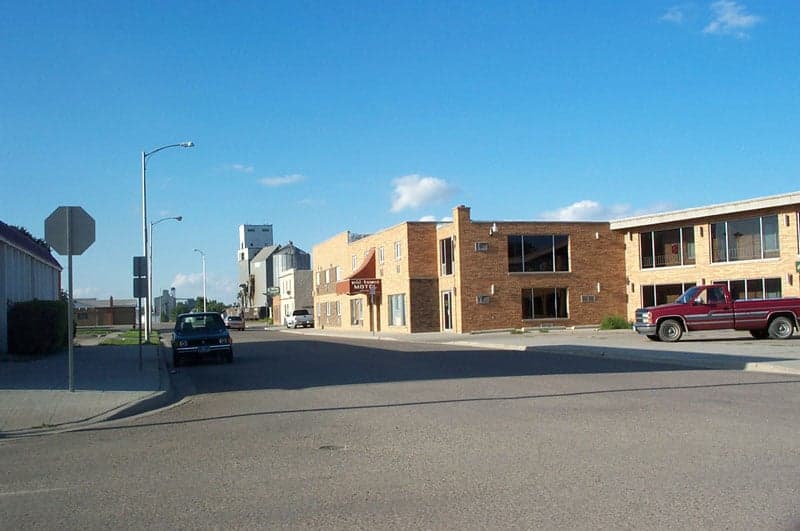
Photo: Wikipedia
Political ClimatePolitical Climate in Grafton, ND
District shown is the primary district for this city’s centroid. Cities may span multiple districts.
Inherited from parent state — no local data available.
Local Political AnalysisPolitical Analysis of Grafton, ND
Grafton, North Dakota, has long been a rock-solid conservative stronghold, and that’s not changing anytime soon. The Cook PVI of R+18 tells you everything you need to know: this area votes Republican by a massive margin, and it’s been that way for decades. You don’t see the wild swings you get in some parts of the country—Grafton is steady, and folks here like it that way. The political lean is deeply rooted in traditional values, a strong work ethic, and a healthy skepticism of government overreach, especially when it comes to personal freedoms and property rights.
How it compares
If you drive an hour south to Grand Forks, you’ll notice a different vibe. Grand Forks is more of a college town with the University of North Dakota, and while it’s still conservative overall, it’s got a noticeable progressive streak—especially among younger voters and faculty. Grafton, by contrast, feels like a throwback to a time when people minded their own business and didn’t expect the government to solve every problem. Head west to Cavalier or east to Park River, and you’ll find similar conservative leanings, but Grafton stands out for its consistency. Even in Walsh County, which is reliably red, Grafton is the anchor. The surrounding rural areas are even more conservative, if you can believe it, with precincts often voting 70-80% Republican. The contrast with Grand Forks is stark: you can feel the difference in the air as soon as you cross into Walsh County.
What this means for residents
For the people living here, the political climate means a lot of things are left up to the community, not some bureaucrat in Bismarck or Washington. You don’t see the kind of overreach that’s become common in blue states—no heavy-handed mandates, no nonsense about telling you what you can and can’t do with your property. The local government is small and responsive, and there’s a strong expectation that they stay out of your life. That said, there’s a growing concern among long-time residents about creeping progressive ideology. You see it in the schools sometimes, with talk of “equity” initiatives or DEI training that feels like a foot in the door. Most folks here are watching it like a hawk. The general attitude is: we’ve kept things right for generations, and we’re not about to let outside influences mess it up. The near-term future looks stable—Grafton isn’t flipping blue anytime soon—but the long-term worry is that national trends could trickle down if people aren’t vigilant.
Culturally, Grafton is a place where your word is your bond, and the Second Amendment isn’t a talking point—it’s a way of life. You’ll see gun racks in pickup trucks and “Don’t Tread on Me” flags flying alongside the Stars and Stripes. There’s a strong sense of personal responsibility, and the idea of the government stepping in to “fix” things is met with a lot of eye-rolling. One policy distinction worth noting: Grafton has resisted the kind of zoning and land-use regulations that choke rural communities elsewhere. If you want to build a shop on your property or keep livestock, nobody’s going to stop you as long as you’re not bothering your neighbors. That’s the kind of freedom that’s getting harder to find, and it’s why people who move here from out of state often say they feel like they can finally breathe. The trajectory is clear: Grafton is holding the line, and the people here are determined to keep it that way.

State Political ClimatePolitical Climate in North Dakota
State Political AnalysisPolitical Environment in the State
North Dakota has long been one of the most reliably Republican states in the nation, with a deep-rooted conservative culture that has only solidified over the past two decades. The state hasn’t voted for a Democratic presidential candidate since Lyndon B. Johnson in 1964, and in 2024, Donald Trump carried it by a staggering 20 points. The dominant coalition here is a mix of rural agricultural interests, energy-sector workers from the Bakken oil fields, and a growing population of freedom-minded transplants fleeing high-tax states. Over the last 10-20 years, the state has shifted even further right, driven by an influx of conservative-leaning newcomers and a backlash against federal overreach during the COVID-19 era. If you’re looking for a place where individual liberty and traditional values still hold sway, this is ground zero.
Urban vs. rural divide
The political map of North Dakota is a study in contrasts, but the conservative lean is overwhelming. The only real blue dot is Fargo, the state’s largest city, which trends slightly more moderate due to its university population (North Dakota State University) and a growing tech sector. In 2024, Cass County, home to Fargo, voted for Trump by a narrower 12-point margin, compared to the statewide 20-point spread. But even Fargo isn’t a progressive stronghold—it’s more of a pragmatic, business-friendly conservative area. The real action is in the rural and energy-producing regions. The Bakken oil counties in the northwest—Williams County (Williston), McKenzie County, and Mountrail County—are deep red, often voting 80%+ Republican. These areas are filled with oil workers, ranchers, and small business owners who value low taxes and minimal regulation. The state’s second-largest city, Bismarck, is a conservative anchor, with Burleigh County consistently voting 65-70% Republican. Grand Forks, home to the University of North Dakota, leans red but has a slight libertarian streak, especially among younger voters. The only politically distinct suburb worth noting is West Fargo, a rapidly growing bedroom community of Fargo that votes even more conservative than the city itself, often by 20 points or more. In short, if you’re outside the immediate Fargo metro, you’re in solidly conservative territory.
Policy environment
North Dakota’s policy environment is a conservative’s dream, with a focus on low taxes, limited government, and individual freedom. The state has no personal income tax—a huge draw for relocators—and a flat corporate income tax rate of just 4.31%. Property taxes are relatively low, though they vary by county; in oil-rich Williams County, they’re offset by energy revenues. The regulatory posture is aggressively pro-business, with a right-to-work law and minimal zoning restrictions outside of major cities. On education, the state has a robust school choice movement, with a new Education Savings Account (ESA) program signed into law in 2025, allowing parents to use public funds for private or homeschool expenses. Healthcare is a mixed bag: the state expanded Medicaid under the Affordable Care Act in 2013, a move that still rankles some conservatives, but it also has some of the lowest healthcare costs in the nation. Election laws are among the most secure in the country—voter ID is required, and there’s no same-day registration. The state legislature is dominated by Republicans, holding supermajorities in both chambers, and Governor Doug Burgum (a Republican) has been a steady hand, vetoing only a handful of bills since 2016. If you’re worried about government overreach, this is a state that largely stays out of your way.
Trajectory & freedom
North Dakota is becoming more free, not less, and recent legislation reflects a clear trend toward expanding personal liberty. In 2023, the state passed a constitutional carry law, allowing any legal resident to carry a concealed firearm without a permit—a major win for gun rights. Parental rights were strengthened in 2024 with the “Parents’ Bill of Rights,” which requires schools to notify parents about curriculum changes and medical services offered to minors. On medical autonomy, the state has resisted federal pressure on vaccine mandates, with a 2021 law banning employers from requiring COVID-19 vaccinations as a condition of employment. Property rights were bolstered by a 2023 law limiting eminent domain for carbon pipeline projects, a direct response to the controversial Summit Carbon Solutions pipeline. Taxation is trending downward: the state legislature is currently debating a bill to eliminate the corporate income tax entirely by 2027. The only concerning trend is a slight uptick in local zoning regulations in Fargo and Bismarck, but these are minor compared to states like California or New York. Overall, the trajectory is one of increasing freedom, with a legislature that’s actively rolling back red tape and protecting individual rights.
Civil unrest & political movements
North Dakota has seen its share of political flashpoints, but they’ve largely been driven by conservative activism rather than left-wing unrest. The most notable was the Dakota Access Pipeline protests in 2016-2017, which drew thousands of activists to the Standing Rock Reservation near Cannon Ball. While the protests were framed as an environmental and indigenous rights issue, they also sparked a strong counter-movement of local residents and energy workers who saw the pipeline as vital to the state’s economy. Since then, the state has seen a rise in organized conservative groups, including the North Dakota Freedom Caucus, which has pushed for stricter election integrity laws and school choice. On the left, there’s a small but vocal activist scene in Fargo and Grand Forks, focused on climate change and racial justice, but it hasn’t gained much traction. Immigration politics are relatively quiet—North Dakota has a low foreign-born population (about 4%), and there’s no sanctuary city movement. Election integrity has been a hot topic, with the legislature passing a 2023 law requiring all ballots to be hand-counted in counties with fewer than 1,000 residents, a move that drew national attention but was widely supported locally. The only visible flashpoint a new resident might notice is the occasional protest at the state capitol in Bismarck over pipeline or energy issues, but these are typically small and peaceful.
Projection
Over the next 5-10 years, North Dakota is likely to become even more conservative and freedom-oriented, driven by demographic shifts and in-migration patterns. The state is seeing a steady influx of people from blue states like California, Illinois, and Minnesota, many of whom are fleeing high taxes and government overreach. These newcomers tend to be politically conservative or libertarian, reinforcing the state’s rightward tilt. The energy sector will continue to be a political anchor, with the Bakken oil fields ensuring that pro-energy policies remain a priority. The only potential wildcard is the growth of Fargo, which could become more moderate as it attracts tech workers and university faculty. However, even that trend is offset by the rapid expansion of conservative suburbs like West Fargo and Horace. By 2030, expect the state to have eliminated its corporate income tax, expanded school choice further, and possibly passed a constitutional amendment to require a supermajority for any new state taxes. For someone moving in now, the North Dakota of 2035 will look very similar to today—just with lower taxes, more parental control in education, and an even stronger commitment to individual liberty.
For a new resident, the bottom line is this: North Dakota offers a rare combination of low taxes, minimal government interference, and a culture that values self-reliance and traditional values. You won’t find the political chaos of coastal states here—just a steady, conservative governance that prioritizes freedom and economic opportunity. If you’re looking to escape the overreach of progressive policies, this is one of the safest bets in the country. Just be prepared for cold winters and a slower pace of life—it’s a trade-off most here are happy to make.
* Values derived from national, state, county, city and local statistics and may differ in a specific area. Last updated: 2026-04-19T06:43:43.000Z
Narrative content on this page is AI-generated and may contain mistakes. Verify any details that matter before acting on them.
ReloMaps may earn a commission from affiliate links at no extra cost to you.

