Photo: Wikipedia
Demographics of Great Falls, MT
Affluence Level in Great Falls, MT
A middle-class area roughly in line with national averages across income, home values, education, and employment.
People of Great Falls, MT
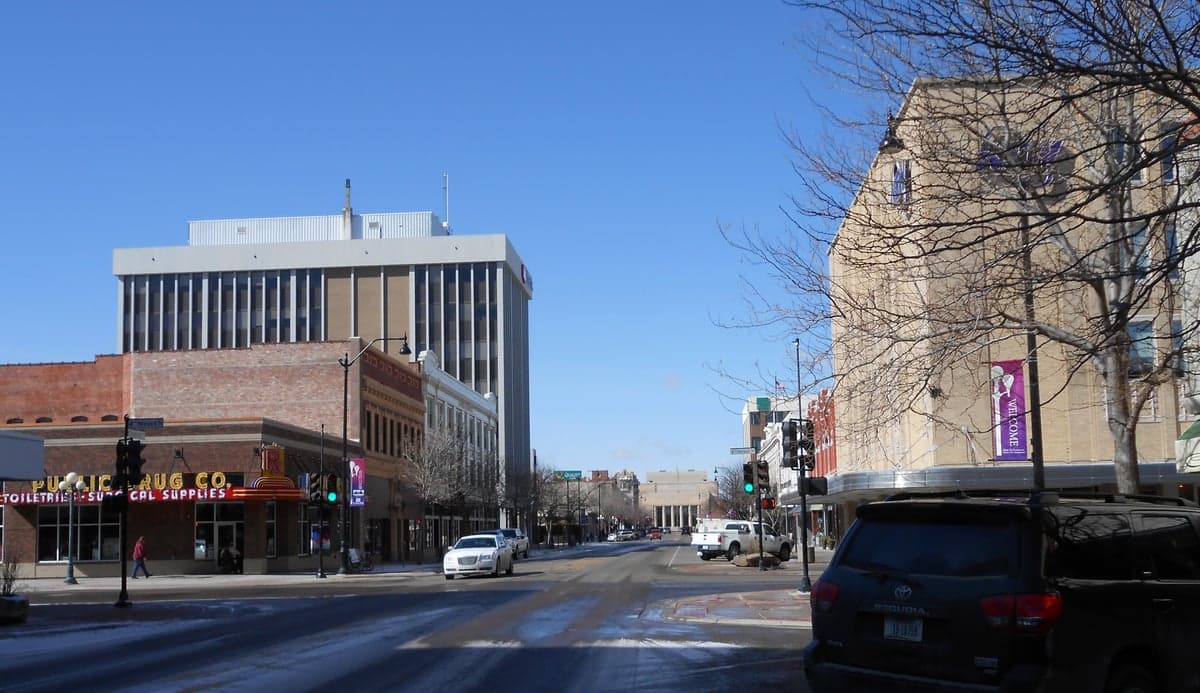
The people of Great Falls, Montana today number 60,412, forming a predominantly white (82.9%) and native-born population with a foreign-born share of just 0.5% — one of the lowest in any U.S. city of its size. The city’s identity is shaped by its historic role as a railroad and smelting hub, its current status as a regional service and healthcare center, and a population density of roughly 2,300 people per square mile that gives it a small-city feel with wide streets and quiet neighborhoods. With 28.3% of adults holding a college degree, Great Falls is less educated than the national average, reflecting a workforce historically tied to industry, agriculture, and the nearby Malmstrom Air Force Base.
How the city was settled and grew
Great Falls was founded in 1884 as a planned industrial city, named for the nearby waterfalls on the Missouri River that promised hydroelectric power. The original population was drawn by the arrival of the Great Northern Railway in 1887 and the opening of the Boston and Montana Consolidated Copper and Silver Mining Company smelter in 1892. The smelter, later part of the Anaconda Copper Mining Company, brought a wave of immigrant laborers — primarily Irish, Italian, and Eastern European men — who built the working-class Riverside neighborhood along the Missouri River, where small bungalows and boarding houses still stand. A second wave of Scandinavian and German homesteaders arrived between 1900 and 1920, settling in the Black Eagle district, a company town built by Anaconda directly across the river from the smelter. The city’s growth peaked in the 1950s and 1960s, driven by the expansion of Malmstrom Air Force Base (established 1942) and the construction of Interstate 15, which brought a wave of military families and service-sector workers into the Skyline and West Side neighborhoods, areas of mid-century ranch homes and newer subdivisions.
Modern era (post-1965)
After the 1965 Hart-Cellar Act, Great Falls saw virtually no increase in foreign-born immigration — the city’s foreign-born share remains at 0.5%, a figure that has barely budged in decades. The post-1965 period instead saw domestic out-migration as the smelter closed in 1980, costing the city over 1,000 jobs and triggering a population decline from a peak of 60,091 in 1960 to 56,690 in 1990. The Hispanic population, now 4.9%, grew modestly from the 1990s onward, driven by Mexican-American families moving into the North Side neighborhood, an area of older homes and rental properties near the former railroad yards. The Black population (1.2%) and East/Southeast Asian population (0.9%) are small and concentrated near Malmstrom Air Force Base in the Malmstrom Heights area, reflecting the military’s role as the primary source of racial diversity. The Indian-subcontinent population (0.1%) is negligible, consisting of a handful of medical professionals at Benefis Health System. Suburbanization in the 1980s and 1990s pushed middle-class white families into the Fox Farm and Sun River subdivisions on the city’s western edge, leaving the older core neighborhoods — Riverside, Black Eagle, and the North Side — with a higher share of rental housing and lower median incomes.
The future
Great Falls is homogenizing rather than diversifying. The white share (82.9%) is slightly above the 2010 figure of 81.5%, and the foreign-born share remains static. The Hispanic population is growing slowly, projected to reach 6-7% by 2035, but this growth is concentrated in the North Side and does not represent a broad demographic shift. The East/Southeast Asian and Black populations are likely to remain small and tied to Malmstrom’s rotational military assignments, meaning they fluctuate with base deployments rather than forming permanent enclaves. The city’s population is projected to grow modestly — to roughly 62,000 by 2035 — driven by retirees from rural Montana and a small influx of remote workers attracted to low housing costs. However, the lack of a major university or large immigrant gateway means Great Falls will remain one of the most ethnically homogeneous cities in the Mountain West, with distinct neighborhood identities based on income and housing age rather than ethnicity.
For someone moving in now, Great Falls offers a stable, low-diversity community where the population is aging slightly and the economy is shifting from industry to healthcare and retail. The city is not tribalizing into ethnic enclaves; instead, it is consolidating into a broad white majority with small, military-linked minority pockets. New residents will find a place where neighborhood identity is tied to history — Riverside’s industrial past, Black Eagle’s company-town roots, and the West Side’s suburban expansion — rather than to ethnic change. The bottom line: Great Falls is a city that looks much like it did in 1970, and demographic projections suggest it will stay that way for at least another generation.

* Values derived from national, state, county, city and local statistics and may differ in a specific area. Last updated: 2026-04-29T20:14:40.000Z
Narrative content on this page is AI-generated and may contain mistakes. Verify any details that matter before acting on them.
ReloMaps may earn a commission from affiliate links at no extra cost to you.

