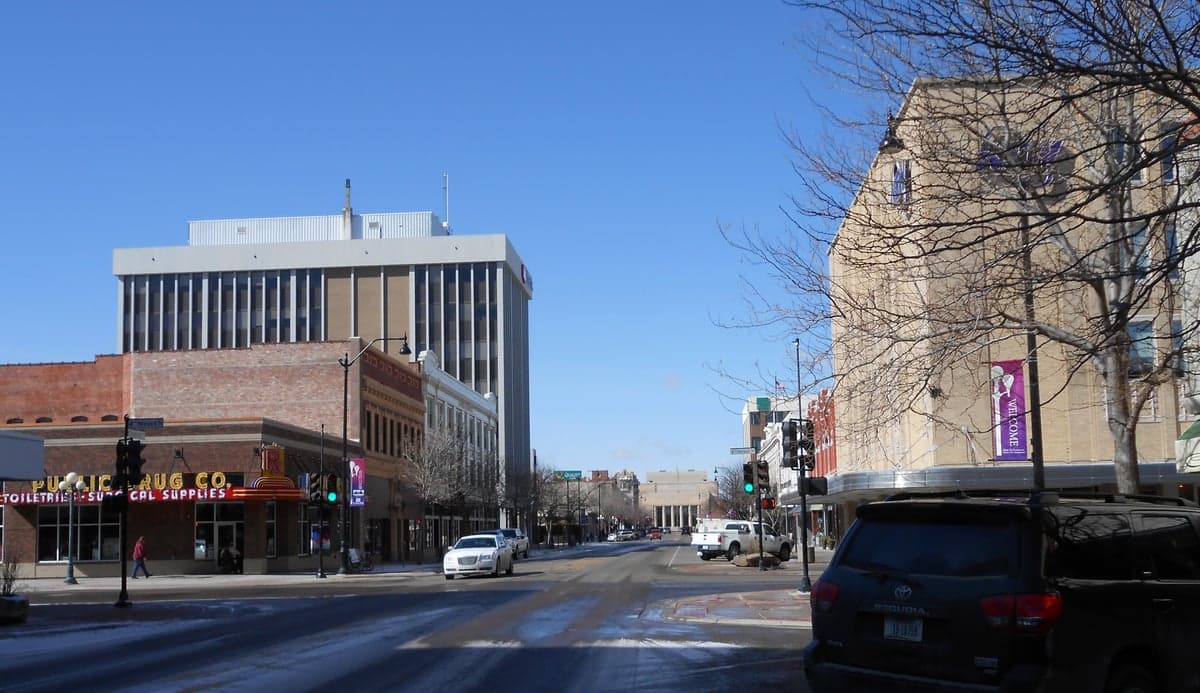
Photo: Wikipedia
Political ClimatePolitical Climate in Great Falls, MT
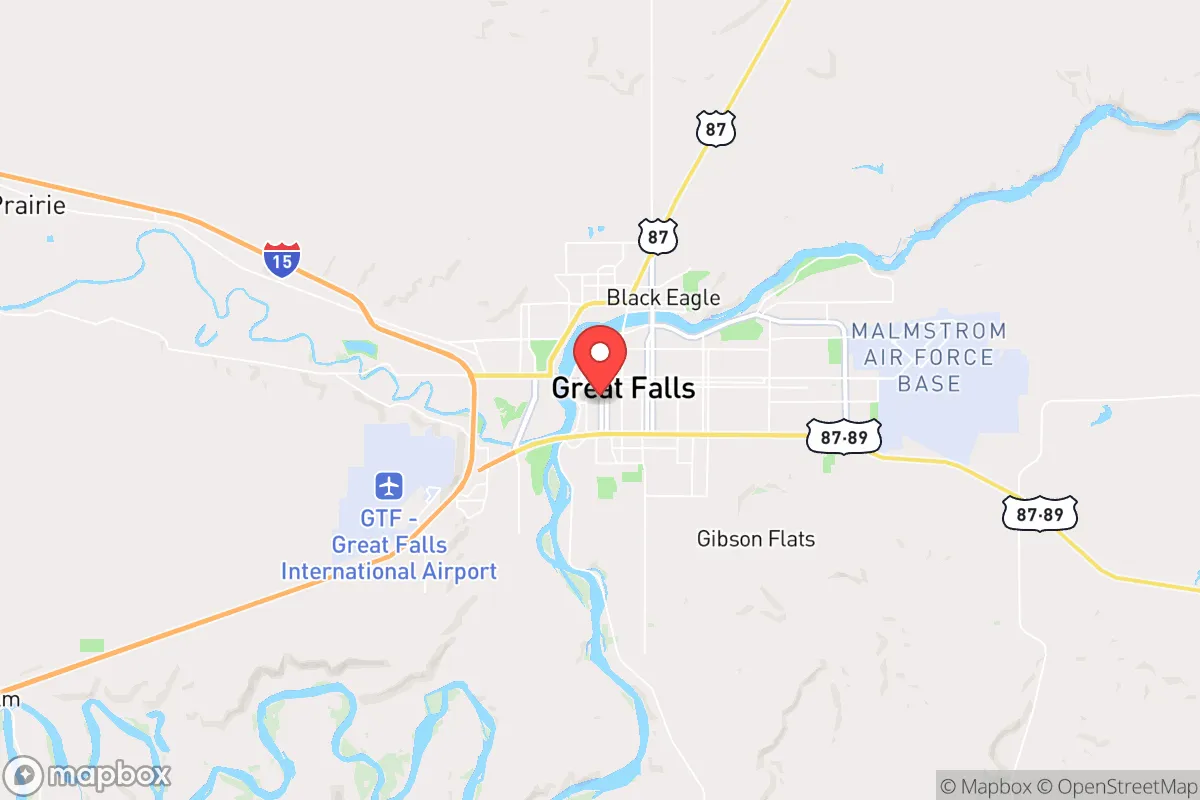
District shown is the primary district for this city’s centroid. Cities may span multiple districts.
Local Political AnalysisPolitical Analysis of Great Falls, MT
Great Falls, Montana, is about as solidly conservative as they come, with a Cook PVI of R+15 that tells you everything you need to know about the local voting patterns. This isn't a place that swings with the national winds; it's a community that has consistently voted for conservative candidates and policies for decades, and the trajectory is holding steady. While you'll see some younger folks and newcomers pushing for change, the core of the city—rooted in agriculture, energy, and military service—remains deeply skeptical of government overreach and committed to personal freedoms. The real story here is how that conservative identity is being tested by outside pressures, but so far, the local culture is holding the line.
How it compares
Drive an hour south to Helena, the state capital, and you'll feel a noticeable shift toward a more moderate, even progressive-leaning vibe, especially around the university and state government offices. Bozeman and Missoula are even further left, with Missoula being a full-on progressive stronghold that often feels like a different state entirely. In contrast, Great Falls sits firmly in the conservative camp alongside smaller towns like Conrad and Shelby to the north. The surrounding Cascade County is reliably red, and while you'll find a few liberal pockets near the college or the hospital, the overall political temperature is unmistakably conservative. This isn't a purple area; it's a deep red one, and the contrast with the growing progressive influence in other Montana cities is stark.
What this means for residents
For someone living here, the political climate translates into a government that generally stays out of your business. Taxes are low, regulations are minimal, and there's a strong expectation that local leaders will respect the Second Amendment and property rights. You won't see the kind of zoning battles or progressive social policies that dominate places like Missoula or Bozeman. That said, there's a growing concern among long-time residents about the influx of out-of-state transplants—many from California or the Pacific Northwest—who bring their big-government ideas with them. These newcomers often push for higher taxes, more restrictive land-use rules, and a more "progressive" approach to everything from schools to public health. The worry is that if this trend continues, Great Falls could slowly drift away from its roots, losing the very freedoms that make it a great place to live.
Culturally, the city's conservative lean is woven into daily life. The Malmstrom Air Force Base is a major employer and a constant reminder of national service and traditional values. Local churches are well-attended, and community events like the Montana State Fair or the rodeo feel distinctly patriotic. There's a strong "live and let live" attitude, but it's paired with a clear expectation that personal responsibility matters more than government handouts. The biggest policy distinction you'll notice is the lack of the kind of progressive social experiments you see in other cities—no sanctuary city policies, no radical school board decisions, and a general resistance to mandates from the state or federal level. For now, Great Falls remains a place where conservative values aren't just tolerated; they're the norm. But keeping it that way will require vigilance against the creeping influence of outside ideology.

State Political ClimatePolitical Climate in Montana
State Political AnalysisPolitical Environment in the State
Montana has long been a reliably Republican state at the presidential level, voting for the GOP candidate in every election since 1968 except for Bill Clinton’s 1992 win. However, the state’s political landscape is far more nuanced than a simple red-state label suggests. Over the past 10-20 years, a growing urban-rural divide, fueled by an influx of out-of-state transplants and shifting economic priorities, has created a dynamic where the old-school libertarian-conservative coalition is increasingly challenged by a more progressive, government-friendly bloc concentrated in a few key counties. The result is a state that feels freer than much of the country but is quietly becoming more contested, with real implications for anyone looking to relocate here.
Urban vs. rural divide
The political map of Montana is a textbook example of the urban-rural split. The state’s population centers—Missoula, Bozeman, and Helena—are the engines of Democratic and progressive power. Missoula County, home to the University of Montana, consistently votes blue by double digits, driven by a younger, college-educated population and a strong environmentalist streak. Bozeman’s Gallatin County, once a conservative stronghold, has flipped decisively in recent cycles as tech workers and remote professionals from California and the Pacific Northwest have poured in, pushing it to a narrow Democratic lean in 2020 and 2024. Helena, as the state capital, also leans left due to the concentration of government workers and lobbyists. In contrast, the vast rural expanse—counties like Ravalli, Flathead, Carbon, and Richland—vote Republican by margins of 60-80%. The eastern plains, including Miles City and Glendive, are deeply red, rooted in agriculture, energy extraction, and a fierce independence from federal oversight. The divide is stark: you can drive 30 minutes from Bozeman’s liberal coffee shops to the deeply conservative ranchlands of Manhattan or Three Forks, where the political conversation is entirely different.
Policy environment
Montana’s policy environment is a mixed bag that still leans heavily toward personal freedom, but with some worrying cracks. The state has no state sales tax, a major draw for conservatives, and a relatively low income tax (a flat 6.75% top rate). Property taxes are moderate, though they’ve been creeping up as home values skyrocket. The regulatory posture is generally business-friendly, with a right-to-work law and minimal zoning in most rural areas. On education, Montana has a robust school choice movement, with charter schools and homeschooling widely accepted, though public school funding remains a perennial fight. The state’s healthcare landscape is a concern: Medicaid expansion was passed under a Republican governor in 2015 and renewed, which some conservatives view as government overreach, but it’s popular in rural areas that lack hospital access. Election laws are solid—Montana has voter ID requirements, no same-day registration, and a clean voter roll system. The state legislature has also passed laws to restrict ballot harvesting and require citizenship verification, which are seen as commonsense integrity measures by most locals.
Trajectory & freedom
Montana is at a crossroads on freedom. On the positive side, the state remains a national leader on gun rights—constitutional carry (permitless carry) has been law since 2021, and there are no magazine capacity limits or red flag laws. The 2023 session saw the passage of a Second Amendment Preservation Act, which prohibits state enforcement of future federal gun bans. Parental rights are strong: Montana has a Parents’ Bill of Rights (2021) that requires schools to notify parents about curriculum changes and medical decisions. Medical autonomy is respected, with no COVID-19 vaccine mandates and a ban on mask mandates in schools. However, the freedom picture is clouded by the influx of new residents who bring big-government habits. The 2023 legislature also passed a land use bill that preempts local zoning restrictions on housing, which is a double-edged sword—it promotes property rights but also allows developers to build without community input. The biggest threat to freedom is the growing influence of progressive local governments in Missoula and Bozeman, which have pushed for inclusionary zoning, climate action plans, and diversity initiatives that feel like creeping government overreach to longtime residents.
Civil unrest & political movements
Montana is not a hotbed of civil unrest, but there are visible flashpoints. The most prominent is the Yellowstone Club and Big Sky area, where massive wealth disparity has fueled tensions between locals and out-of-state billionaires. Protests have been small and sporadic—mostly environmental activists blocking logging roads or pipeline construction, and a few anti-fracking demonstrations in the east. The Montana Freedom Caucus is a powerful force in the state legislature, pushing for nullification of federal laws, including on public lands management and gun control. There’s a strong county supremacy movement in rural areas, where sheriffs have declared they won’t enforce certain state or federal mandates. Immigration politics are muted—Montana has a tiny foreign-born population, but there’s been a backlash against refugee resettlement in Billings and Missoula, with some local governments passing symbolic sanctuary city resolutions that have been met with fierce opposition. Election integrity controversies are minimal, though the 2020 and 2022 cycles saw some localized disputes over mail-in ballot procedures. Overall, the political temperature is lower than in coastal states, but the undercurrent of distrust in government is real and growing.
Projection
Over the next 5-10 years, Montana is likely to become more politically competitive, but not necessarily more progressive. The in-migration wave is slowing, and many of the new arrivals are actually conservatives fleeing blue states—they’re not all left-leaning tech workers. The state’s rural counties are growing slowly but remain deeply red, while the urban centers are hitting affordability limits that may slow their leftward drift. The key battleground will be the Gallatin Valley and the Flathead Valley (Kalispell area), where growth is fastest. If the state legislature can hold the line on taxes, gun rights, and school choice, Montana will remain a beacon of freedom. However, if the progressive urban counties gain more legislative seats through redistricting or population shifts, expect fights over Medicaid expansion, land use, and environmental regulations to intensify. The wildcard is the public lands debate—federal ownership of 30% of the state is a constant source of tension, and any move toward federal land grabs could ignite a backlash that solidifies conservative control for another generation.
For a new resident, the bottom line is this: Montana still offers a level of personal freedom that’s rare in the Lower 48, especially on guns, taxes, and parental rights. But you need to choose your location carefully. If you want a community that shares your values, look to the rural counties or smaller towns like Hamilton or Lewistown. Avoid the urban islands of Missoula and Bozeman unless you’re prepared for progressive local politics and skyrocketing costs. The state is still worth the move—just know that the fight for its soul is far from over, and your vote and voice will matter more here than almost anywhere else.
* Values derived from national, state, county, city and local statistics and may differ in a specific area. Last updated: 2026-04-29T20:14:40.000Z
Narrative content on this page is AI-generated and may contain mistakes. Verify any details that matter before acting on them.
ReloMaps may earn a commission from affiliate links at no extra cost to you.

