
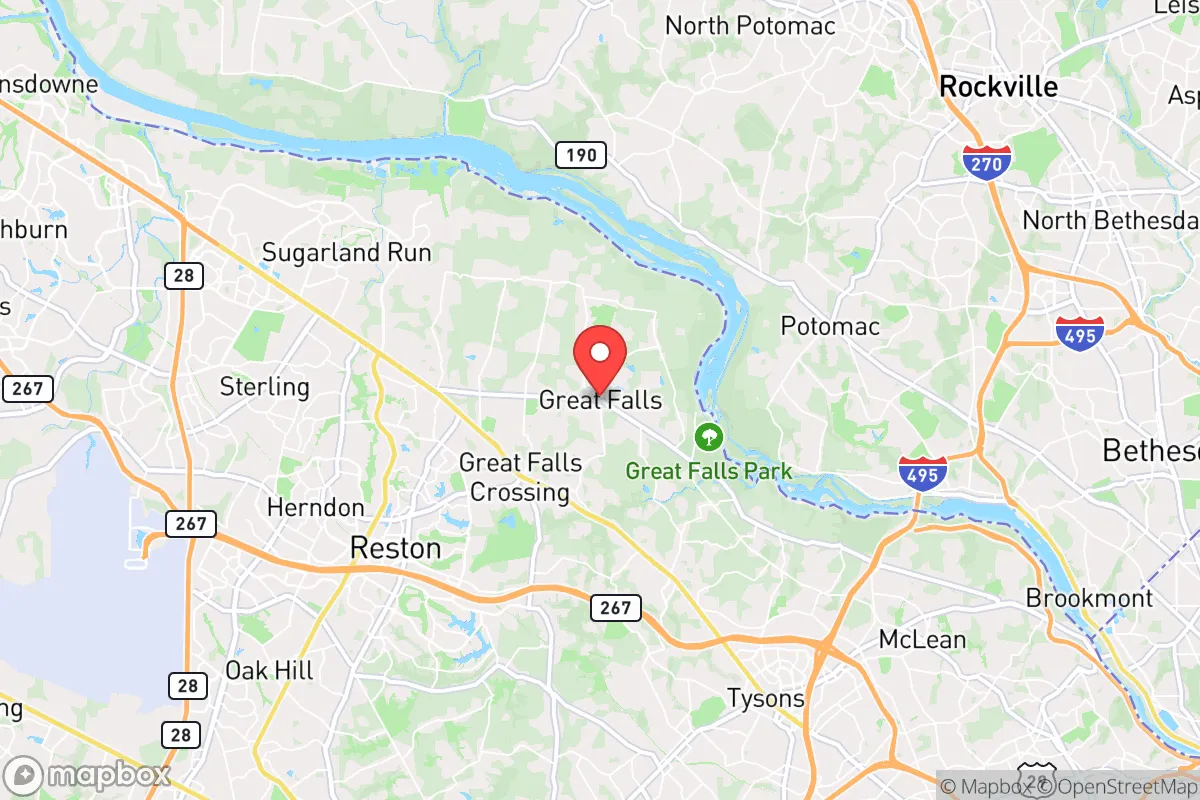
Quality of Life in Great Falls, VA
A high quality of life with strong walkability, manageable living costs, healthy neighborhood signals, and solid amenity access.
What does Quality of Life tell us?
Quality of Life blends cost of living, nearby amenities, socioeconomic signals, and neighborhood character. City-level scores represent the whole municipality; individual neighborhoods can differ.
What does this tell us?
Quality of Life blends cost of living, nearby amenities, socioeconomic signals, and neighborhood character. City-level scores represent the whole municipality; individual neighborhoods can differ.
Cost of Living
269% above national average
The Real Cost of Living in Great Falls, VA for 2026
| Tier | Individual | Family (4) |
|---|---|---|
| Survival | $55k | $104k |
| Comfortable | $261k | $383k |
| Luxury | $452k+ | $700k+ |
| Elite (Top 5%) | $629k+ | $975k+ |
65%
The Area Signal
A metric tracking the socioeconomic signals of the area.


Hobbies
Explore the areaGroceries
2 within 10 miles
Gas
0 within 10 miles
Hospital
3 within 20 miles
Airport
DCA — Ronald Reagan Washington National
Post Office
USPS — Merrifield, VA
Critical Amenities
Quality-of-Life Analysis
Great Falls, Virginia, is one of the most affluent communities in the Washington, D.C. metropolitan area, home to a highly educated population of executives, diplomats, and federal contractors who prioritize privacy, space, and top-tier schools over urban proximity. With a cost of living index of 369—nearly 3.7 times the national average—the town is defined by its sprawling estates, equestrian properties, and a demographic where the median household income exceeds $250,000. Life here is quiet, land-rich, and family-oriented, attracting those who can afford a semi-rural lifestyle within commuting distance of the nation’s capital.
Cost of living, housing costs, and how Great Falls compares to McLean and Reston
The cost of living in Great Falls is driven almost entirely by housing. The median home value sits at $1,342,400, placing it well above neighboring McLean (median ~$1.1 million) and significantly higher than Reston (median ~$650,000). Rental options are scarce and expensive, with a median rent of $3,463 per month—roughly double the national average. For context, a comparable single-family rental in McLean or Vienna might run $3,800–$4,200, but Great Falls offers larger lots (often 1–5 acres) and greater seclusion. Property taxes in Fairfax County average about 1.07% of assessed value, meaning a $1.34 million home carries an annual tax bill near $14,400. Groceries, healthcare, and transportation also run 20–30% above national averages, though utilities are roughly in line with the region. The trade-off is clear: residents pay a steep premium for land, low density, and access to the Great Falls Park and Potomac River bluffs, but they sacrifice the walkability and transit options found in Arlington or D.C. proper.
What daily life is like for families: schools, amenities, and the commute reality
Daily life in Great Falls revolves around the Fairfax County Public Schools system, which consistently ranks among the top in Virginia. Elementary schools like Great Falls Elementary and Forestville Elementary feed into Cooper Middle School and Langley High School—the latter frequently cited as one of the best public high schools in the nation, with a 98% graduation rate and average SAT scores above 1350. After-school life is dominated by youth sports at the Great Falls Swim & Tennis Club, horseback riding at local stables, and weekend trips to the Old Town Great Falls commercial node, which offers a handful of upscale restaurants, a farmers market, and boutique shops. The average commute of 33 minutes masks a split reality: residents driving to Tysons Corner (15–20 minutes) or D.C. (35–50 minutes via the Dulles Toll Road or George Washington Parkway) face heavy congestion during peak hours, while those working in Reston or Herndon enjoy a shorter, reverse-commute flow. There is no Metro station in Great Falls; the nearest are Wiehle-Reston East (Silver Line) and McLean (Silver Line), both a 10–15 minute drive. The lack of sidewalks and streetlights in many neighborhoods reinforces a car-dependent, private-estate lifestyle that appeals strongly to families seeking safety and space over urban convenience.
Great Falls is best suited for high-income families, empty-nesters, and professionals who value land, privacy, and elite public schools above all else. It is not a place for young renters, singles seeking nightlife, or anyone on a typical national budget—the cost barrier is simply too high. Those who thrive here are typically dual-income households in law, government contracting, or executive roles who can absorb the 369 COL index and the 33-minute commute in exchange for a 2-acre lot, a Langley High School diploma, and the ability to hike the Potomac bluffs on a Sunday morning without leaving their zip code.

Crime in Great Falls, VA
Generally safer than 61% of comparable U.S. locations.
Violent CrimeViolent Crime Analysis
Property CrimeProperty Crime Analysis
Crime Analysis
Great Falls, Virginia, consistently ranks as one of the safest communities in the Washington, D.C. metropolitan area, with violent crime rates significantly below both state and national averages. The town's violent crime rate of 203 incidents per 100,000 residents is roughly half the national average of 380 per 100,000, while property crime stands at 1,344.2 per 100,000, also well below the national figure of 1,954 per 100,000. However, as a wealthy enclave within a large, liberal-leaning metro area, residents should remain aware of how regional criminal justice policies can affect local safety conditions.
Crime in context
Great Falls' violent crime rate is 203 per 100,000, compared to the Virginia state average of approximately 240 per 100,000 and the national average of 380 per 100,000. Property crime in Great Falls is 1,344.2 per 100,000, versus the state average of 1,550 and the national average of 1,954. These figures place Great Falls in the safest quartile of Virginia communities. However, the town is not immune to regional trends. Fairfax County, which encompasses Great Falls, operates under a progressive prosecutorial philosophy. The Fairfax County Commonwealth's Attorney's office has implemented policies emphasizing diversion programs and reduced sentences for non-violent offenses, which critics argue can lead to higher recidivism and embolden property criminals. While violent crime remains low, the broader metro area's approach to justice—prioritizing offender rehabilitation over strict punishment—means that residents should not become complacent about home security and situational awareness.
What residents experience
For most Great Falls residents, daily life is characterized by a strong sense of security. The town's low population density, high property values, and active neighborhood watch programs contribute to a low likelihood of random violent encounters. The most common crimes are property-related: burglary, vehicle break-ins, and package theft, often perpetrated by individuals traveling from less affluent areas of the D.C. region. The Fairfax County Police Department maintains a visible presence, with response times averaging under 10 minutes in Great Falls. However, the progressive justice environment in the region means that even when property criminals are caught, they frequently face minimal consequences. First-time offenders may receive probation or community service rather than jail time, a policy that some residents feel undermines deterrence and contributes to repeat offenses. This dynamic is particularly relevant for homeowners with high-value assets, as the risk of property crime, while statistically low, is not negligible.
Neighborhood-level variation in Great Falls is minimal but worth noting. Areas closer to the Potomac River and the Maryland border, such as the River Bend and Seneca communities, report slightly higher rates of vehicle break-ins, likely due to easier access from major roads like Georgetown Pike and Route 7. Conversely, gated communities and homes with private security systems in the central and western parts of town experience near-zero crime. Overall, Great Falls offers a safe environment by any national standard, but the regional progressive justice system means that residents should take proactive measures—such as installing security cameras, joining neighborhood watch groups, and securing vehicles—to mitigate the risk of property crime that the local legal framework does not adequately deter.
* Values derived from national, state, county, city and local statistics and may differ in a specific area. Last updated: 2026-04-16T00:22:01.000Z
Narrative content on this page is AI-generated and may contain mistakes. Verify any details that matter before acting on them.
ReloMaps may earn a commission from affiliate links at no extra cost to you.

